

Scientists have established that the various fragments collectively known as space debris are not found only in low Earth orbit. They are also present farther from our planet, including in the vicinity of the Moon. If humans plan to travel there in the future, these objects could pose a threat to both spacecraft and their crews.
Lunar Traffic Is Growing Rapidly
As the number of lunar-exploration missions increases, it is becoming necessary to study the orbits of debris and determine whether any fragments pose a collision risk. In a recent paper published on the arXiv preprint server, a team of researchers from the Chinese Academy of Sciences (CAS) examined the dispersal of debris clouds produced by collisions involving objects in distant retrograde orbits (DROs). Their findings offer insight into the evolution of debris in the Earth–Moon system and could contribute to the development of safety regulations and mitigation strategies for future lunar missions, phys.org reports.
International missions to the Moon have increased significantly in recent years, reflecting the growing presence of both national and commercial organizations in space. These missions include China’s Longjiang-2 orbiter and the more recent Chang’e missions. Other examples include India’s Chandrayaan-2 and Chandrayaan-3 orbiters, operated by the Indian Space Research Organisation (ISRO), South Korea’s Danuri orbiter, Israel’s Beresheet lander, and Japan’s Hakuto-R Mission 1.
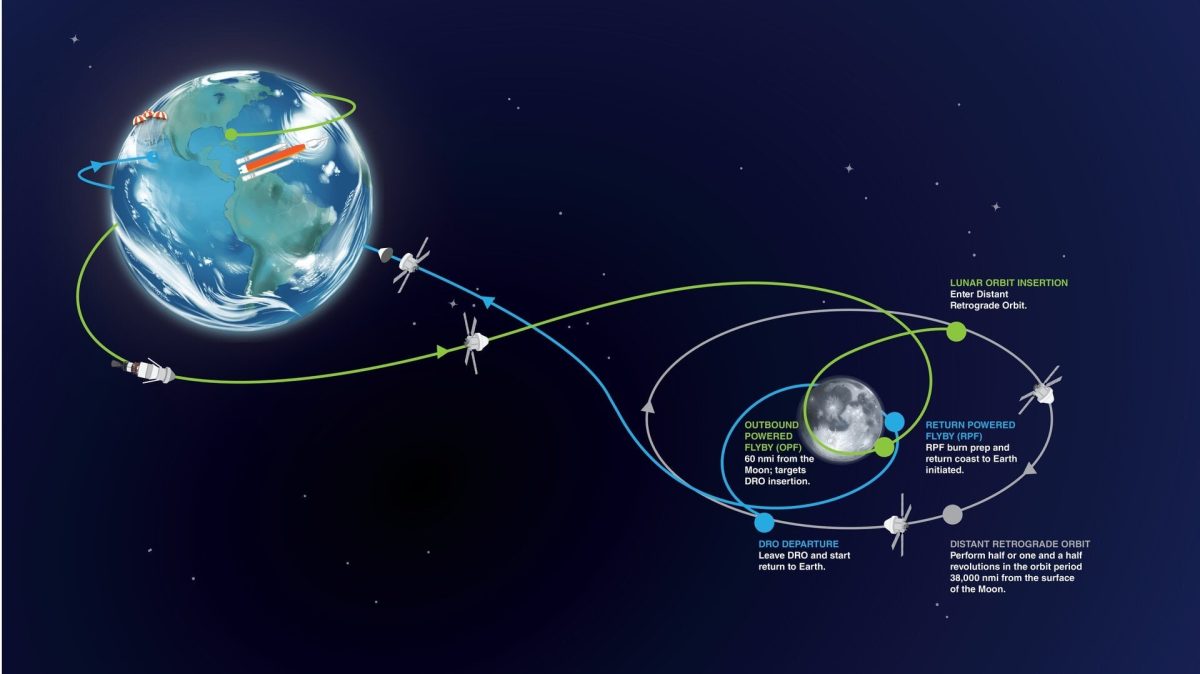
In addition to the successful uncrewed Artemis I test flight and the crewed Artemis II lunar flyby, NASA’s CAPSTONE mission, launched in June 2022, became the first spacecraft to successfully enter a near-rectilinear halo orbit around the Moon. By 2030, NASA and China plan to send astronauts and taikonauts to the lunar surface, followed by additional missions and the establishment of permanent facilities.
Debris Creates a Collision Risk
For China, these plans will include the International Lunar Research Station, or ILRS, which will consist of surface elements and potentially an orbital component. Although NASA had planned since 2012 to place the Lunar Gateway station in a halo orbit, it later decided to develop surface infrastructure and a permanent lunar base. The amount of traffic required to support these facilities—including landers and lunar ascent vehicles transporting cargo and crews to and from the surface—will be considerable, phys.org reports.
The presence of debris in cislunar space and lunar orbit will create a significant collision risk for missions traveling to and from the Moon. In addition to threatening active missions, collisions between debris objects could cause further fragmentation and produce a domino effect in which additional debris increases the likelihood of subsequent collisions. This is similar to concerns about space debris and the Kessler syndrome in low Earth orbit, which threaten satellite constellations, spacecraft, and space stations.
Modelling Debris Clouds in Distant Retrograde Orbits
To help reduce collision risks, the research team assessed how debris clouds would disperse following potential breakup events. The researchers used the Circular Restricted Three-Body Problem model (CR3BP) to construct reference orbits. NASA’s Standard Breakup Model was then used to simulate debris fragmentation at several locations along three distant retrograde orbits. The final stage, which modelled debris propagation over 30 days, was performed using the Bicircular Restricted Four-Body Problem model (BCR4BP).
The team then examined the potential effects of debris propagation on both the lunar surface and objects in orbit. Their simulations showed that the cumulative percentage of fragments striking the Moon would remain low—below 3.5%—during the 30-day propagation period. They also found that breakup events occurring near the Moon’s far side produced a higher initial impact risk in some orbital simulations.
To assess orbital collision risks, the team defined a “protected zone” around the Moon—a doughnut-shaped region 200 kilometres, or approximately 125 miles, in diameter that encompasses the entire path of a spacecraft’s trajectory.
Risk Assessment and Environmental Regulation
The results showed that debris entered the protected zone with an average probability of approximately 3%, usually reaching its peak less than one day after a breakup event. However, some fragments could remain in the zone for weeks before clearing it.
Over the 30-day period, the total number of debris fragments entering the zone varied considerably depending on the simulated orbit, ranging from ten or fewer to more than one hundred. Overall, potential collision encounters were generally characterized by rapid flybys rather than prolonged co-orbital threats.
As the team noted in its conclusions, lunar missions should undergo comprehensive risk assessments to comply with planetary-protection requirements and environmental regulations. In the near future, this will likely include agreements intended to prevent the contamination of the space between Earth and the Moon by spent rocket stages, inactive satellites, and other mission components that inevitably become debris.
Such measures will most likely supplement existing and future low Earth orbit debris-mitigation protocols by extending them all the way to the Moon.
If humanity intends to expand its presence on the Moon, proper governance and environmental stewardship will be essential.
