

Star formation in the large galaxy neighboring ours is gradually declining. The cause is not a deficiency of the gas and dust necessary for star formation. It is most probable that a period of quiescence has been established following an era of intense activity in the distant past.
Census of the stellar population
The Andromeda Galaxy is situated approximately 2.5 million light-years from Earth and possesses a diameter considerably greater than that of the Milky Way; however, the masses of both systems are approximately equal. At this distance, it is feasible to discern individual stars within its disk, rather than merely observing a general luminescence.
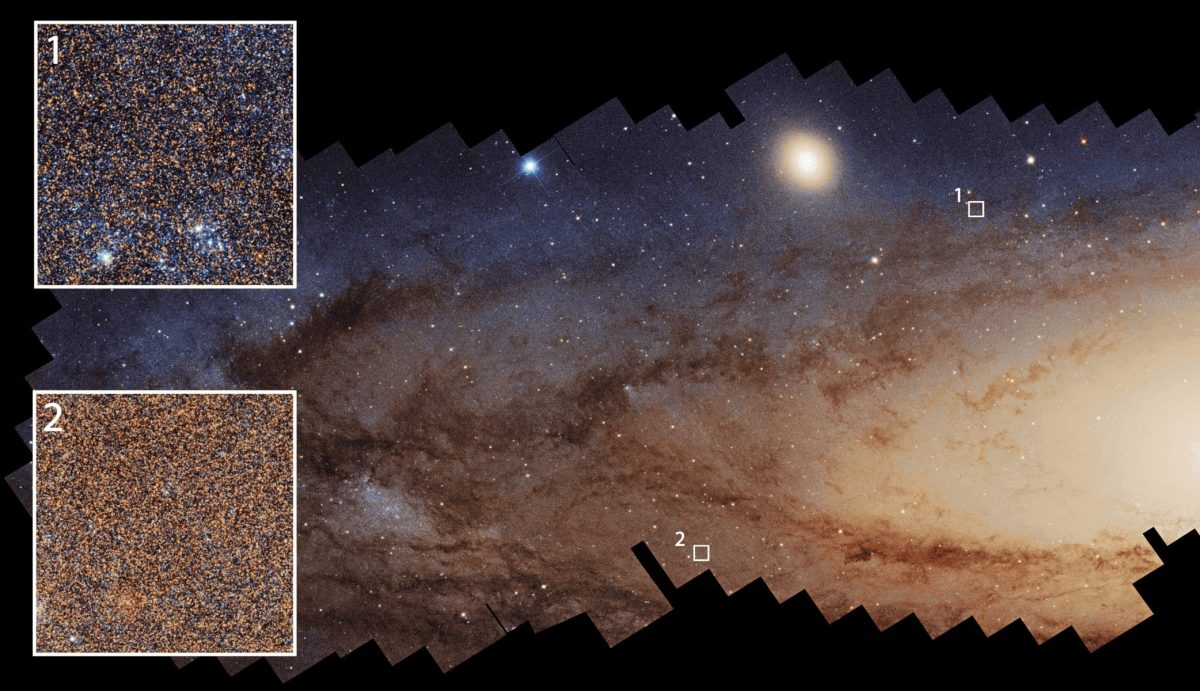
The conclusion regarding the fading is derived from data obtained through two Hubble surveys, which collectively encompassed two-thirds of the disk with exceptional detail. The researchers analyzed the characteristics of approximately 200 million stars. The findings were published in the peer-reviewed journal The Astrophysical Journal and subsequently reported by NASA.
Massive stars emit light predominantly in the blue spectrum and possess relatively brief lifespans. Conversely, less massive stars exhibit a redder hue and endure significantly longer. By analyzing the ratio of these stellar populations, it is feasible to ascertain the period of peak activity within a specific region of the galactic disk. According to Dr. Ben Williams, an astronomer affiliated with the University of Washington, stars serve as a historical record of the galaxy’s formation, and only the Hubble Space Telescope possesses the requisite resolution to examine such an extensive area.
The pace is decelerating
Astronomers evaluate the intensity of this process by measuring the quantity of gas and dust that, annually, serve as the material for new stars across the entire galaxy. Half a billion years ago, the rate in Andromeda was five times greater than at present, with the most significant decline observed over the past 40 million years. Currently, the Milky Way is forming new stars at a rate at least eight times higher than that of a comparable neighboring system.
Prior research indicates that approximately two billion years ago, an intense burst of activity took place in the Andromeda galaxy, which is considered to be associated with an ancient interaction or merger with another celestial system. Since that time, the activity has been gradually diminishing. The authors of the study generally posit that the present condition represents a natural culmination of that tumultuous period, rather than being attributable to a scarcity of material.
A ring surrounding the nucleus of the galaxy
The images were partitioned into thousands of squares, each spanning 300 light-years, and the historical record of each segment was reconstructed independently. This methodology demonstrated that the decline is unevenly distributed across the disk.
The majority of recent star formation takes place within a ring situated roughly 32,000 light-years from the core. The diminution of activity within this structure significantly contributes to the overall understanding of the phenomenon.
The role of the closest companion
A separate study investigated whether the adjacent galaxy M32 exerts an influence on the Andromeda disk. Although when projected onto the celestial sphere, they appear approximately 16,000 light-years apart, their true three-dimensional spatial relationship is not well understood. Consequently, the timing of a potential close approach remains indeterminate.
Based on data from a survey of the southern region of the disk, it is observed that the formation of new stars occurs at a slower rate near M32 compared to other areas. This decline commenced roughly 60 million years ago, potentially constraining the timeframe for a possible encounter.
There is currently no definitive evidence establishing a direct connection. According to Tobin Weiner of the University of Washington, it cannot be conclusively determined that the decline was specifically caused by the neighboring system; however, due to its proximity, it remains the most plausible explanation.
Next step
Upcoming images from the Nancy Grace Roman Space Telescope, which is scheduled to launch no earlier than August 30, are expected to offer a more detailed depiction. The instrument’s field of view surpasses that of the Hubble Space Telescope by a factor of at least 100 in the near-infrared spectrum for individual observations.
The approved scientific program stipulates the imaging of the entire disk in conjunction with sections of the surrounding halo. Concurrently, the team persists in analyzing archival data and aims to integrate this information with observations obtained from ground-based observatories.
