

How do black holes in the centers of galaxies form and evolve over time? To answer this question, scientists need to detect and study supermassive black holes located at enormous distances, whose light has been traveling to us for billions of years. A new study suggests that NASA’s Nancy Grace Roman Space Telescope, scheduled for launch on August 30, 2026, will be able to detect these distant objects, which already existed 11 billion years ago.
New capabilities of the Nancy Grace Roman telescope
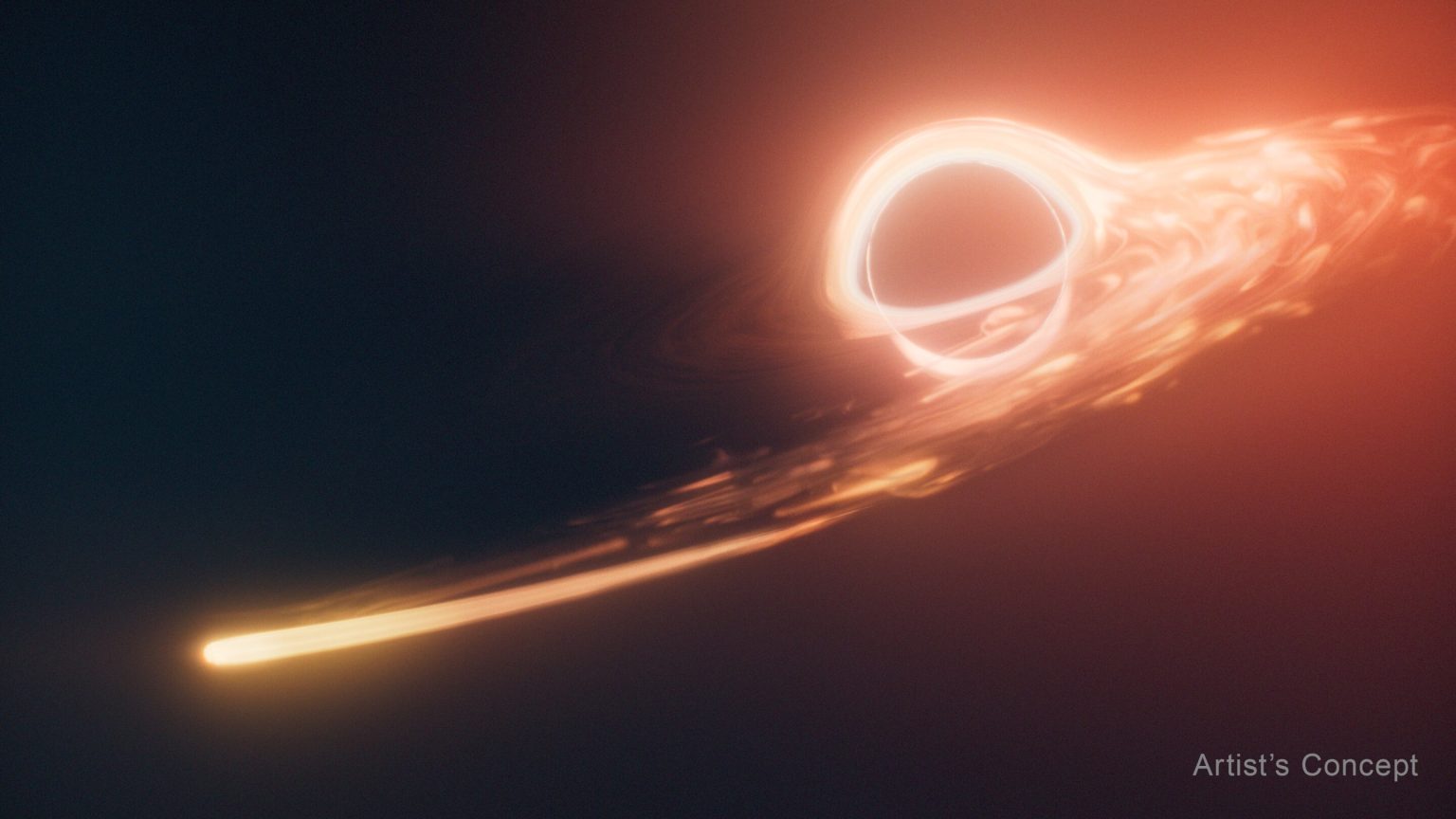
Supermassive black holes are best studied by observing the light emitted by their accretion disks, the material that swirls around them before being swallowed up. The gas and dust that swirl around them form a hot accretion disk that emits a huge amount of light. Lighter supermassive black holes are difficult to observe because they are usually less bright due to their slower accretion rates. Sometimes the situation changes dramatically: if a star comes too close, tidal forces tear it apart, and some of the material begins to fall onto the black hole. The result is an extremely bright flash that can temporarily outshine the entire galaxy. This phenomenon is called a tidal disruption event (TDE).
As phys.org notes, by determining the characteristics of this population of early supermassive black holes and finding out how they evolve and grow over billions of years, the Roman telescope project will help astronomers test current theories of their origin and figure out which scenario is most likely.
“The Roman Space Telescope will be a real revolution for transient science,” said the study’s lead author Mitchell Karmen of Johns Hopkins University, a graduate student and National Science Foundation fellow. “Thanks to Roman’s high sensitivity, we will be able to detect numerous tidal disruption events at greater distances and in much earlier cosmic epochs than ever before.”
The phenomenon of tidal disruption of stars by black holes
Roman’s High-Latitude Time-Domain Survey — one of its three main observing surveys — is especially well suited for detecting and studying tidal disruptions in the early Universe. This survey will cover about 18 square degrees of the sky, an area equivalent to 90 full moons, with regular cadence. By repeatedly observing the same regions, astronomers will be able to detect a large number of temporary phenomena, such as TDEs.
Tidal collapses of stars most often occur near supermassive black holes with masses of about 100,000 to 100 million times that of the Sun. If the black hole is much more massive, its event horizon is so large that the star can be almost completely engulfed before tidal forces can tear it outward. In contrast, lighter supermassive black holes tear the star apart, after which some of its material forms a hot accretion disk. This is what produces a bright flash, the luminosity of which increases over several weeks, and then gradually fades over months or even years.
The rate of tidal disruptions varies over cosmic time. Previous studies predicted that the TDE rate would decrease with distance, because most young black holes were too light to generate TDEs. However, this new study takes into account numerous factors that change over time, such as the rate of galaxy mergers, and therefore black hole mergers, as well as the number of stars in each galaxy’s core and how densely they are clustered.
Karmen and his colleagues modeled these and other effects to predict how many tidal disruption events Roman will be able to observe, as well as how many such events other observatories will be able to detect, including the ground-based NSF–DOE Vera C. Rubin Observatory and NASA’s James Webb Space Telescope. The team predicts that astronomers will observe an increase in the rate of stellar tidal disruption events as Roman looks to greater distances and earlier periods, up to “cosmic noon” — roughly 11–12 billion years ago, when star formation across the Universe reached its peak — after which the rate will begin to decline again.
Help from other observatories in detecting TDEs
Roman will observe the Universe in the near-infrared. Light from distant tidal disruptions of stars is shifted to longer wavelengths by the expansion of the Universe, a phenomenon known as cosmological redshift. That’s why the telescope is optimized to detect such events at distances from which their light has traveled to Earth for about 8 to 11 billion years.
The Rubin Observatory will also scan large areas of the sky and detect many new TDEs. However, it will observe in visible light, which limits it to tidal events located closer than those Roman can detect.
The Carmen team’s research suggests that the Vera Rubin Observatory will detect thousands to tens of thousands of TDEs per year. While Roman is expected to detect up to 100 TDEs per year, these black holes will be located much further away. It is these early cosmic epochs that contain key information that will help test different scenarios for the formation of the first supermassive black holes.
Two theories of the origin of supermassive black holes
Astronomers have observed truly gigantic black holes at a very early stage in the history of the Universe — so early that theories cannot explain how they could have become so large in such a short time. Evidently, they were initially smaller and grew over time, but how much smaller?
One theory, known as “light seeds,” assumes that black holes form as a result of the death of massive stars. The mass of such black holes can reach several hundred times the mass of our Sun. Later, these black holes merge with one another and also consume surrounding gas at an astonishing rate. Under this scenario, one would expect every young galaxy to have a massive black hole at its center.
The second theory, known as “heavy seeds,” suggests that a black hole can form with a much greater mass — up to a million times the mass of our Sun — as a result of a process such as the direct collapse of a gas cloud. However, this process must be less common, which would make supermassive black holes much rarer in early galaxies.
“Tidal disruption events help us study the population of light supermassive black holes, which in turn can help us distinguish between these models,” Karmen said.
Ultimately, Roman’s data on tidal disruption events will help researchers trace the global effects that influence the black hole population over time. Once both telescopes begin regular scientific operations, the team looks forward to comparing its predictions with the actual data obtained by these observatories.
