

A cloud of fine particles surrounding another star complicates the search for signs of life on planets in that system. Scattered radiation enters the data together with the light reflected by the planet. As a result, traces of gases in the spectrum appear weaker than they actually are. New modeling has shown how serious this obstacle may be for future observations.
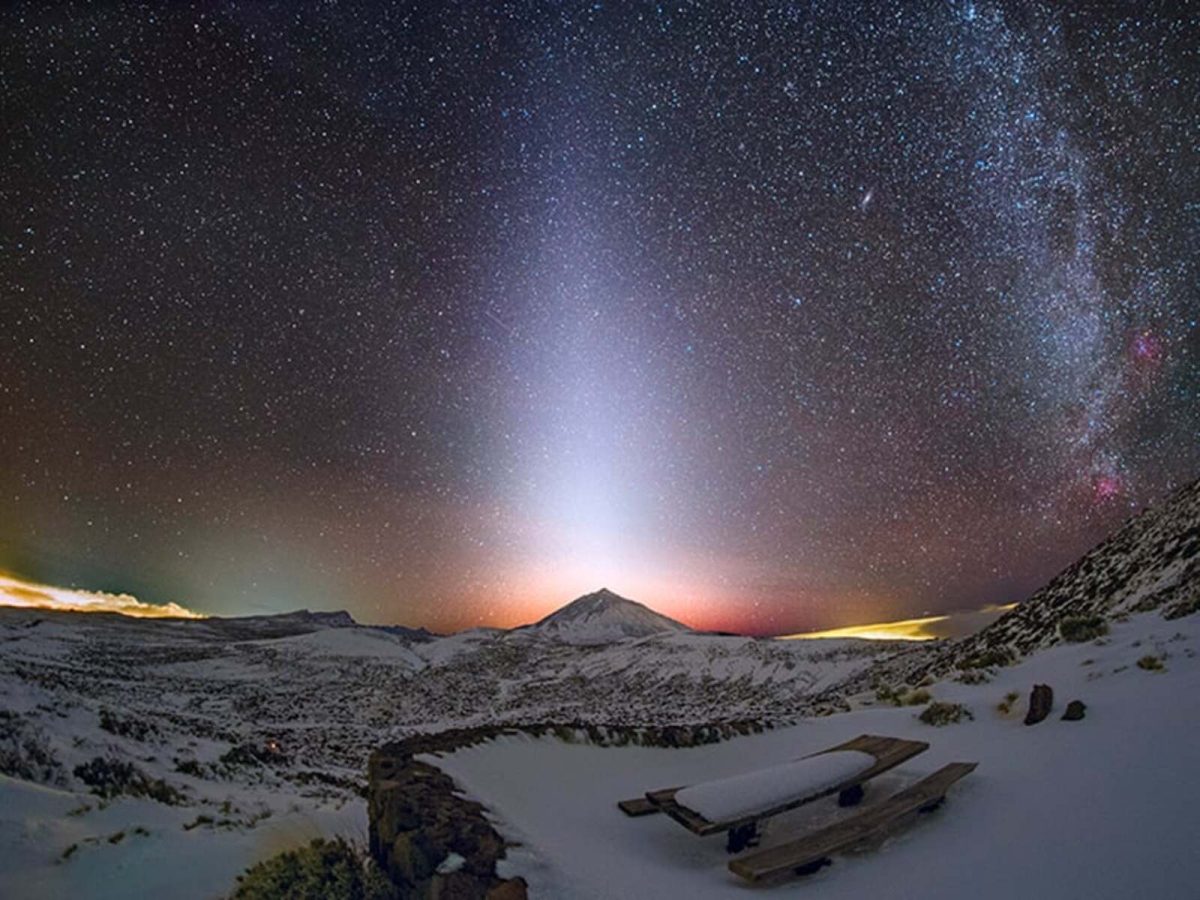
A Familiar Glow Above the Horizon
A faint glow can sometimes be seen in Earth’s sky before dawn, while darkness still remains. It rises from the east in a narrow cone and disappears with the arrival of morning. Its source is fine particles in the inner Solar System, distributed in the same plane as the orbits of the planets closest to the Sun.
Because this glow is visible from Earth against the background of the zodiacal constellations, the phenomenon was named zodiacal light. Similar dust disks are expected to exist around most stars with rocky worlds. The presence of dust grains in the warm zone indicates that solid bodies have formed there.
An Obstacle to Spectral Analysis
Astronomers expect future telescopes to detect signs of life by analyzing light from a host star reflected by a planet. Molecules in the atmosphere absorb certain wavelengths, producing characteristic absorption bands in the spectrum. The depth of these bands reveals which gases are present and in what quantities.
A team from NASA’s Goddard Space Flight Center modeled the type of data that could be obtained with the future Habitable Worlds Observatory if some of the dust could not be removed from the image. The study was published on the arXiv preprint server and was briefly covered by Universe Today.
Light scattered by the particles raises the background level, making spectral lines less pronounced—sometimes by as much as half. The effect increases with wavelength, meaning that molecules whose spectral signatures lie in the infrared range are the most vulnerable.
How Much Dust Surrounds Other Worlds?
The typical level of dust was estimated through the Hunt for Observable Signatures of Terrestrial Systems survey, known as HOSTS, conducted with the Large Binocular Telescope Interferometer. For 30 stars near the Sun, researchers measured the thermal emission of particles in the zone where liquid water could exist. The median level was three times higher than that of the Solar System, while the 95% confidence upper limit reached 27 units.
This means that the list of targets for the new observatory will have to be based not simply on distance from the star, but also on how clear the surrounding space is. The nearest system is no longer automatically the most convenient one. Preliminary measurements of the dust background become a filter that determines which worlds will be included in the observational program at all.
Distorted Conclusions
Dust glow that cannot be removed from the data distorts not only the strength of the signal but also the inferred properties of the planet itself. In calculations where the brightness of the particle glow matched that of the planet, the algorithm estimated a radius approximately 50% larger than the true value. With weaker contamination, the result changed in the opposite direction. The planet appeared slightly smaller than its actual size, while its cloud cover was overestimated by about one and a half times.
The color of the particles also matters. Dust with a blue spectral slope scatters little radiation at longer wavelengths, whereas a red slope makes the greatest contribution to the background. In terms of optical properties, material in the Solar System is closer to the second case.
A similar problem has already arisen in observations of debris disks, where scattered light also had to be separated from the signal of bodies within the system. The difference is that, for exoplanet atmospheres, the required precision of this separation must be several orders of magnitude greater.
How the Effect Can Be Reduced
Scientists are not yet able to remove the dust glow completely from the data. Existing methods work reasonably well for systems viewed almost face-on, but approximately half of the targets will be more strongly inclined, making the task more difficult.
Part of the problem can be mitigated by the design of the instruments themselves. If the light is divided into much narrower spectral intervals, the absorption lines become clearer, reducing the required level of data cleanliness by approximately a factor of thirty.
