

Our solar system is frequently depicted as encompassing the Sun and eight major planets orbiting it. However, in reality, hundreds of thousands — and potentially even millions — of objects revolve around our star, some of which are notably sizable. Presented here are the ten largest among these objects.
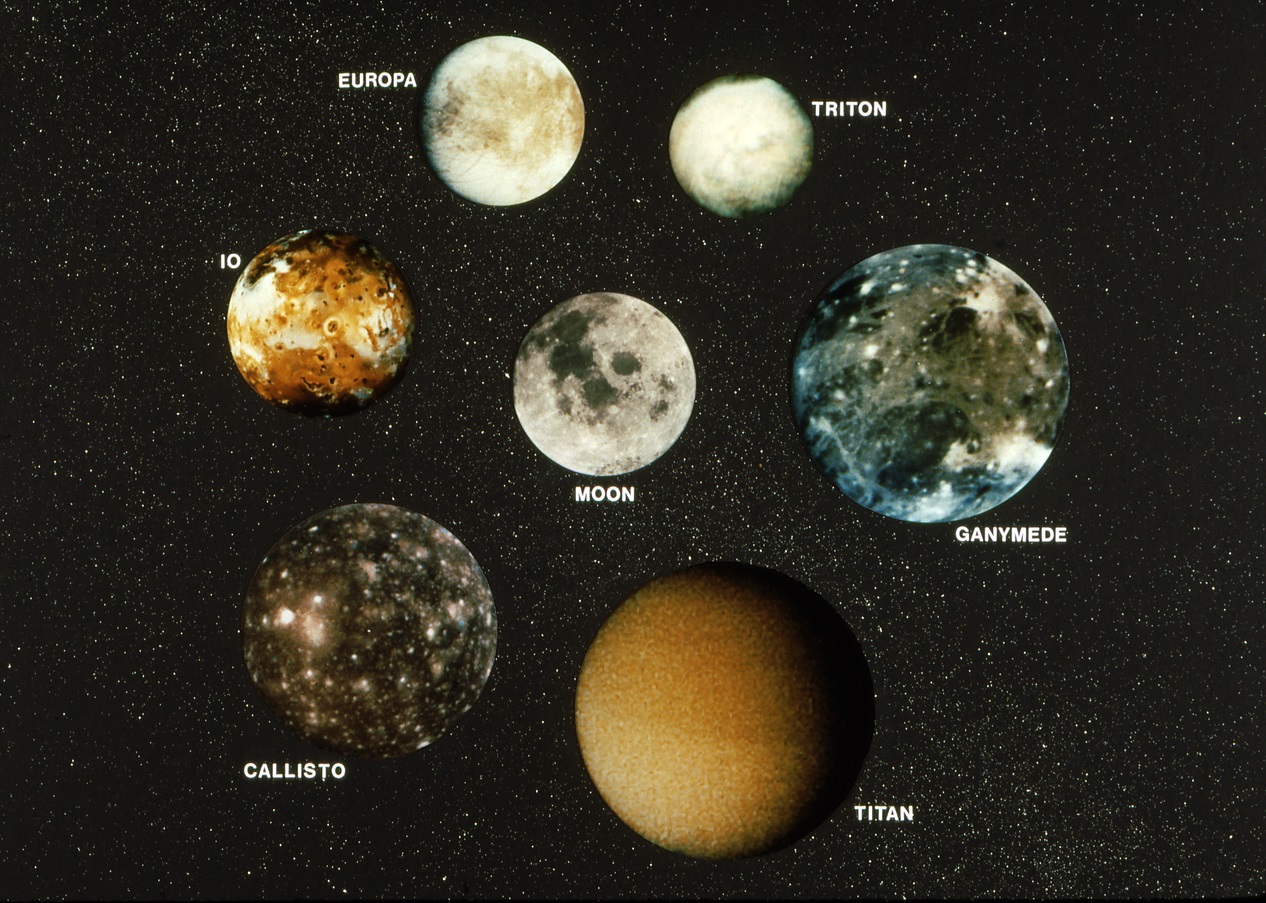
The largest bodies in the Solar System
If inquiring about the proportion of the Solar System’s total mass attributed to our Sun, the response would be 99.86%. Consequently, our central star must be regarded as the genuinely substantial object within the Solar System.
Jupiter is the next largest planet, comprising 0.1%, which exemplifies the relative nature of the term “large” within the Solar System. While Jupiter is diminutive compared to the Sun, it is simultaneously substantially more massive than all the other planets in the Solar System.
Objects that are not classified among the eight major planets constitute a negligible proportion of the Solar System’s total mass. However, this does not imply that such objects are insignificant in size. The surface area of some of these objects is remarkably comparable to that of the largest nations on Earth.
Presented herein are the ten largest celestial objects within the Solar System that do not qualify as planets.
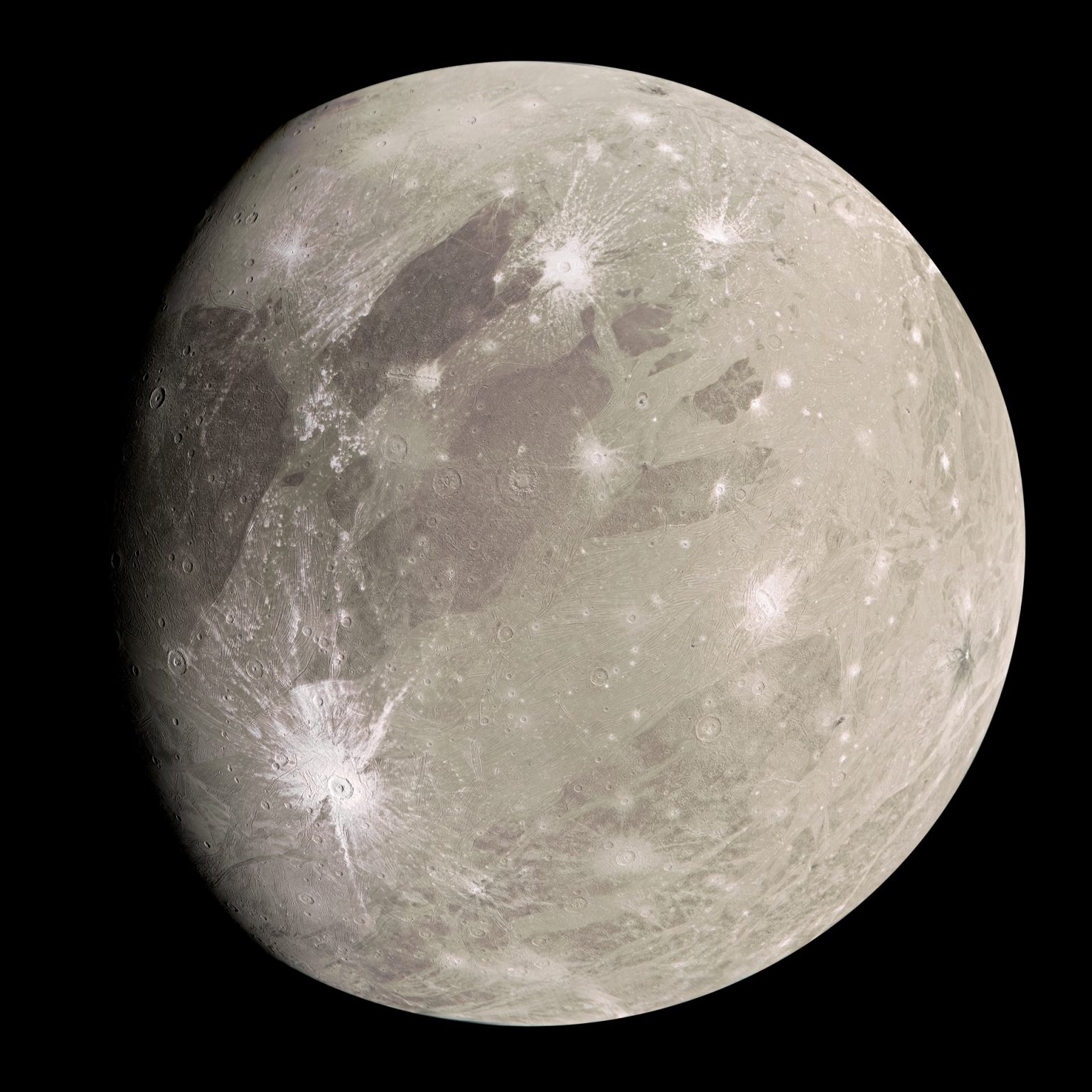
1. Ganymede
The “largest of the small’ celestial body within the Solar System is Ganymede, a natural satellite of Jupiter. With a radius measuring 2,634.1 km, it exceeds the size of the smallest major planet, Mercury. Ganymede orbits Jupiter in a nearly circular trajectory at an average distance of approximately 1.07 million kilometers. It completes an orbit around the planet in slightly over a week.
Ganymede’s mean density is calculated at 1.936 g/cm³. This suggests that the celestial body is predominantly composed of water ice intermixed with silicate rocks, with a probable iron-enriched core situated at its center. Additionally, scientific evidence supports the hypothesis that Ganymede has experienced internal differentiation of the subsoil, implying the possible existence of a subsurface ocean of liquid water — potentially conditions suitable for life are able to exist — lying beneath its icy crust.
2. Titan
However, one aspect that scientists are unequivocally certain of is the presence of liquid on Saturn’s largest moon, Titan. Nonetheless, it is important to note that Saturn is situated significantly farther from the Sun than Jupiter, resulting in substantially lower temperatures on its moons.
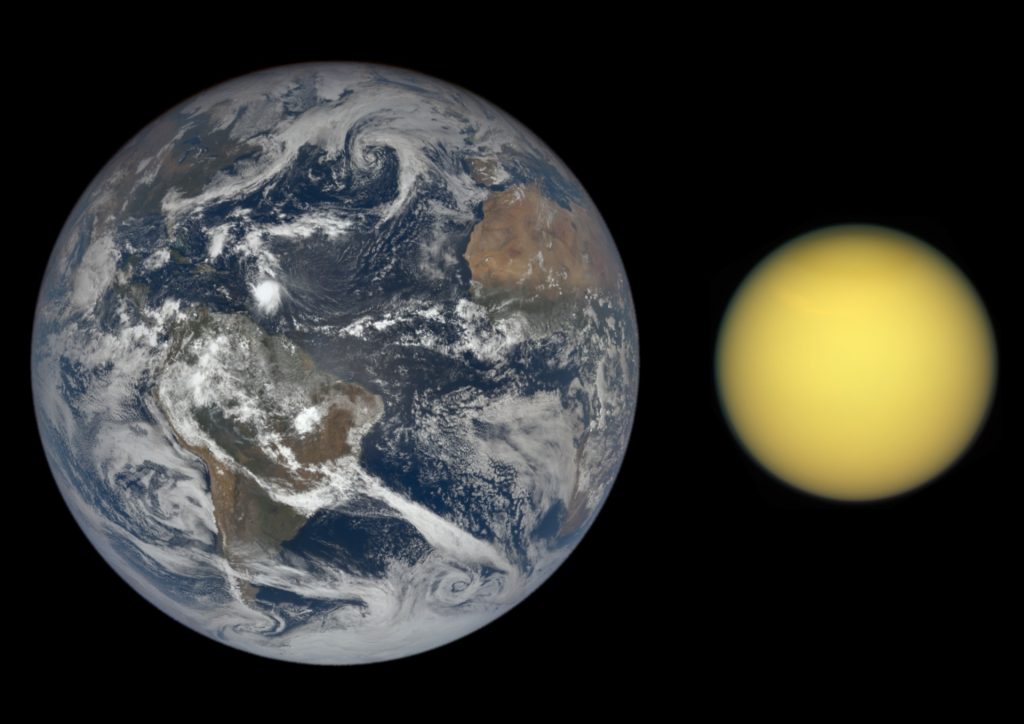
With a radius of 2,574.73 km, Titan remains larger than Mercury, yet it has a substantially lower mass — its average density is 1.88 g/cm³. This is attributable to the presence, on Titan, of not only water but also a considerable quantity of other substances, which, on Earth, predominantly exist as gases, in liquid and solid forms.
Particularly, this pertains to hydrocarbons — the identical substances that constitute natural gas on Earth. On Titan, these compounds can precipitate as rain and snow, create complete seas, and solidify into ice at their boundaries.
3. Callisto
Callisto is another moon of Jupiter. With a radius of 2,410.3 km, it is marginally smaller than Mercury, and if it orbited the Sun instead of the gas giant, it could potentially qualify as a planet.
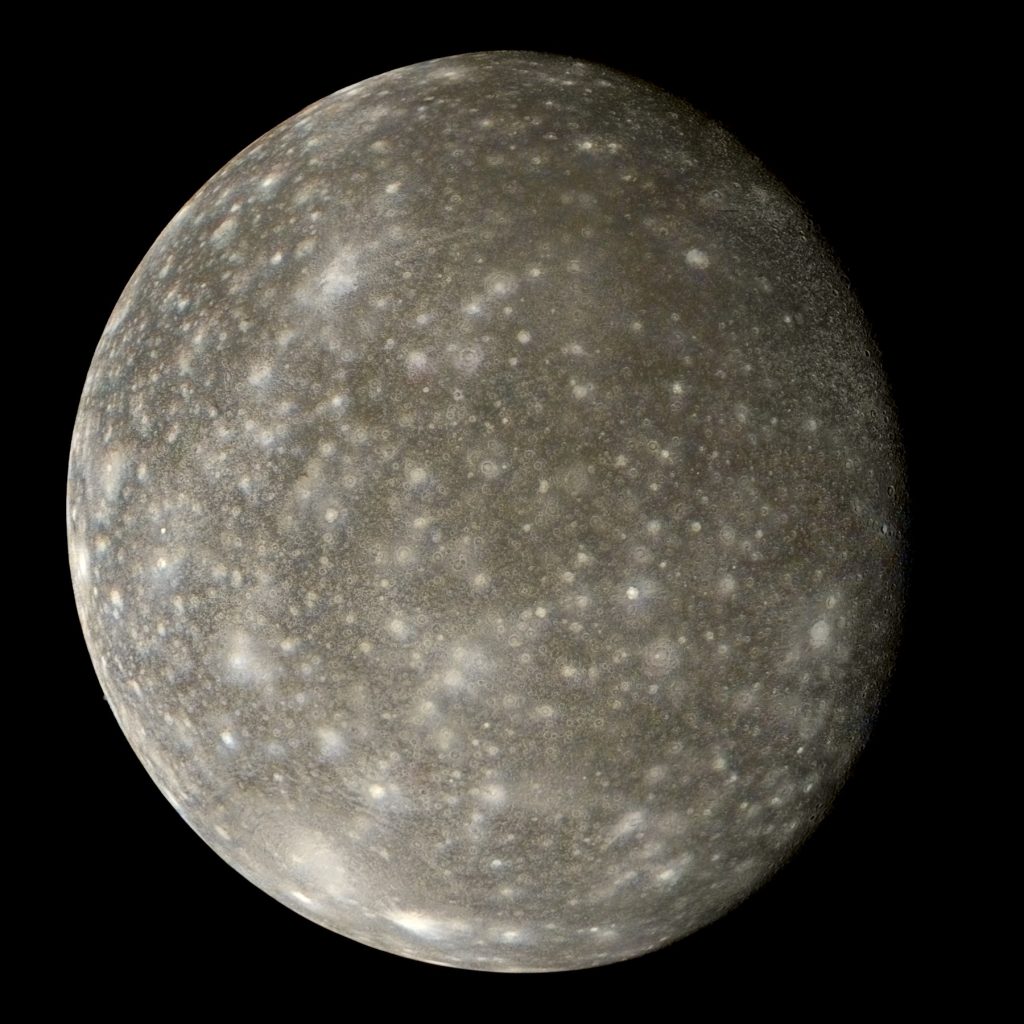
Callisto is the most distant of Jupiter’s four largest moons. Its chemical composition closely resembles that of Ganymede; however, its surface exhibits virtually no smooth areas. It is completely encrusted with craters.
It is highly probable that the primary cause of this phenomenon is the body’s considerable distance from the gas giant. The gravitational gradient experienced by the body is relatively minimal and insufficient to induce melting within its interior. Consequently, the surface of this celestial body was liquid solely during the initial stages of its formation, and it is evident that no ocean capable of supporting life exists beneath its icy crust.
4. Іо
With a radius of 1,821 km, Io is not only Jupiter’s third-largest moon but also the fourth-largest celestial body in the Solar System that is not classified as a major planet. It completes one orbit around the gas giant in merely 1.77 days.
Among Jupiter’s prominent moons, it is the nearest to the planet, which accounts for its distinctive appearance. The formidable gravitational pull of the gas giant persistently deforms the moon, resulting in internal heating.
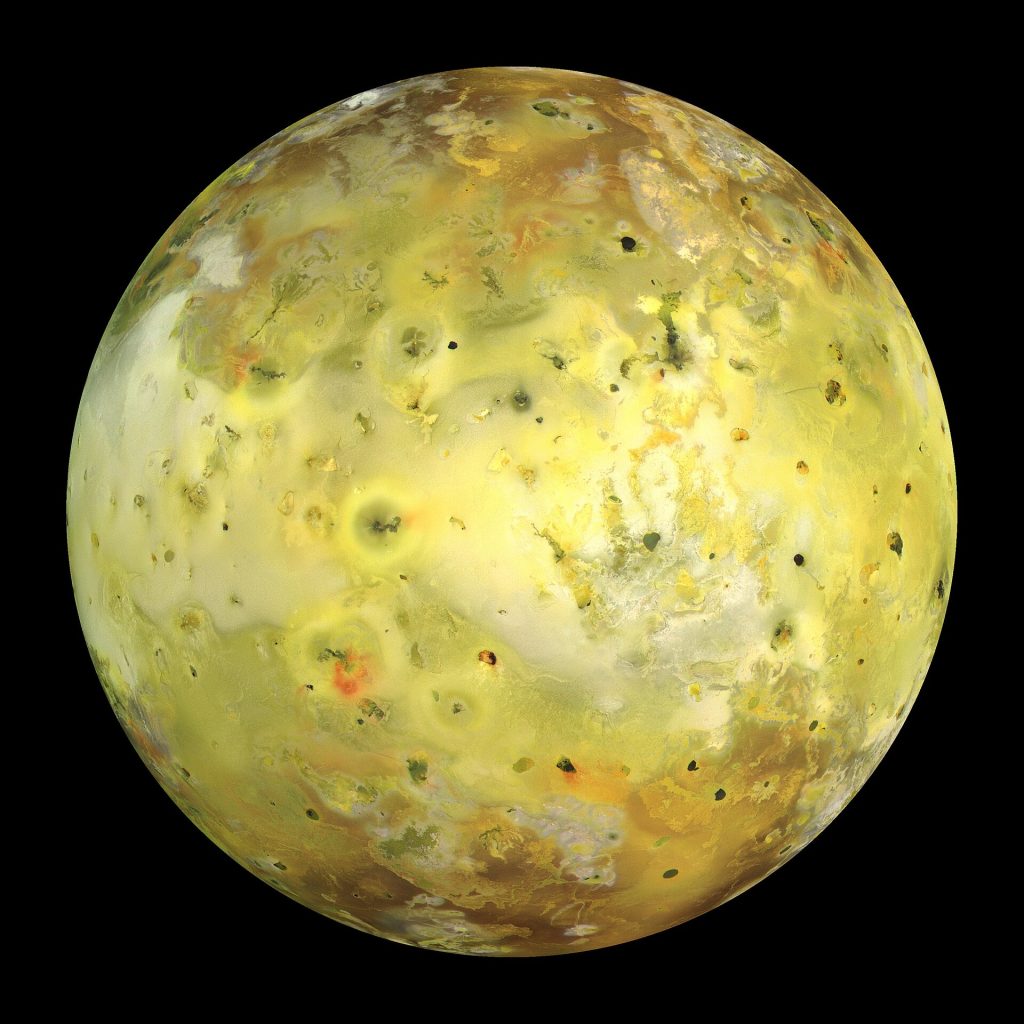
That is precisely why Io’s surface exhibits significant differences from that of Jupiter’s other major moons. There is an absence of ice, and impact craters are exceedingly rare. These features are continuously obliterated by persistent volcanic eruptions. Io hosts the largest volcanoes in the Solar System — considering the diameter of their craters rather than their height. Volcanoes of the Solar System.
5. Moon
The Moon, a celestial body well-known to us, ranks fifth among the largest moons in the Solar System. With a radius of 1,737.4 km, it is slightly smaller than Io. In comparison to most of the aforementioned bodies — except for Io and Europa — the Moon possesses a considerably higher density: 3.344 g/cm³.
The reason for this is largely comparable to the one that influenced Io. In both instances, most of the volatile substances were lost during the initial phases of these bodies’ evolution. However, whereas Io’s loss can primarily be attributed to intense tidal heating, the Moon’s loss is due to its proximity to the Sun. Although it cannot be entirely dismissed that in the distant past, when our natural satellite was in a much closer orbit around Earth, tidal heating may have also contributed.
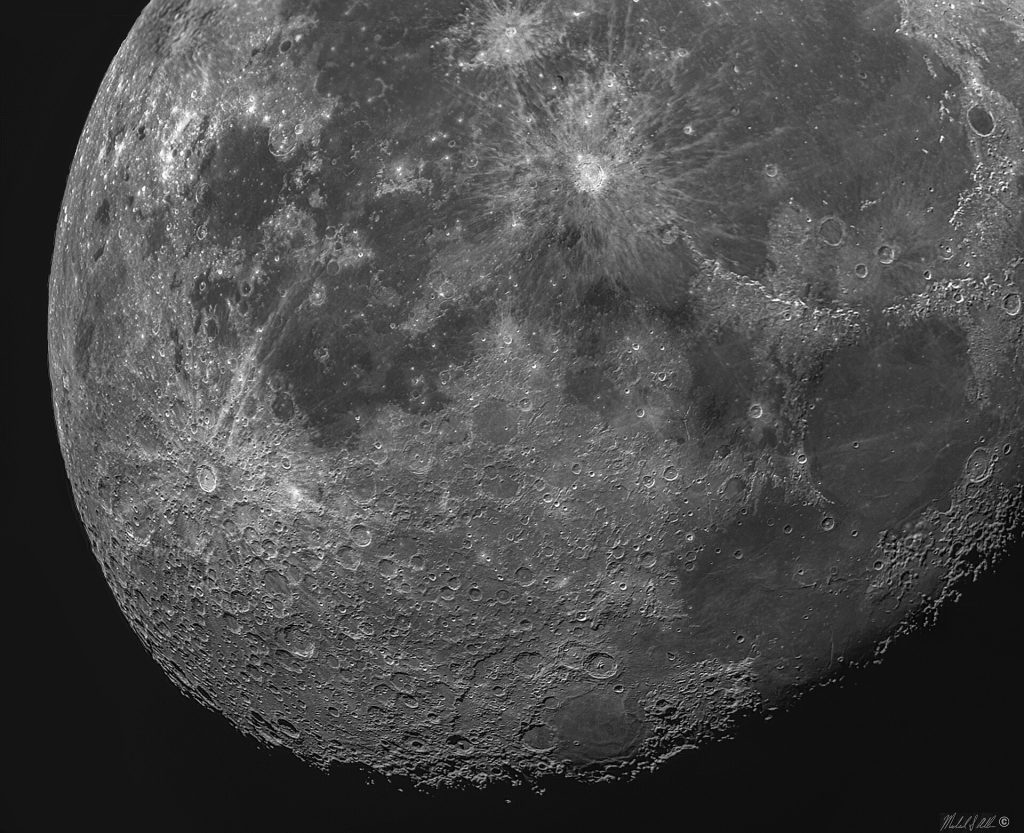
An additional noteworthy characteristic of the Moon is that, in contrast to all preceding celestial bodies, it possesses a substantial mass relative to its host planet. Consequently, the center of mass of the Earth–Moon system is situated not far beneath the surface of our planet, along the line connecting the centers of both celestial bodies.
6. Europa
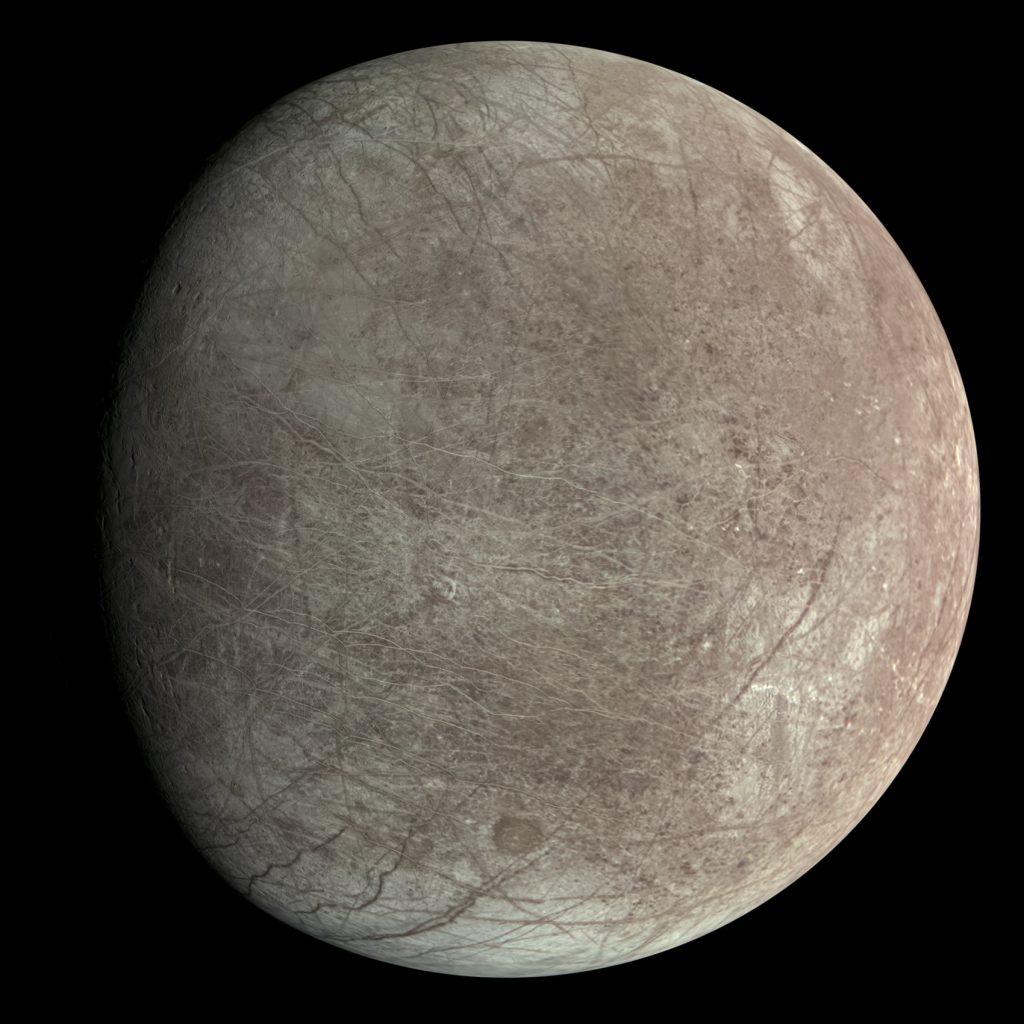
Europa is Jupiter’s fourth-largest moon. Its radius measures 1,560.8 kilometers. The average distance from Jupiter is 670,000 kilometers, and it completes an orbit around Jupiter in approximately 3.5 Earth days.
Owing to its proximity to Jupiter, Europa is subjected to the planet’s intense gravitational influence, which is evidently reflected in its appearance. It seems that tidal heating is adequate to entirely melt the ice within its interior. Beneath the icy crust, there is probably a subsurface global ocean of liquid water extending several tens of kilometers in depth.
Simultaneously, this water consistently percolates through the fissures, revitalizing the surface. Consequently, Europa exhibits virtually no craters, as its entire surface appears as a smooth sphere intersected by fault lines.
7. Triton
Triton is the largest natural satellite of Neptune. It has a radius of 1,353.4 kilometers and an average density of 2.061 g/cm³. This indicates that, despite Triton’s surface being predominantly covered by various forms of ice (including nitrogen ice, which freezes at the prevailing temperatures), its interior likely comprises silicate rocks and potentially metals.
Triton orbits Neptune approximately every 5.88 Earth days at an average distance comparable to the radius of Earth’s Moon orbit. Notably, it exhibits a retrograde orbit, moving in the opposite direction to the planet’s rotation. Its chemical composition, combined with this orbital characteristic, indicates that Triton is a Kuiper Belt object that was likely captured by the gravitational influence of the eighth planet.
8. Pluto
Unlike all other celestial bodies on this list, Pluto is classified as a dwarf planet rather than a moon. It possesses a diameter of 2,377 km and completes one orbit around the Sun every 248 years.
This diminutive icy celestial body possesses several characteristics that distinguish it as unique. Regarding its dimensions, the most noteworthy fact is that Pluto’s largest moon, Charon, is approximately half the size of Pluto itself. Consequently, this system bears many similarities to the Earth-Moon system.
9. Eris
Eris is classified as a dwarf planet rather than a moon. This designation indicates that it possesses sufficient size to assume a predominantly spherical shape due to its own gravity, yet it lacks the mass necessary to clear its orbital path of other similar objects. Its radius measures 1,163 kilometers.
Eris is also the least studied object on this list. It was discovered in 2003, and there are no close-up images of its surface. It may take several decades before such images can be obtained.
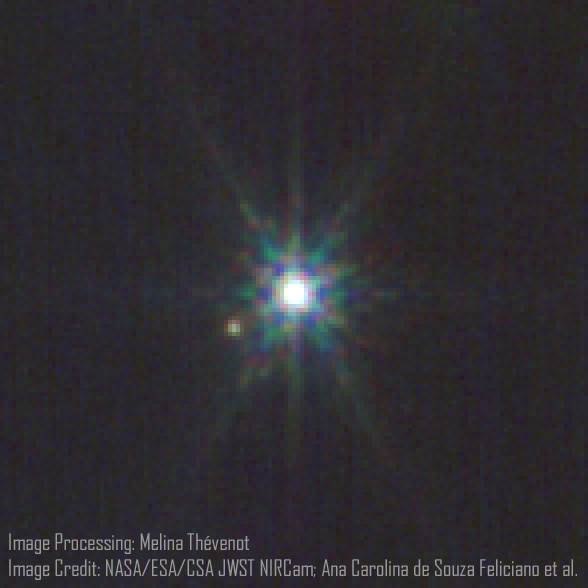
Eris is appropriately named, deriving from the ancient Greek goddess of discord. The discovery of this celestial body compelled astronomers to revise the classification system for objects within the Solar System. Consequently, Pluto was stripped of its planetary status and reclassified as a dwarf planet.
10. Titania
Completing the list of the ten largest non-planetary bodies in the Solar System is Titania, the largest moon of Uranus, with a radius of 788 km. It is a diminutive ice-stone celestial body that orbits the planet in 8.7 Earth days.
Titania is considerably smaller than all the preceding objects. Furthermore, it is the sole object in the listed top that does not derive its name from Greco-Roman mythology. It was named after the Queen of the Fairies from William Shakespeare’s play A Midsummer Night’s Dream.
