

Black holes at the centers of galaxies gained most of their mass while hidden beneath dense layers of dust and gas. Optical sky surveys revealed only part of the picture. A more complete view became possible by matching an X-ray map with distance measurements for each source. During the early history of the Universe, such objects were far more common than previously assumed.
The Sky from Both Hemispheres
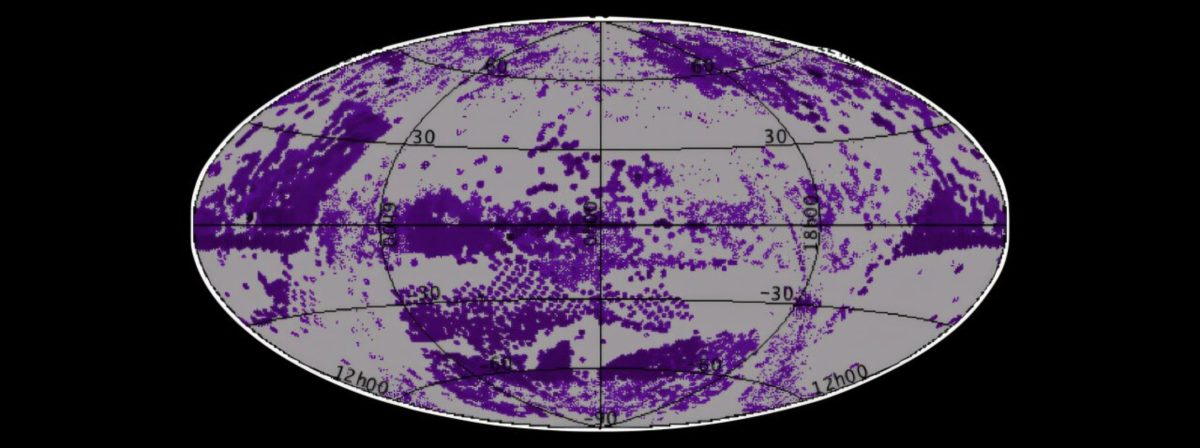
The twentieth data release of the Sloan Digital Sky Survey (SDSS) includes, for the first time, optical spectra collected in the Southern Hemisphere, Phys.org reports. They were obtained with the du Pont Telescope at Las Campanas Observatory in Chile, while the northern portion of the data continues to come from the Apache Point site in New Mexico.
The total volume exceeds 3.3 million spectra, covering half a million galaxies and 1.5 million stars. Light from each target is collected by optical fibers, which robotic positioners direct toward the required point on the focal plane, sharply increasing the pace of observations.
X-Rays Paired with Optical Data
The main source of astrophysical value in the new dataset is the SPectroscopic IDentification of eROSITA Sources program, or SPIDERS. Its purpose is to match an X-ray map with ground-based measurements in visible light in order to determine what is emitting the radiation and how far away it is.
Using this method, researchers obtained optical counterparts and precise redshifts for approximately 200,000 high-energy objects. This is the largest and most homogeneous sample of its kind in the history of observations, and the vast majority of the objects are active galactic nuclei—that is, supermassive black holes accreting matter.
The images used for this work were obtained by the eROSITA telescope aboard the Russian-German Spektr-RG observatory. In late February 2022, following Russia’s invasion of Ukraine, the German side placed the instrument into safe mode, and no new sky scans have been conducted since then. The X-ray catalog matched with the new spectra was released only on July 31, 2026, although the observations used to compile it were completed before the shutdown.
Growth Hidden from View
The distribution of these objects by luminosity shows how rapidly they gained mass during each cosmic epoch. The new data cover the range from the nearest regions of the Universe to redshifts of about six, corresponding to a time when the Universe was less than one billion years old.
The brightest active galactic nuclei were found to be more common in the early Universe than models had predicted. An even larger proportion is entirely absent from visible-light and ultraviolet surveys, especially at great distances and moderate luminosities. According to the authors’ estimates, between 70% and 90% of all supermassive black-hole mass growth occurred behind dense dusty envelopes or in states from which almost no X-ray radiation escaped.
The Limits of Automated Analysis
The brightness of quasars changes over time, and this variability can be used to calculate parameters that cannot be measured directly. Repeated spectra of the same fields, taken at intervals ranging from several days to several years, reveal a delay between the signal from the inner disk and the response of the surrounding gas. That delay can then be used to determine the mass of the central object.
A separate program covers tens of thousands of quasars whose spectra are recorded at different points in time, revealing changes that occur over years or decades. The most pronounced changes take place when an object shifts between states and its radiation takes on a different character.
The diversity of the collected material proved so great that automated analysis of part of the dataset became impossible. Those spectra were reviewed manually, and the results of that inspection were also included in the public data release. Mara Salvato, a senior researcher at the Max Planck Institute for Extraterrestrial Physics, noted that working with unusual objects taught the team methods that will be useful for future releases.
