

The world’s most powerful telescope has captured images of the Sun’s visible surface at the highest resolution ever achieved in the history of solar observation. These unique images have enabled astronomers to uncover a hidden process that serves as a primary driver of solar activity.
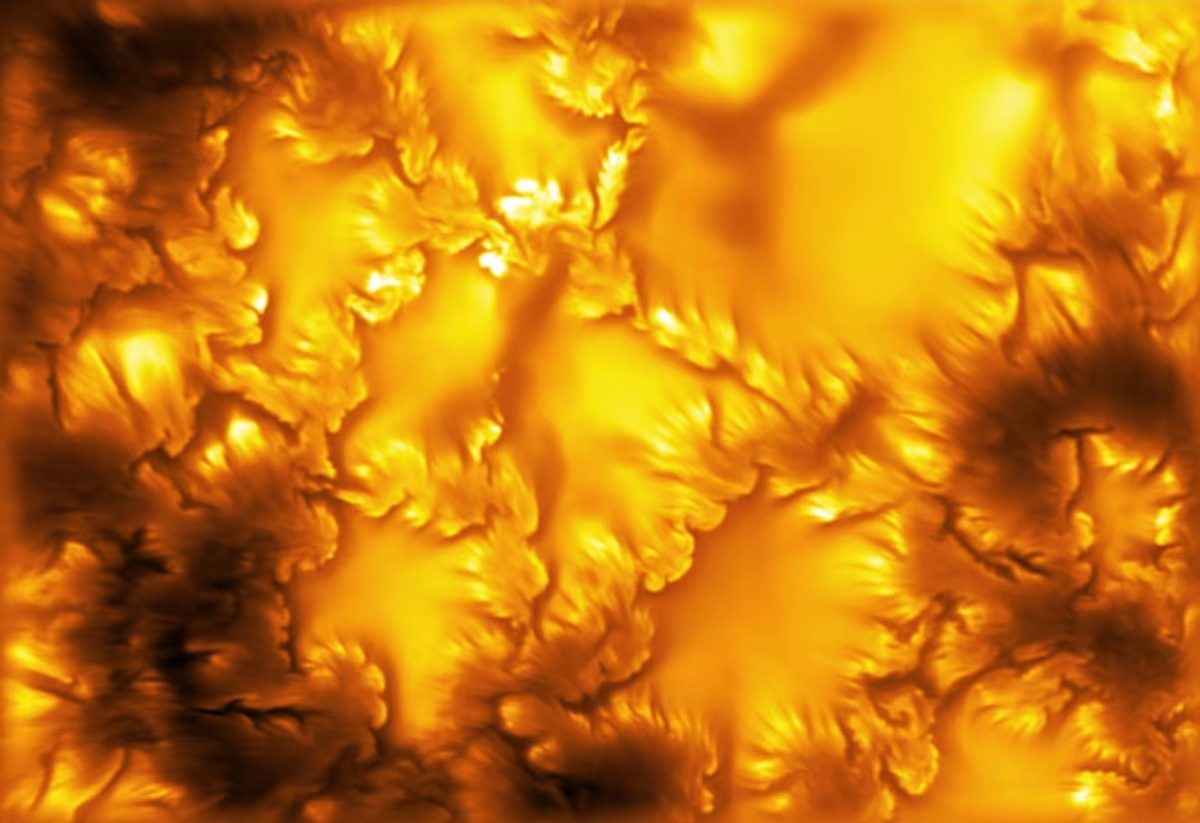
Using the Inouye Solar Telescope, located near the summit of the Hawaiian volcano Haleakalā, scientists obtained an extremely close view of a magnetically active region surrounding a sunspot. Such areas have traditionally been regarded as the true epicenters of our star’s turbulent activity. The images and time-lapse videos revealed an unprecedented view of the complex and dynamic photosphere—the Sun’s visible surface. It is a thin atmospheric layer shaped by magnetic fields and continuous flows of fluid plasma.
Unprecedented Detail and an Unexpected Discovery
Combining the new high-resolution images with computer simulations enabled scientists to make a major breakthrough in heliophysics. Researchers identified tiny vortices on the solar surface that may directly affect life on Earth. These swirling patterns, known in physics as Kelvin–Helmholtz instability (KHI), may help explain fundamental cosmic mysteries—for example, why the star’s outer atmosphere, or corona, is far hotter than the surface itself.
The detected vortices may also explain how magnetic energy accumulates before triggering solar flares and coronal mass ejections. When this energy is directed toward our planet, the ejected particles can seriously disrupt satellites, disable power grids, and interfere with other vital communications infrastructure.
The findings, recently published in the authoritative journal Nature, will help astronomers better understand the behavior of the Sun, which has so far proved extremely difficult to predict.
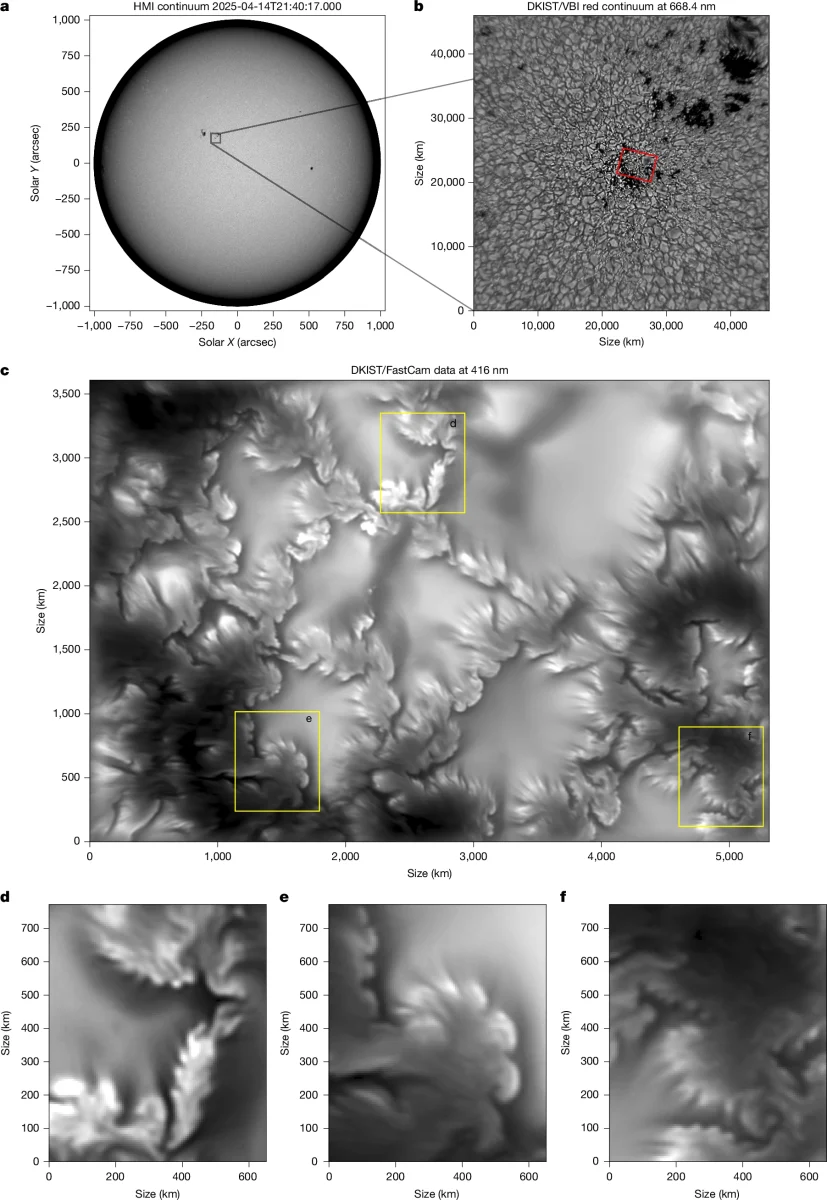
“Although theoretical models suggested that conditions suitable for Kelvin–Helmholtz instability could exist in the photosphere, seeing these structures on the surface came as an enormous surprise,” said the study’s lead author, Dr. David Kuridze of the National Solar Observatory. According to him, the formation of such vortices on the Sun has always remained a central question in heliophysics. Scientists have now identified their origin and operating mechanism for the first time.
What Is Kelvin–Helmholtz Instability?
According to the study, KHI occurs when two fluids or gases move past one another at different speeds. This produces tiny disturbances that eventually curl into spiral vortices. Scientists have previously observed this pattern in ocean waves, in the formation of clouds on Earth, and in the atmospheres of large gas giants such as Jupiter and Saturn.
“A beautiful example can be seen along the boundaries of Jupiter’s cloud bands, where vortices form along the edges,” said Dr. Maria Weber, director of the planetarium at Delta State University in Mississippi. “The largest of them all is the famous Great Red Spot.”
The images taken by the Inouye telescope represent the first time in the history of science that this phenomenon has been recorded directly on the Sun.
Microscopic Engines with a Global Impact
For many years, scientists believed that the Sun stores energy through the “braiding of flows,” in which magnetic field lines twist around one another. Eventually, the magnetic tension becomes so unstable that the fields break apart and then reconnect, releasing an enormous burst of energy. However, the reason these entanglements form in the first place remained a mystery.
The new discovery provides an answer: vortices at the edges of magnetic regions act as twisting mechanisms. “KHI is a highly efficient way for the Sun to break large plasma flows down into much smaller motions,” Dr. Kuridze emphasized. “The energy cascades toward microscopic scales, where it can easily be released as heat. This gives us an extremely important piece of the puzzle.”
These magnetic vortices effectively act as microscopic engines that generate and transport energy.
A New Window into Space Weather
Although the Sun is capable of producing massive eruptions, thousands of tiny nanoflares occur on it every second. According to scientists, these micro-events have a much greater effect on the Sun’s thermal structure than rare large flares. It is these small-scale events that ultimately shape global space weather.
Dr. Nour Rawafi, a scientist with NASA’s Parker Solar Probe mission, described the discovery as a genuine breakthrough in understanding the dynamics of the lower solar atmosphere. “The widespread presence of vortices and the instability associated with them makes complete physical sense—we simply did not previously have the capability to observe structures this small,” he said.
All of these observations were made possible solely by the technical capabilities of the Inouye telescope. According to Dr. Friedrich Wöger, its four-meter mirror and advanced adaptive optics system, which compensates for blurring caused by Earth’s atmosphere, make the facility unique.
And this is only the beginning. Astronomers are confident that many more revolutionary discoveries about the nature of our star still lie ahead.
We previously reported on how Solar Orbiter revealed the Sun’s “fluffy” surface in exquisite detail.
According to CNN
