

NASA’s PUNCH mission has begun observing the Sun. Scientists have already used its data to create a space weather forecast far more accurate than anything available before.
Coronal Mass Ejections and the Purpose of PUNCH
Using continuous images obtained by NASA’s PUNCH mission, or Polarimeter to Unify the Corona and Heliosphere, scientists conducted a preliminary proof-of-concept test and predicted the arrival of a solar eruption at Earth with an accuracy of 30 minutes. The results, presented on Tuesday at a scientific conference of the Committee on Space Research and currently undergoing peer review at the journal Space Weather, could fundamentally change the way solar storms affecting Earth are forecast. phys.org reported the findings.
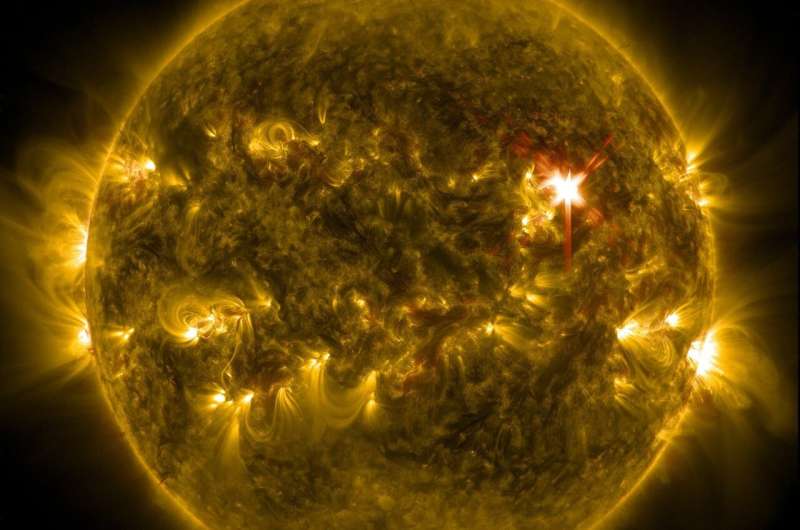
Solar storms are caused by enormous eruptions of material from the Sun’s surface known as coronal mass ejections. Predicting when these ejections will reach Earth is essential for reducing their impact on power grids, satellites, and astronauts. Until recently, however, coronal mass ejections could not be continuously tracked during a substantial portion of their journey through the Solar System.
That changed in 2025 with the launch of the PUNCH mission, in which four spacecraft in low Earth orbit conduct continuous 3D observations of the inner Solar System. Before PUNCH was launched, coronal mass ejections could be observed only while traveling through roughly one-fifth of the distance from the Sun to Earth, leaving scientists to infer what happened during the rest of the journey. Thanks to PUNCH’s wider field of view, researchers can now routinely track solar eruptions along almost their entire path to Earth, receiving a new image every four minutes.
A Forecast Refined in Transit
Scientists used data from a coronal mass ejection that occurred on the Sun on May 31, 2025, to retrospectively test whether forecasting models could be improved. They uploaded the images into a computer model that analyzed the leading edge of the coronal mass ejection over time. As the eruption moved and changed through the inner Solar System, the model used its speed and geometry to calculate when it would reach Earth.
Twelve hours after the coronal mass ejection left the Sun, the model produced its final forecast, predicting that the storm would arrive eight hours later. The projected arrival time ultimately proved accurate to within half an hour, which is ten times better than current methods that provide only a five-hour window. The model also showed when the estimate had stabilized, allowing a space weather forecaster to predict the arrival time with confidence.
Scientists believe they achieved an improvement of an entire order of magnitude over the most advanced existing method using a remarkably simple process, made possible solely by the ability to continuously track the coronal mass ejection through the Solar System.
New Data on the Structure and Behavior of Solar Plasma
These initial results demonstrate the effectiveness of PUNCH’s wide-angle imaging for tracking solar phenomena as they travel away from the Sun. Ultimately, scientists believe that more precise PUNCH data and improved models will allow them to predict the arrival times of coronal mass ejections even earlier.
Beyond space weather forecasting, the images are also helping scientists gain new insights into coronal mass ejections themselves. High-resolution images have revealed previously unseen structures within the eruptions, showing that the clouds of material are more clumpy than previously believed and continue to evolve as they move through the Solar System.
Data from the PUNCH mission are also helping scientists better understand how plasma—the solar material expelled during coronal mass ejections—moves through space. This information may help astrophysicists better understand the behavior of plasma throughout the galaxy, including in star-forming regions where it is nearly impossible to study on small scales.
