
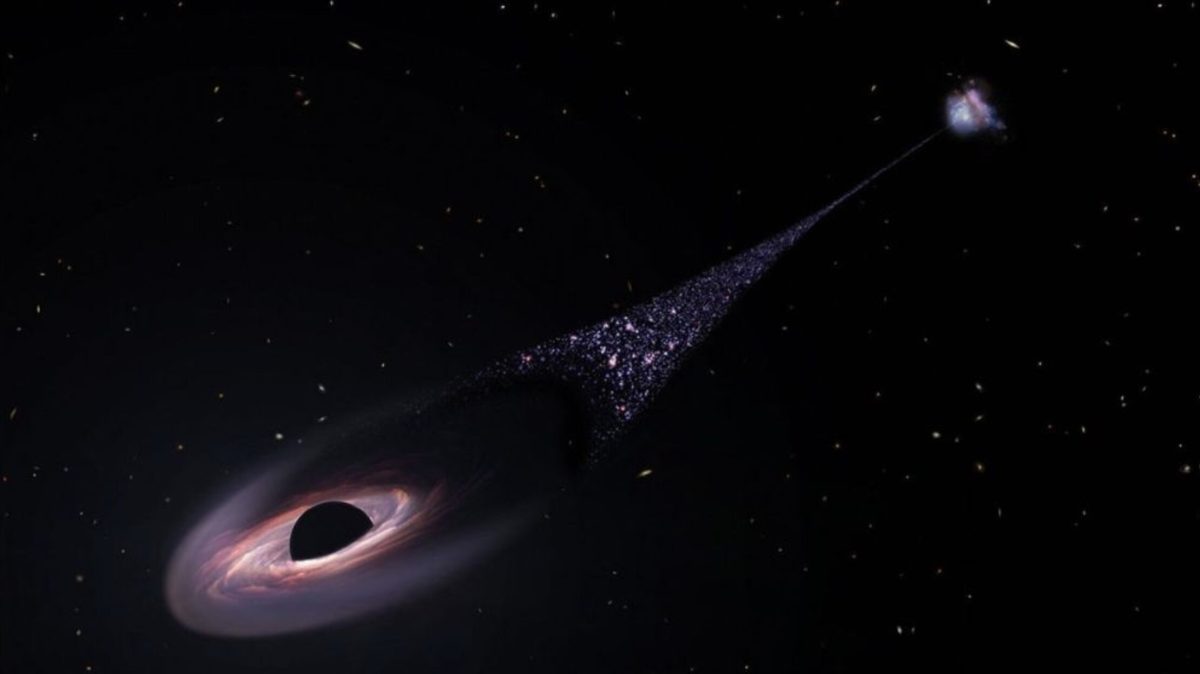
Astronomers are studying a supermassive black hole that was likely ejected from the center of its host galaxy as a result of a merger between its two predecessors. Based on the black hole’s parameters, they were able to reconstruct the characteristics of the original merger, which occurred nearly 70 million years ago.
A Black Hole Moving at an Incredible Speed
Black holes are fascinating regions of space where gravity is so strong that nothing, not even light, can escape. The largest known black holes, called supermassive black holes, have masses millions or billions of times greater than that of the Sun and are usually located at the centers of galaxies.
As phys.org reports, about three years ago astronomers observed a “runaway” supermassive black hole that appeared to be moving through space at nearly 1,000 km/s, or 620 miles per second. The black hole was detected by both the James Webb Space Telescope and the Hubble Space Telescope (HST), the two largest space observatories built to date.
Researchers from the Kavli Institute for Theoretical Physics (KITP), the University of California, Santa Barbara (UCSB), and the University of Texas at Austin recently attempted to shed more light on the origin of this moving black hole, known as RBH-1. Their paper, published in Physical Review Letters, suggests that the black hole was probably ejected into space as a result of the merger of two supermassive black holes.
“Although recoiling supermassive black holes have been hypothesized before, RBH-1 is the first compelling example of a supermassive black hole that appears to have been expelled from the center of its host galaxy, most likely by a powerful gravitational-wave recoil following the merger of two supermassive black holes,” said Tousif Islam, the paper’s lead author.
The Study’s Central Question
In an earlier paper, Islam and other researchers showed that a black hole left behind after a merger can be launched into space at a high recoil velocity of up to 5,000 km/s, or 3,100 miles per second. A black hole merger could therefore potentially explain the behavior of the rapidly moving RBH-1 observed by James Webb and Hubble.
Working with Tejaswi Venumadhav and Digvijay Wadekar, Islam set out to reconstruct the black hole merger that likely produced the substantial gravitational-wave recoil, or “kick,” responsible for propelling RBH-1 through space at such a high speed. To do so, they used a combination of theoretical simulations and analytical approaches.
“We asked: Can the observed properties of RBH-1 reveal the masses and spins of the two supermassive black holes that merged approximately 70 million years ago?” Islam said. “More broadly, can we use a runaway black hole as a window into a history of galaxy mergers that we can no longer observe directly? The main goal of our work was to answer these questions.”
Reconstructing the Merger That Produced RBH-1
Most black hole mergers produce relatively small recoil velocities that would be too weak to expel the newly formed merged black hole from its galaxy. To reconstruct a merger capable of sending RBH-1 through space so quickly, the researchers first estimated the speed at which it was moving after being ejected from the galaxy. It was approximately 1,000 km/s.
The scientists combined observational data with theoretical models of binary black hole mergers developed from high-precision numerical-relativity simulations, which solve Einstein’s equations on supercomputers, as well as black hole perturbation theory.
The researchers used numerical relativity models that relate the masses and spins of the two black holes before the merger to the mass, spin, and recoil velocity of the residual black hole. They then compared millions of simulated configurations of binary supermassive black holes with the measured properties of RBH-1 to determine the most likely parameters of its progenitors.
“This allowed us to identify the combinations most consistent with the data and place quantitative constraints on the original system,” Islam said. “We showed that the merger most likely involved two supermassive black holes with a mass ratio of less than approximately 6:1, with the larger black hole spinning rapidly and the binary system probably precessing before the merger.”
A Contribution to Future Gravitational-Wave Research
The study shows that reconstructions of supermassive black hole mergers can be used to identify the physical properties that likely led to the formation of specific supermassive black holes. By applying this approach, Islam, Venumadhav, and Wadekar were able to determine the characteristics of the two supermassive black holes that merged to form RBH-1 and gain insight into the galaxy merger that probably brought them together.
“More broadly, our work demonstrates how astronomical observations and theoretical models based on Einstein’s general theory of relativity can be combined to ‘rewind time’ and uncover the history of extraordinary cosmic events,” Islam said.
In the future, the team’s findings may complement direct observations of gravitational waves from supermassive black hole mergers collected by the Laser Interferometer Space Antenna, or LISA. LISA is a space-based gravitational-wave observatory being developed by the European Space Agency in partnership with NASA.
The scientists are currently working to improve their simulations of binary black hole mergers. In particular, they plan to develop more accurate theoretical models of such mergers based on Einstein’s general theory of relativity.
“We also hope to apply these methods to future discoveries of recoiling supermassive black holes made with James Webb, the Nancy Grace Roman Space Telescope, and other observatories,” Islam added. “As the number of observed systems increases, we will be able to reconstruct their merger histories and gain a deeper understanding of how supermassive black holes and their host galaxies evolve together. Ultimately, we hope these studies will complement LISA’s future gravitational-wave observations of supermassive black hole mergers and provide a more complete picture of these extraordinary events.”