

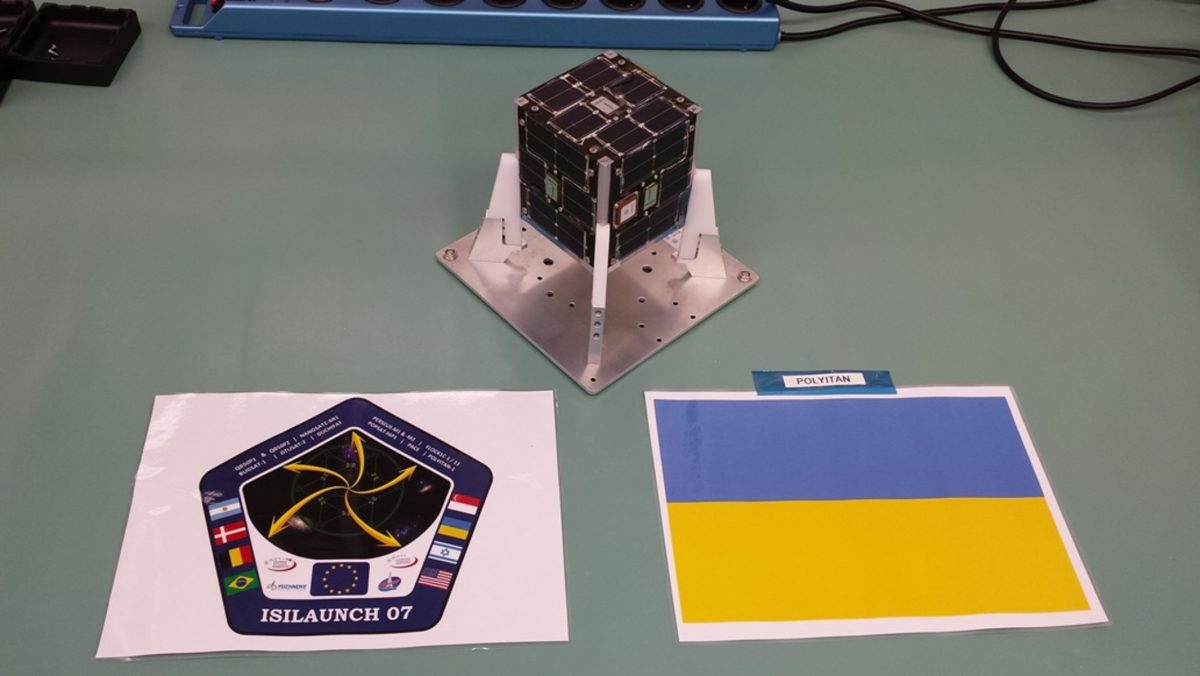
A Ukrainian nanosatellite was expected to operate in orbit for only a few years. Instead, PolyITAN-1 has been transmitting signals for more than a decade. It was created by lecturers, postgraduate students, and students of Igor Sikorsky Kyiv Polytechnic Institute. The duration of its flight has now been officially recognized as a national record.
Official Recognition
The ceremony marking the entry into the Ukrainian Book of Records was held on July 30 at the National Technical University of Ukraine “Igor Sikorsky Kyiv Polytechnic Institute,” where the national achievement was registered in the category “Longest Flight of a Ukrainian Nanosatellite in Space.” The record was confirmed by Vitalii Zorin, an expert from the National Register of Records of Ukraine.

The event was attended by the satellite’s developers together with its scientific supervisor, Borys Mykhailovych Rassamakin, as well as representatives of the State Space Agency of Ukraine and the Main Astronomical Observatory of the National Academy of Sciences of Ukraine. Among the guests was Oleksandr Korniienko, First Deputy Chairman of the Verkhovna Rada of Ukraine and head of the university’s Supervisory Board. He emphasized the need to develop Ukraine’s own space technologies and support engineering education.
Twelve Years in Orbit
The PolyITAN-1 nanosatellite was launched into space on June 19, 2014, aboard a Dnipro launch vehicle. It has been transmitting telemetry continuously ever since.
Another 32 spacecraft from 17 countries entered low Earth orbit alongside it. The Ukrainian nanosatellite is the only one from the entire group that is still functioning.
The satellite’s intended service life expired many years ago, yet it continued operating in orbit. This result became the basis for submitting the achievement to the national record registry.
Three Times Longer Than Designed
“No one expected the satellite to operate for almost three times longer than planned during its design,” Vitalii Zorin said. In his assessment, the result was 90% due to technology and only 10% due to luck.
CubeSat nanosatellites are assembled from cubic modules measuring 10 centimeters on each side. Their active service life rarely exceeds two years because batteries and solar cells degrade quickly, while the thin upper atmosphere gradually slows spacecraft in low orbit. Twelve years of telemetry from the Ukrainian satellite is far beyond these typical limits.
Ukraine’s Own Space Program
PolyITAN-1 became the first university-built nanosatellite of its kind in Ukraine. It marked the beginning of Kyiv Polytechnic’s modern space engineering school.
The university has launched three of its own satellites in total. Igor Sikorsky Kyiv Polytechnic Institute has established a complete cycle for designing, manufacturing, and testing small spacecraft, together with their power-supply, thermal-control, orientation, navigation, and communications systems.
Anatolii Melnychenko, Rector of Igor Sikorsky Kyiv Polytechnic Institute, emphasized that lecturers, postgraduate students, and students are involved in developing the components. According to him, the university has also established training programs for engineers in the space sector.
Last year, more than 40% of all applicants to the Aviation and Rocket-Space Engineering program chose Kyiv Polytechnic. It is the only institution in the country with its own space program.
The next generation of spacecraft is being designed as multifunctional platforms. They are being prepared to obtain high-precision images of Earth’s surface and study the atmosphere.
