

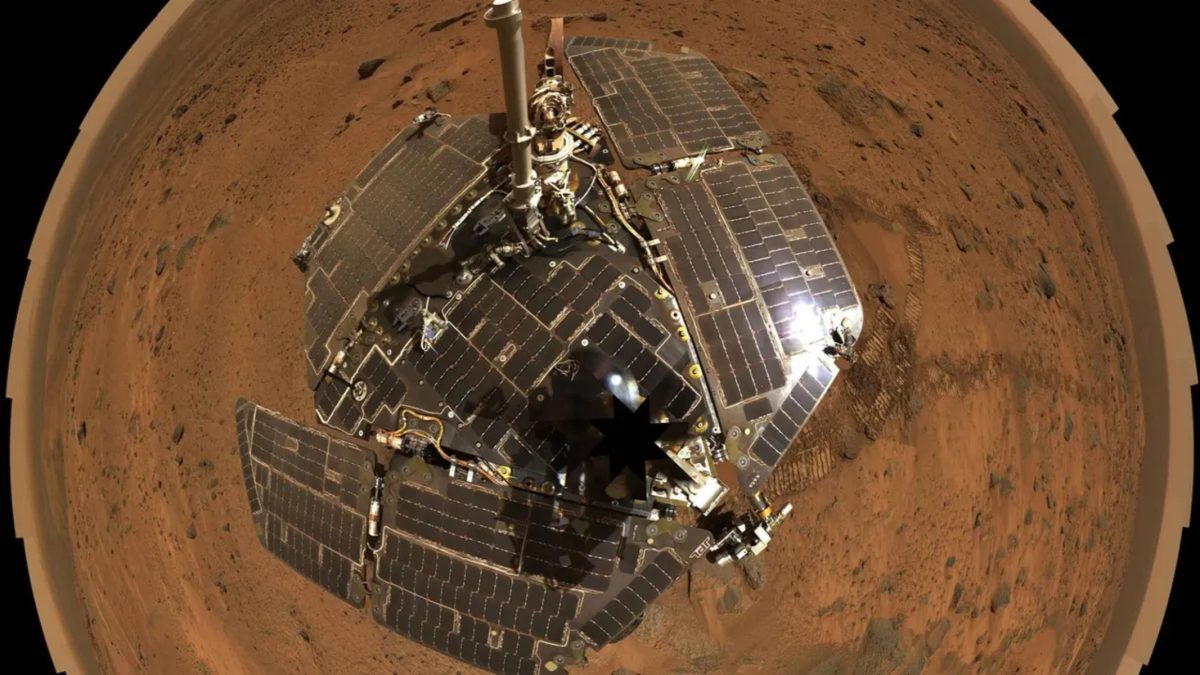
Archived data collected by the Spirit rover from the soil of Gusev Crater contained an unnoticed piece of evidence of Mars’s watery past. Researchers rediscovered it two decades after the spacecraft landed. To do so, they had to combine a large number of individual spectra, because the signal in each one was too weak on its own.
A New Approach to Old Data
The miniature Mössbauer spectrometer MIMOS II aboard Spirit collected data while the rover was operating from 2004 to 2010. During that time, it examined 32 undisturbed soil sites in different parts of Gusev Crater.
Each individual measurement lasted from 30 minutes to several hours. This was sufficient to identify the main minerals in the soil, but not enough to reliably detect trace components accounting for less than 5% of the total spectral area. Imagine a photograph taken with a very short exposure: large objects are visible, while faint details disappear into the noise. Crystalline hematite and altered magnetite were hidden precisely within this blind spot.
The study’s authors, led by Paulo de Souza of Edith Cowan University, combined measurements from different locations into a single composite spectrum for the first time, Space.com reports. The total accumulated time in RAcT terms amounted to 150 hours and 25 minutes. This represents the total effective integration time, rather than the instrument operating continuously. It proved sufficient for a signal spread across years of observations to emerge at a level suitable for analysis.
Which Minerals Were Detected
In the combined spectrum, the researchers identified crystalline hematite and altered magnetite. Hematite is considered an important mineralogical indicator of past water activity on Mars, although it can also form under volcanic and hydrothermal conditions. The altered magnetite showed signs of partial iron oxidation, consistent with the chemical transformation of primary magmatic minerals.
Both phases were detected in ordinary soil, rather than only in isolated local deposits. Crystalline hematite had previously been thought to be largely absent from soils around Spirit’s landing site. The findings strengthen the hypothesis that chemical processes involving water may have been more widespread in the Gusev Crater region than earlier analyses suggested.
Dust, Weathering, and Water
The soils on the plains of Gusev Crater share many characteristics and are often regarded as representative of common Martian surface material. They formed over millions of years under the effects of wind erosion, sharp temperature fluctuations, and dust transport.
The new data provide grounds for adding chemical weathering, potentially associated with water, to the list of possible factors. This is indicated both by the presence of hematite and by the nature of the magnetite, whose partial oxidation is consistent with possible chemical alteration involving water, although other mechanisms cannot be completely ruled out.
The npFe phase, which the authors define as a paramagnetic iron(III) phase, was detected in all samples. It also points to prolonged chemical alteration of the basaltic substrate. This component is interpreted as a mixture of nanocrystalline iron oxides and oxyhydroxides—that is, products of oxidative weathering.
A Legacy That Is Still Producing Results
The study demonstrates that new scientific findings can be obtained by reanalyzing data from completed space missions. Sometimes, all that is required is a new way of examining measurements collected decades earlier. The authors plan to apply the same method to data from the Opportunity rover at Meridiani Planum to determine whether the upper layer of Martian soil is truly globally uniform.
The findings were published in the journal Interactions. Data from the Mars Exploration Rover mission are available through NASA’s Planetary Data System.