

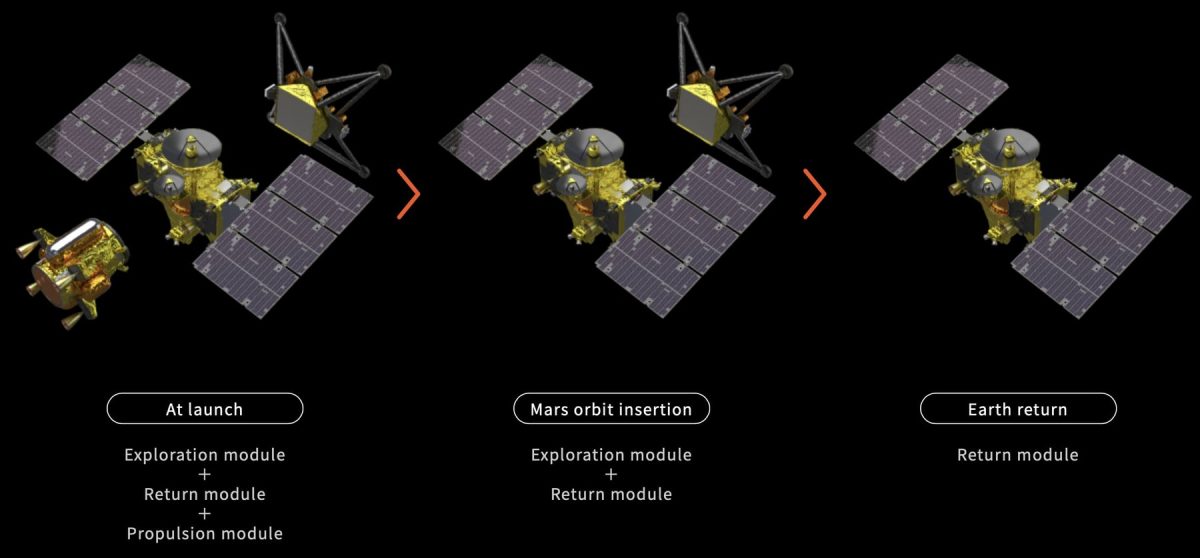
A Japanese probe has set off for Mars on a mission to bring the first samples from Phobos back to Earth. Traveling with it is a French-German rover designed to drive across the Martian moon’s surface. The rover will first separate from the probe above Phobos, after which the spacecraft itself will land, collect soil, and begin its return journey.
Launch from Tanegashima
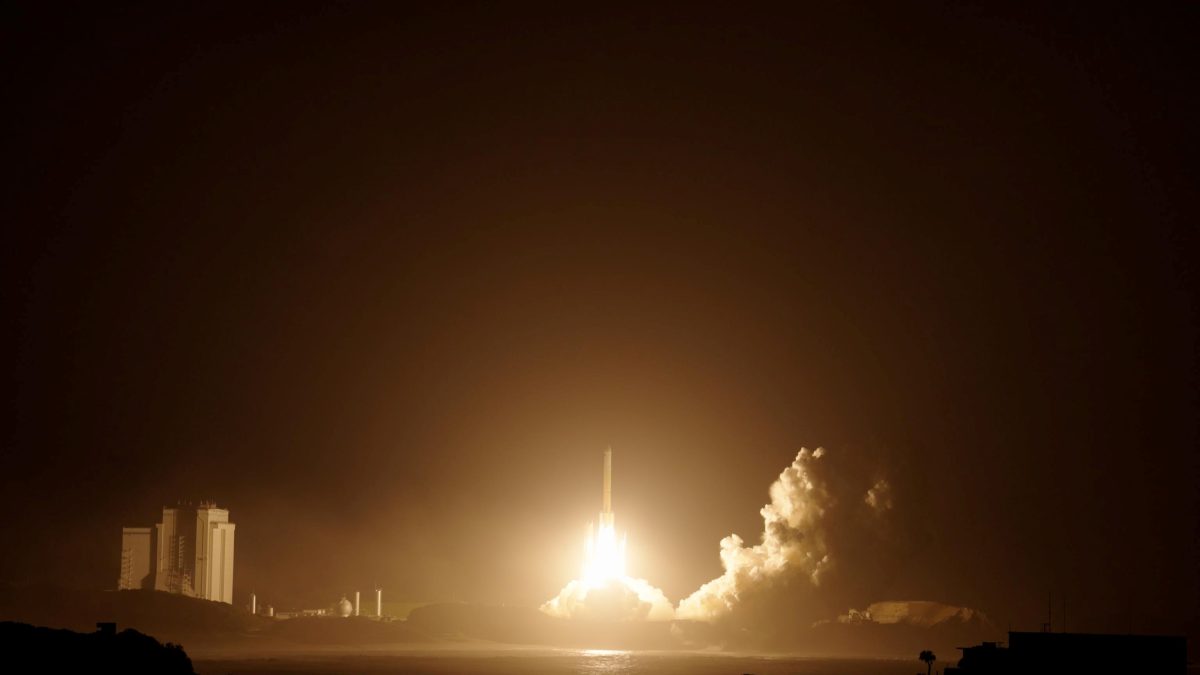
The H3 rocket lifted off from Japan’s Tanegashima Space Center on October 19 at 10:41 p.m. Kyiv time. Approximately 71 minutes later, the MMX (Martian Moons eXploration) probe entered its planned orbit, the Japan Aerospace Exploration Agency (JAXA) reported.
The journey will take about a year. The spacecraft will arrive at Mars in the summer of 2027 and later enter a quasi-satellite orbit, meaning it will orbit the planet almost in sync with Phobos, remaining close to the moon throughout. The mission is expected to last approximately five years, and we previously described its stages in detail.
Landing Without Braking
The first to descend onto Phobos will be the 25-kilogram Idefix rover, jointly developed by the German Aerospace Center (DLR) and France’s National Centre for Space Studies (CNES). In late 2028 or early 2029, the probe will release it from an altitude of 40–100 meters, with nothing to slow its fall. After impact, Idefix will bounce several times, right itself into its operating position, and deploy its solar panels.
An animation of the MMX mission: the journey to Mars, observations of Phobos from orbit, the Idefix rover’s surface operations, sample collection, and the return to Earth. Credit: DLR. Source: JAXA Sagamihara YouTube channel
Disregarding the probe’s velocity at release, a fall from 100 meters will take approximately three minutes. The rover will hit the surface at the same speed it would reach after falling just five centimeters on Earth. This is due to the weak gravity: gravitational acceleration on Phobos is less than 0.01 m/s², compared with 9.8 m/s² on Earth.
A day on the moon lasts approximately seven and a half hours and is governed by Mars. The planet’s gravity long ago synchronized Phobos’s rotation so that the same side always faces Mars. As a result, one rotation on its axis takes the same amount of time as one orbit around Mars. During that time, the surface temperature changes by more than 200°C.
How the Rover Will Move
Japan, France, and Germany have already worked together on an asteroid landing. In 2018, the French-German MASCOT lander, delivered by Hayabusa2, landed on the asteroid Ryugu. However, MASCOT moved by hopping, while Idefix will become the first spacecraft to drive on wheels across a body with extremely weak gravity.
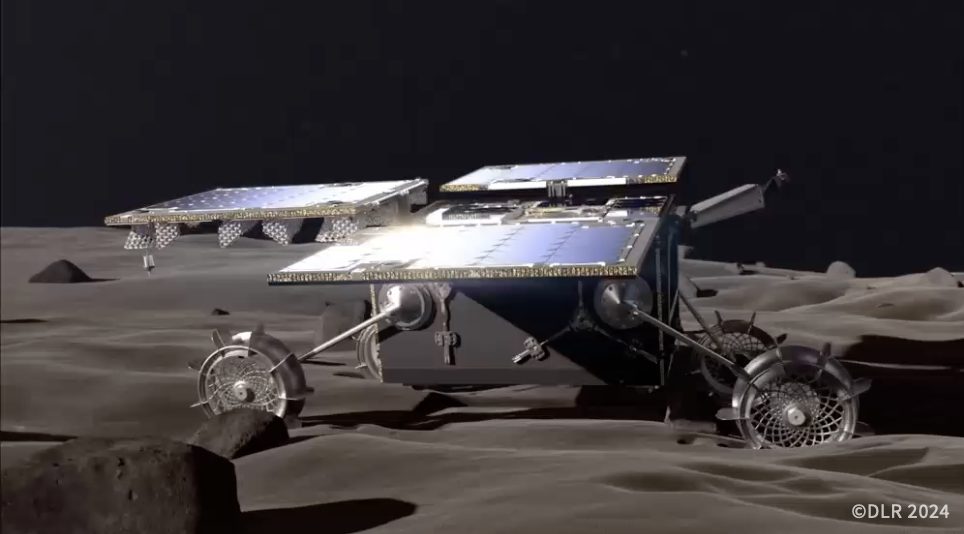
The rover carries a Raman spectrometer, which determines mineral composition by measuring how material scatters laser light, and a radiometer for measuring temperature. Both instruments were developed by German engineers, according to DLR. The rover’s data will help select a location where the probe will later collect soil.
A signal’s round trip to Earth takes up to 44 minutes, making real-time rover control impossible. Markus Grebenstein, Idefix project manager at DLR, explains that the first real test will be the rover’s ability to right itself from any position.
Where Did Mars Get Its Water?
The mission’s principal investigator, Kiyoshi Kuramoto, points out that Phobos and Deimos closely resemble carbonaceous asteroids, as noted on the mission website. Such bodies may have delivered water and atmosphere-forming substances to planets.
Samples from Phobos could therefore explain where the young Mars obtained its water and thick atmosphere. Planetary scientists will seek the answer after 2031, when a capsule containing at least 10 grams of soil returns to Earth. That is almost twice the 5.4 grams Hayabusa2 brought back from Ryugu.
