

At the dawn of the Universe, space was filled with gigantic black holes. Their sizes are so extraordinary that science still has no precise explanation for how they formed. However, a new discovery may overturn our understanding of the early cosmos.
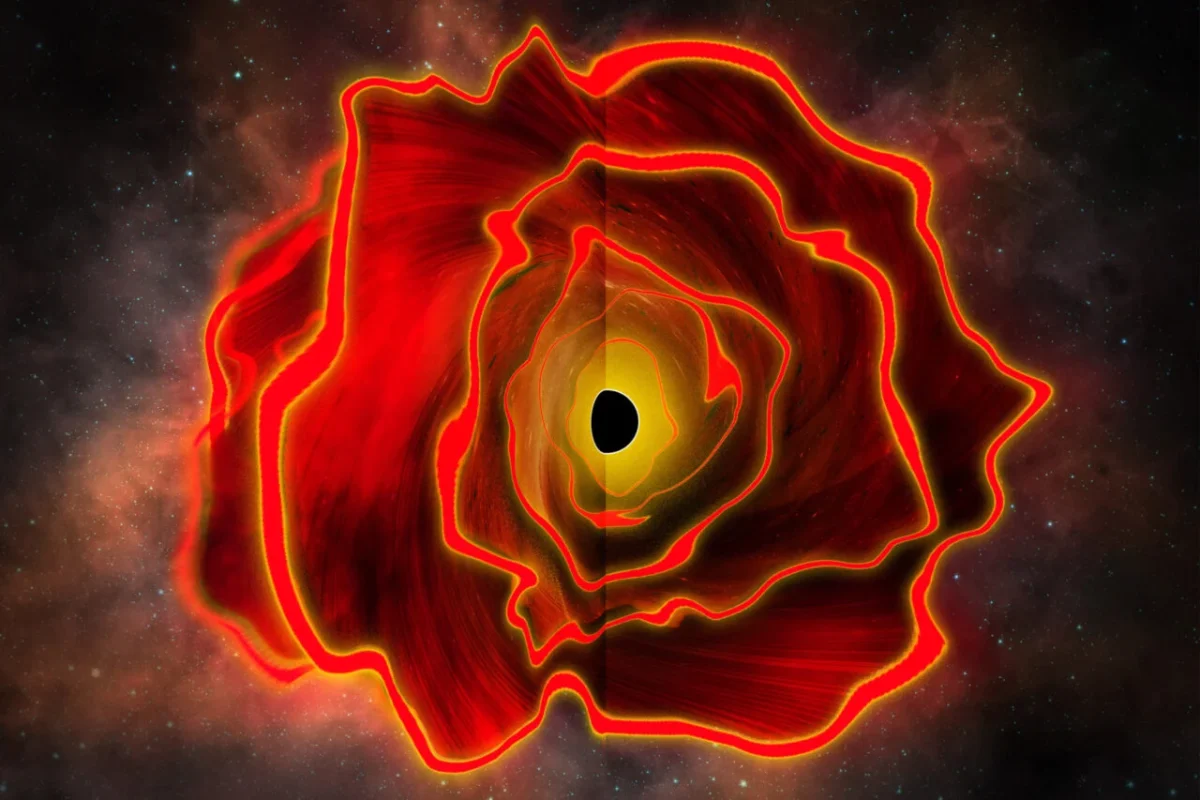
In a recent issue of the journal Nature, astronomers reported the discovery of an anomalously bright red spot in the early Universe. The object is roughly the size of our entire Solar System, yet it emits 100 billion times more energy than any known star. Such characteristics are typical of black holes.
After a detailed analysis, scientists concluded that they were looking at an entirely new class of cosmic objects, which they named a “black hole star.” The first object discovered was designated MoM-BH*-1. The study’s lead author, University of Hawaii astronomer Rohan Naidu, notes that the structure is surrounded by such a dense layer of gas that its radiation is disguised as stellar processes.
“This is truly an exceptional event,” the scientist said. “MoM-BH*-1 is a one-in-a-billion case.”
The Mystery of the Little Red Dots
The scientific community has been debating so-called Little Red Dots for some time — bright, compact objects from the early Universe with high redshifts. Their light has traveled toward Earth for billions of years. When the James Webb Space Telescope first detected them, researchers were so puzzled that they even suspected the spacecraft might be malfunctioning. It is now clear, however, that solving the mystery of these relics from the cosmic dawn is key to understanding the evolution of our Universe.

The discovery of MoM-BH*-1 sheds light on the mystery of how the earliest supermassive black holes formed, with masses ranging from millions to billions of times that of the Sun. Naidu suggests that “black hole stars” may represent a kind of prehistory in the birth of every supermassive black hole. At the same time, the “Little Red Dots” may be similar objects, simply hidden inside large galaxies.
A New Chapter in Astrophysics
Usually, a red hue in cosmic objects indicates the presence of dust, which absorbs and scatters blue light. However, spectral analysis of MoM-BH*-1 revealed something different: the object is dominated by an enormous cloud of ionized gas, while the amount of dust is minimal.
The object’s light drops sharply at a particular wavelength, a phenomenon known as the Balmer jump. Because MoM-BH*-1 completely outshines its host galaxy, scientists can observe its “pure” light, which remarkably combines properties associated with both a star and a black hole.
If the red color of these early structures is indeed caused by gas, this could explain why the first supermassive black holes turned out to be much larger than classical cosmological models predicted.
We previously reported on how the oldest black hole challenges the theory of how these objects form.
According to Gizmodo