

The European probe heading toward Jupiter’s icy moons made its second close approach to Earth today. During the gravity-assist maneuver, the planet’s gravity changed the spacecraft’s direction of travel and speed with almost no fuel consumption. The new course placed it on a more elongated orbit around the Sun, from which it will return to us once more for a final flyby. At the same time, all of the probe’s scientific instruments are collecting data about Earth and the Moon.
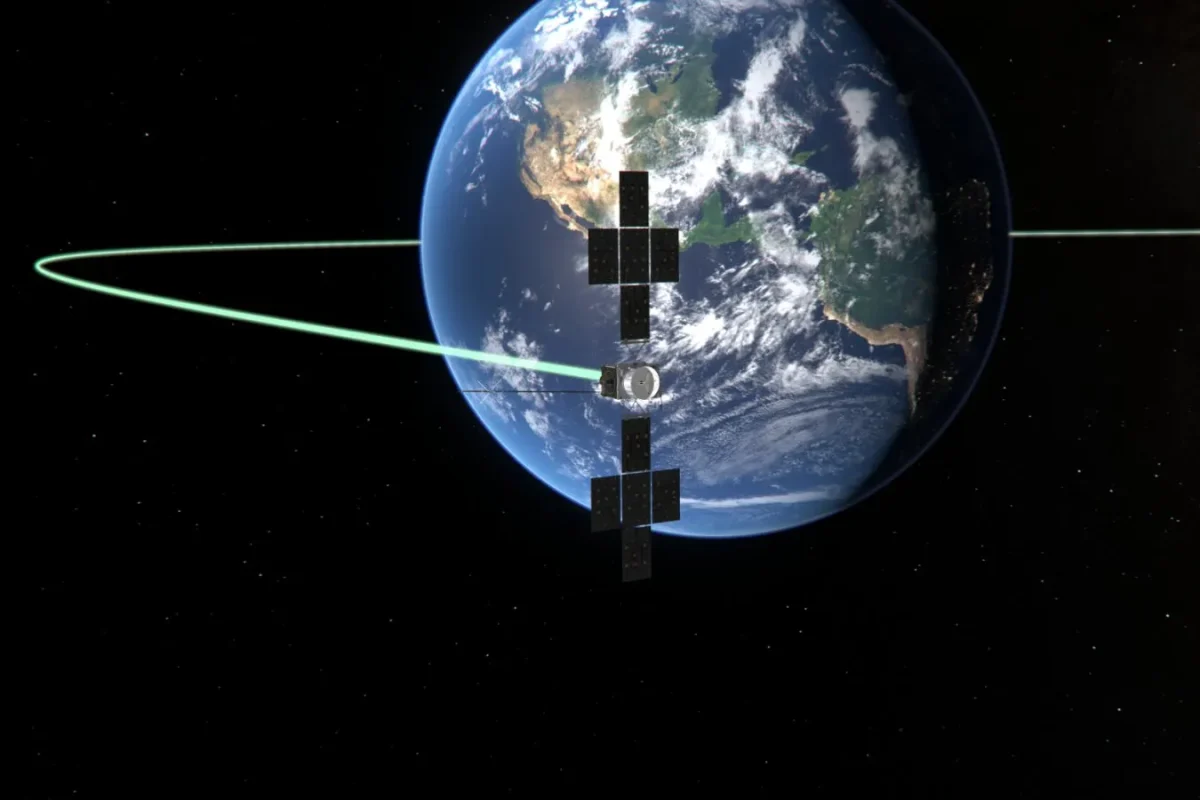
Over the Indian Ocean
The Juice spacecraft made its closest approach to our planet on September 28 at 2:45 p.m. Kyiv time, according to ESA. At that moment, it was 8,640 kilometers from Earth, with the Indian Ocean below it.
The gravity-assist maneuver deflected its trajectory by approximately 20 degrees and added about 3.5 kilometers per second to its speed. To achieve this, Juice had to approach Earth at a precisely calculated angle, because even a small error would have altered its entire subsequent route to Jupiter.
Between 15 and 30 minutes before closest approach, the probe passed over Australia from the northeast toward the northwest of the country. Amateur astronomers with suitable telescopes or binoculars could try to track it.
Why Take a Detour
A direct flight to the gas giant would take much less time. However, it would require an enormous rocket and a huge amount of fuel, with even more needed for braking near the destination.
This factor can be clearly seen in the example of NASA’s Europa Clipper, launched in October 2024. The more powerful Falcon Heavy rocket gave it a higher departure speed from Earth, so its route required only two gravity assists. In March 2025, the spacecraft passed by Mars, whose gravity changed its trajectory around the Sun and turned its course in the opposite direction. In December 2026, the probe will encounter our planet at another point in its orbit, because Earth itself will have traveled a considerable distance around the Sun by then. This flyby will provide the main acceleration toward Jupiter, where Europa Clipper will arrive in April 2030, more than a year earlier than the European mission.
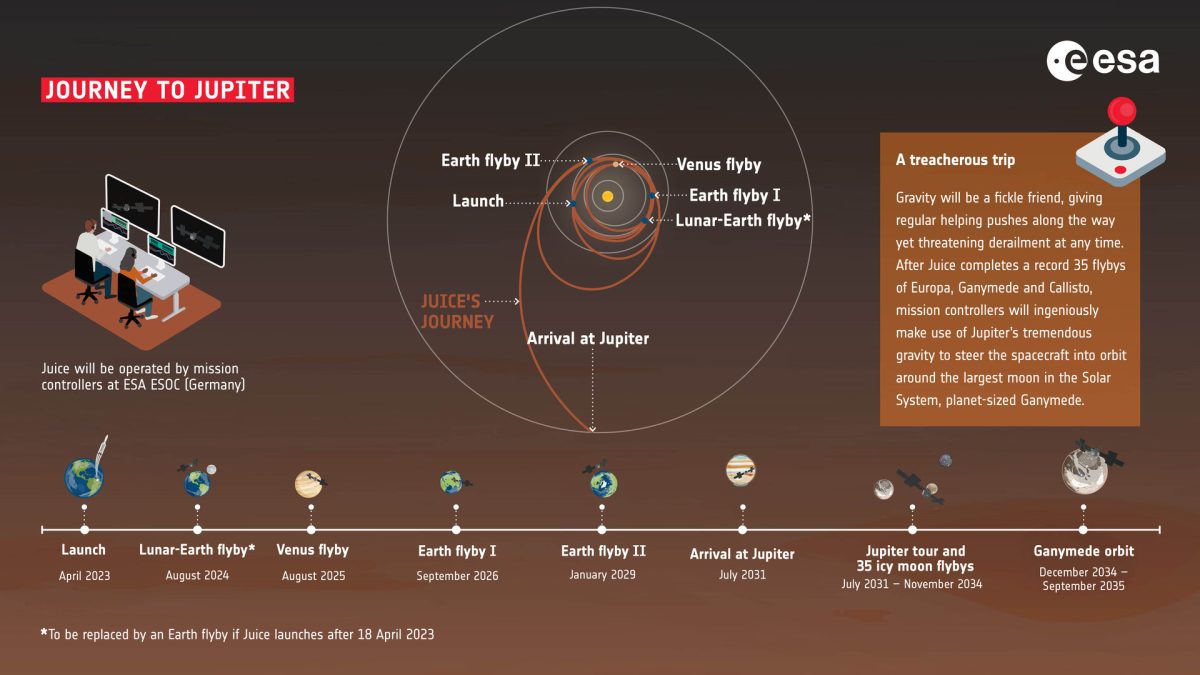
For Juice, ESA specialists chose a longer but more economical option. The world’s first Moon-Earth flyby in August 2024 slowed it down and sent it along a shorter route via Venus, where it gained some speed. Today’s close approach prepared it for the final one, scheduled for January 2029. When Juice reaches Jupiter in July 2031, enough fuel will remain in its tanks to enter orbit around the planet and then, in 2034, move on to Ganymede.
A Night on Batteries
The navigation campaign began on August 17. Six time windows were allocated for small trajectory corrections, but only one was needed, four weeks before the flyby. “It was relatively small, but extremely effective,” Juice spacecraft operations manager Angela Dietz explained about the correction.
The nighttime phase proved more challenging. From 10:24 p.m. on September 27 until 7:03 a.m. on September 28, Kyiv time, the probe was in Earth’s shadow and operated only on battery power. To avoid fully draining them, specialists prioritized the most important observations.
A little later, at 9 a.m., reserve time was set aside for emergency intervention. It would have been needed only in the event of critical calculation errors or a threat of collision with other satellites.
Science Along the Way
From September 23 to October 3, all ten onboard scientific instruments are switched on. The teams are calibrating them on real surfaces and preparing the analysis tools for work near the gas giant. According to project scientist Claire Vallat, this flyby is simpler than the double maneuver of 2024, so the probe can be turned in different directions for observations.
Animation of the Juice probe’s flyby past Earth on September 28, 2026, with an overall view of the Earth-Moon system. Source: ESA
The spacecraft will spend several days in Earth’s magnetotail. This part of the magnetosphere stretches away from the Sun and is shaped by charged particles coming from our star. The measurements obtained can later be compared with the results of the European-Chinese Smile mission.
Meanwhile, the navigation camera is aimed at the edge of the Moon. This is being used to test a new optical navigation method for flights between Jupiter’s moons. Two additional monitoring cameras are recording the entire close approach through September 29.
