

Jupiter’s small moon Kallichore remained largely inaccessible to ground-based observations for an extended period. Its dimensions and morphology were determined at the precise moment it obscured the light of a distant star. The surface was found to be exceptionally dark. Thanks to improved coordinate accuracy, a flyby of the moon became a feasible mission for a European probe.
Dark surface and elongated shape
The moon Kallichore orbits Jupiter along a highly non-circular trajectory, which is the basis for its classification as an irregular moon. Its diameter, when considering the area, is approximately 3.8 km, and the minimum ratio of its semi-major to semi-minor axes is 1.53. Its form is distinctly elongated rather than spherical.
We have also established the reflectivity of the surface concerning incident sunlight, with the geometric albedo measured at approximately 3.7%. The only other celestial surfaces within the Solar System exhibiting comparable darkness are comet nuclei and primitive asteroids.
The Moon’s surface reflects three times the amount of sunlight. Kallichore reflects approximately the same as fresh asphalt.
Observation of a star’s occultation
Even the most powerful instruments are unable to directly observe such a body due to its diminutive size and proximity to Jupiter’s luminous disk. Consequently, the researchers capitalized on a rare coincidence when the moon transited directly in front of a distant star.
Initially, images were captured utilizing the Hubble Space Telescope, which offered the approximate celestial coordinates. Based on these images, scientists determined the specific locations and times at which the eclipse would be observable from Earth. Consequently, on December 15, 2025, observers in Europe and the United States observed the event.
The decrease in luminosity was documented at the Aosta Valley Observatory in northern Italy, where three positive chords were recorded. These measurements served as the foundation for a direct assessment of the object’s dimensions. Additionally, a further series of astrometric and photometric observations was carried out utilizing the 10.4-meter Gran Telescopio Canarias.
Refined orbit
The primary practical outcome pertains not to the size, but rather to the position of the object in the sky. According to Universe Today, the uncertainty in the coordinates was diminished by approximately 80 percent. Without this level of precision, plotting a trajectory for the approach would have been unfeasible.
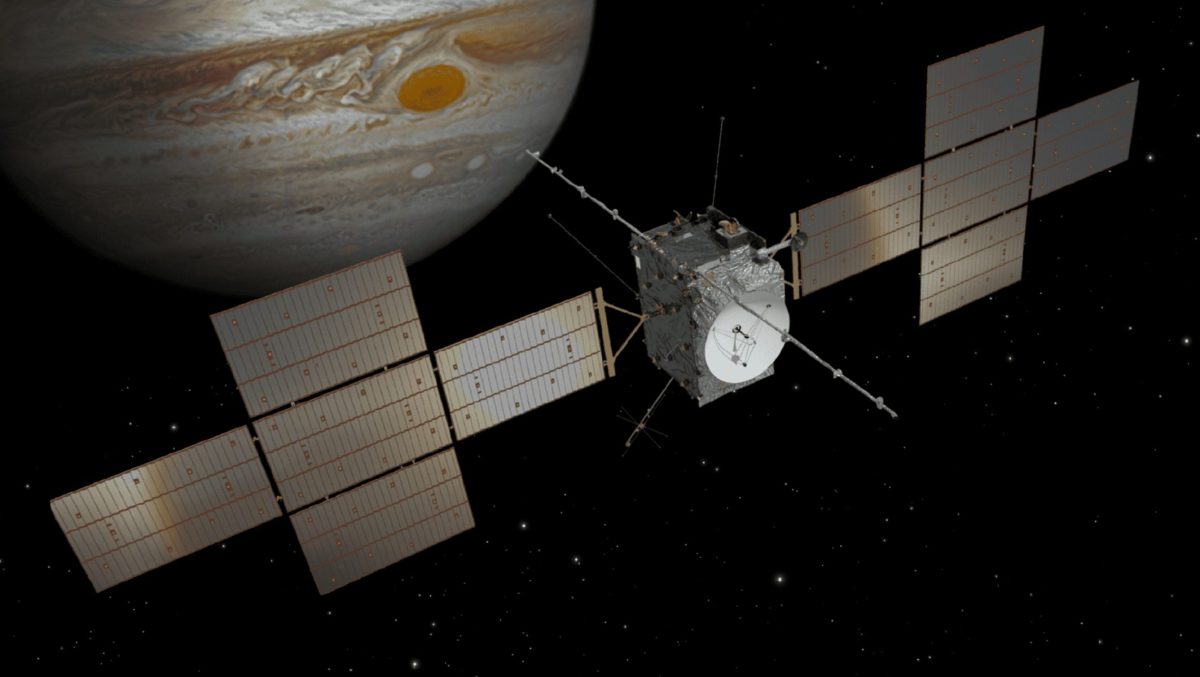
Among the irregular celestial bodies in the vicinity of Jupiter, only Kallichore is sufficiently proximate to the projected trajectory of the JUICE spacecraft. This European endeavor, aimed at the exploration of the gas giant’s icy moons, is scheduled to reach the planetary system in 2031.
The primary objective is dedicated to Ganymede, Europa, and Callisto; furthermore, a flyby of a small, dark body would constitute an additional scientific accomplishment. Currently, it remains a feasible — albeit unconfirmed — component of the plan.
Fragments of ancient matter
Irregular moons were not formed concurrently with Jupiter; rather, they were captured by its gravitational field subsequent to the planet’s formation. Consequently, their composition preserves features from the initial periods of the Solar System’s history, whereas Io and Europa have undergone significant transformations since their inception.
The results were published in the peer-reviewed journal Nature Astronomy, with the author team headed by Juan Luis Rizos of the Andalusian Institute of Astrophysics. No evidence of another, smaller body in proximity to Kallichore was identified.
