

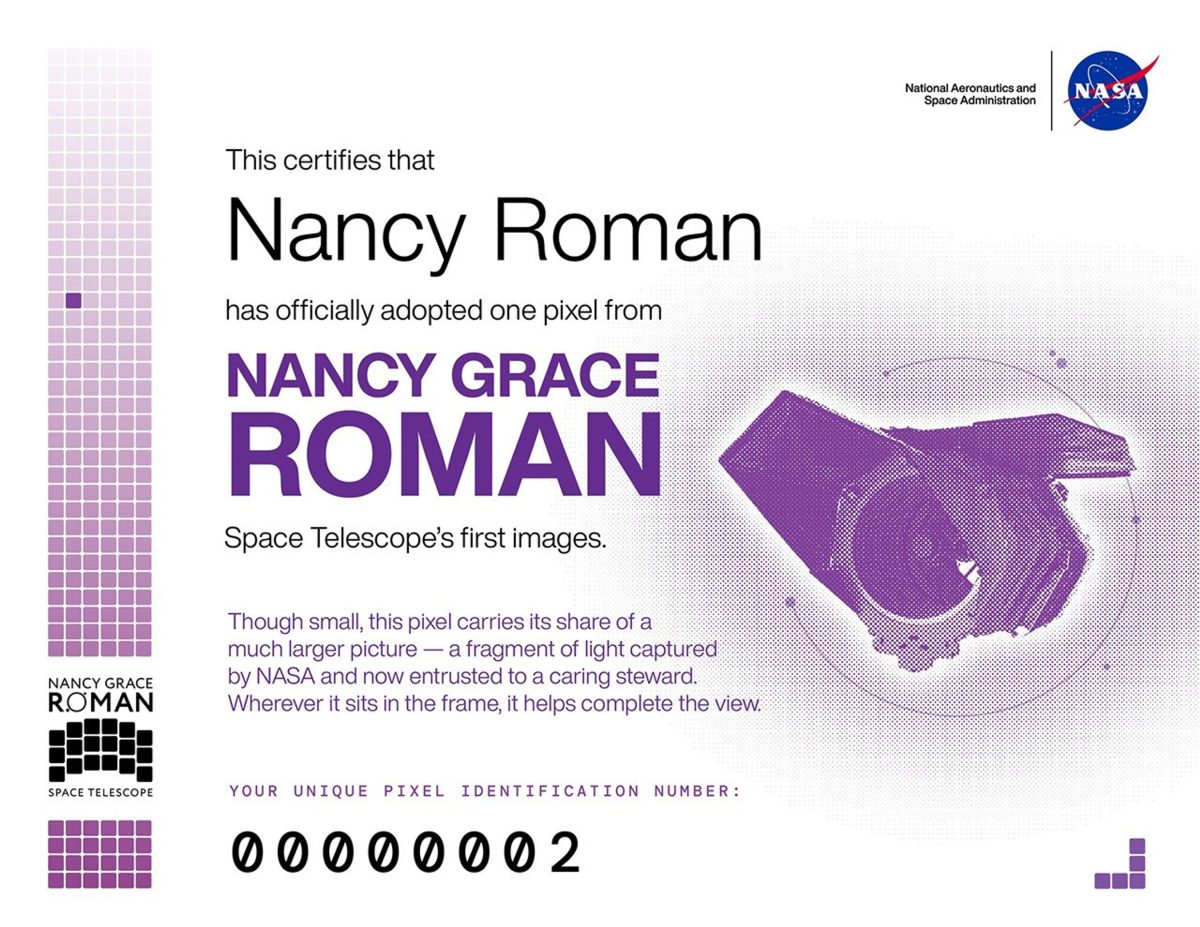
Individuals interested in participating may claim a single pixel in one of the initial images captured by the Nancy Grace Roman Space Telescope. To do so, simply provide your email address on the campaign webpage. The system will promptly generate a certificate indicating the pixel number, which can then be downloaded. The images themselves will not be accessible until at least the following year.
What are the benefits of registration?
On the “Adopt a Pixel” campaign webpage, users are required to provide their email address. Subsequently, the system allocates a designated point within the future image to that email address. No donations or registration forms are necessary.
An address grants access to only one pixel. In cases where multiple family members share a single mailbox, they will need to collaboratively share one pixel.
The deadline for submitting applications is not specified in the campaign description. An email address is required not only for registration but also so that you can receive your pixel later.
When will the photograph be accessible?
The Nancy Grace Roman Observatory was launched from Florida on August 30, 2026, aboard a Falcon Heavy rocket. The journey to the Lagrange point L2, one and a half million kilometers from Earth, is expected to take approximately three months.
Subsequently, the instruments will undergo testing and calibration, a process anticipated to require approximately the same duration. The initial scientific data is projected to be available in 2027; thus, a minimum interval of six months will elapse between the commencement of data collection and the release of the first images.
The scale of a single frame
The images are acquired utilizing the observatory’s primary instrument, a wide-angle device. Each frame encompasses an expanse of the sky approximately 100 times greater than that depicted in the most extensive Hubble images.
The focal plane of this device comprises eighteen detectors and encompasses over three hundred million pixels — approximately ten times the population of Ukraine (estimated at about 29 million within government-controlled territories in 2026, as per the Mykhailo Ptukha Institute of Demography and Quality of Life Research of the National Academy of Sciences of Ukraine). Even if each resident were to be issued a certificate, more than ninety percent of the frame would remain unprocessed.
Why give away pixels?
This is not the initial instance of the American agency conducting a campaign of this nature. The names of individuals who registered have previously traveled into space via microchips embedded in the Perseverance rover, the Europa Clipper spacecraft, and the Artemis I mission. However, in those instances, the names were engraved on a plaque rather than incorporated into the scientific data.
This time, the approach is different, because the site is linked to an actual image of the sky. For a broad audience, this is a way to at least somewhat relate to a device that will operate beyond the reach of even repair expeditions.
