

The idea is to place a radio telescope on the far side of the Moon, which is naturally shielded by the Moon itself from the enormous amount of radio interference coming from Earth. This is especially important for low-frequency radio astronomy because Earth’s ionosphere partially absorbs or reflects low-frequency radio emission. The problem is that this “radio-quiet haven” may soon cease to be quiet. By 2030, planned activity involving orbiters and landing missions could create permanent sources of radio-frequency interference even on the far side of the Moon. This is precisely why there is a proposal to implement the LFT3 mission as quickly and cheaply as possible.
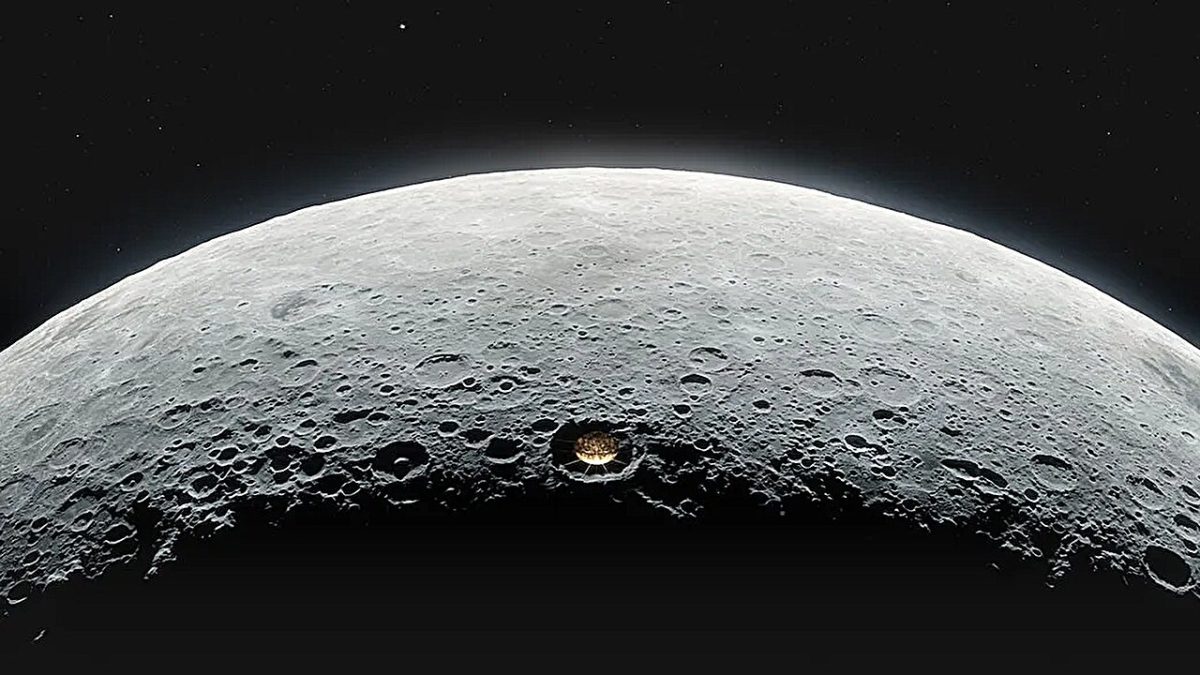
The Far Side of the Moon
For many years, scientists have been looking for a place in space where a large radio telescope could be installed. The far side of the Moon is best suited for this purpose, but so far these plans have not progressed beyond the idea stage. However, as phys.org reports, a new proposal has now emerged.
It concerns a study published on the arXiv preprint server by researchers from the University of Oxford. They suggest that these plans may become irrelevant after 2030. The reason is that orbital infrastructure around the Moon may develop so rapidly that lunar orbits could soon become crowded with spacecraft transmitting data and creating interference for astronomical observations.
On Earth, this has long been a problem and may soon make scientific work by astronomers impossible in many fields, including the search for signals from extraterrestrial civilizations. But it may turn out that astronomers simply have nowhere to “escape.”
The LFT3 Mission
The authors of the study consider the Lunar Farside Transients and Technology Telescope (LFT3) mission a way to at least partially solve this problem. It differs from how the construction of a lunar radio telescope has been envisioned over the past several decades. In those plans, it was supposed to be built as a fairly expensive permanent structure alongside a lunar base.
However, everyone understands that the cost of implementing such a concept could be so high that it may never be realized — or at least not before the radio environment on the far side of the Moon becomes as polluted by radio noise as it is on Earth. This is why scientists propose implementing the LFT3 mission as soon as possible. It would be a spacecraft with a huge antenna that would land on the Moon and begin studying space.
Its primary targets would be signals from extraterrestrial civilizations, but it could also search for auroras on exoplanets and fast radio bursts. At the same time, it would still have to survive the sharp temperature fluctuations on the lunar surface. Nevertheless, it would be a mission costing only about $150 million, which could be delivered to the Moon as part of an ordinary commercial cargo-delivery program.
Far more importantly, LFT3 could become a hostage to the very condition for which it is being proposed, because where there is no terrestrial radio noise, there is also no direct radio communication with Earth. LFT3 would not have a direct line of sight to Earth, so transmitting data would require a relay satellite in lunar orbit. According to the concept authors, current lunar infrastructure limits transmission to approximately 100 GB of data per month. That is insufficient for full-scale, high-resolution observations.
The project authors see the solution in processing part of the data directly aboard the spacecraft itself. This would require significant onboard computing power, but the developers say they can handle it. However, despite all these assurances, funding for the mission has still not been allocated.
