

In the works of ancient astronomers, Theta Eridani is described much brighter than we see it today. Today, however, it is visible to the naked eye but is no longer especially prominent. Now scientists believe they have found an explanation for this mystery.
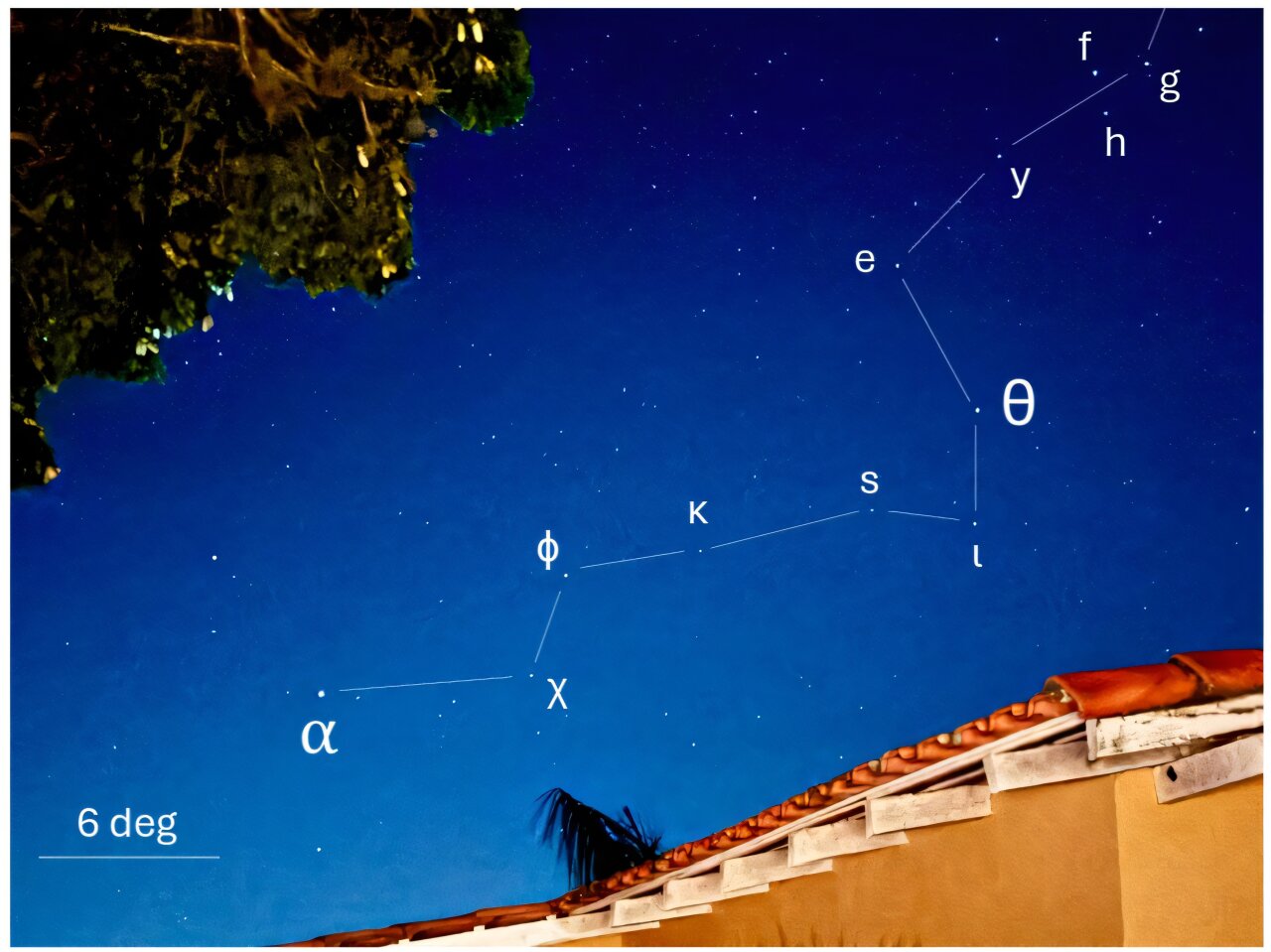
Theta Eridani
Astronomers have been observing the night sky for thousands of years, and ancient records sometimes become valuable material for modern research. This is precisely the case described by phys.org. It concerns a recently published arXiv paper devoted to Theta Eridani.
Eridanus is a large southern constellation, much of which remains low above the horizon even for Northern Hemisphere observers. Ancient astronomers described it as much brighter than it is today.
We are talking about Theta Eridanus, which is now only the third brightest star in the constellation itself. Today, its most prominent stars are Achernar and Akamar. So Hipparchus in 129 BC described it as the brightest in the River, meaning that Eridanus is the river from ancient myths.
Ptolemy agreed with him in 132 CE, as did the Arab astronomer al-Sufi in 964 CE. Approximately two thousand years ago, Theta Eridanus had an apparent magnitude of about +0.2. Yet in the works of European astronomers from the seventeenth century, its brightness was already estimated at magnitude +3 stellar magnitude, approximately the same value observed by astronomers today.
A Mysterious Star System
At first glance, the difference between magnitudes +0.2 and +3 seems insignificant. In fact, the brightness scale in astronomy is logarithmic, so this corresponds to a dimming of about 12 times. This is extremely difficult to explain, especially because both its earlier and present states appear to have persisted for centuries.
The difference therefore cannot be explained by temporary flares. What, then, caused it? According to astronomers, the answer lies in the nature of Theta Eridani itself. It is actually a system consisting of three stars: a close binary pair and a third star located much farther away, orbiting the common center of mass of the first two.
The a close pair of two stars attracted the researchers’ attention. They are massive stars with masses of 2.2 and 2.3 times that of the Sun. The distance between them is only 0.083 astronomical units, less than the distance between Mercury and the Sun. Both stars are at a late stage of evolution and have nearly filled their Roche lobes, the regions of space they can occupy before matter begins to flow from one star to the other.
At present, the more massive star has just completed hydrogen burning in its core. The researchers suggest that several centuries ago, when hydrogen was still its main source of energy, the star’s envelope reached the boundary of its Roche lobe. As a result, matter may have flowed onto the companion star, causing a sharp increase in the luminosity of the system. Later, the rate of energy production decreased, the envelope contracted, and the transfer of matter ceased.
According to phys.org
