

Why does Venus lack any moons? This inquiry has perplexed scientists for decades. Was it never capable of forming a moon, or did it initially have one that has since vanished? Recent research may contribute to elucidating this enigma.
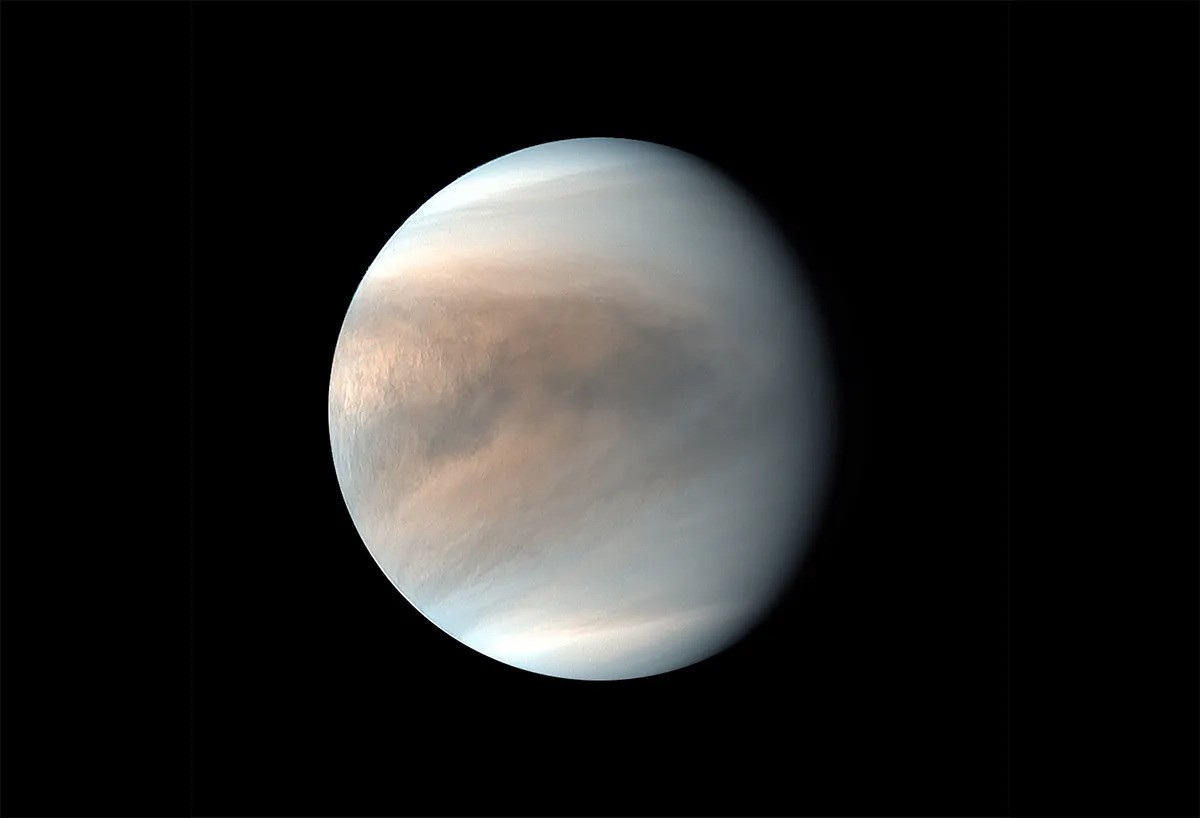
Earth’s mysterious “twin”
Venus is one of the solar system’s most unusual planets. It may sometimes be called “Earth’s twin” because of its similar size and density, but it rotates on its axis in the opposite direction of most planets, has surface temperatures hot enough to melt lead and lacks a moon.
According to the website phys.org, a recent study by astronomers aims to address this question. The authors have not yet provided a definitive explanation; however, they are contemplating plausible scenarios regarding the existence of Venus’s moon and are inclined towards one of these hypotheses. Consequently, how can scientists investigate a moon that no longer exists?
Computer modeling of a hypothetical satellite
The team led by Stephen R. Kane fed a range of data, including Venus’s spin speed, a hypothetical moon’s mass, its orbital distance from the planet and internal tidal friction, into a computer model. Then they ran computer simulations spanning 4.5 billion years. They also tweaked core variables to see which scenarios allowed a moon to survive and which led to its destruction.
The scientists found that the moon’s fate depended heavily on factors such as its mass and how fast Venus was spinning. Under some conditions, a moon could have survived for 4.5 billion years, while under others it would have been destroyed.
In many scenarios where the moon was destroyed, it initially moved outward before changes in Venus’s spin caused its orbit to reverse and spiral inward toward the planet.
Doomed by Venus itself
And which possibility does the team think is most likely? They suggest that the moon was most likely destroyed after spiraling back toward Venus. Depending on the moon’s mass and the planet’s initial spin, this could have happened anywhere from 30 million years to 1.7 billion years after the moon formed.
As the researchers elucidate in their publication, Venus’s absence of a moon is attributable to its initial conditions, rather than a singular catastrophic event. In essence, an external collision was unnecessary to alter its trajectory. It is conceivable that its destiny was determined from the very outset.
This may elucidate the reasons why Earth and its purported “twin” evolved along different trajectories. The existence or lack thereof of a moon early in Venus’s history might have represented a pivotal divergence point in this evolutionary split.
