

Where does the boundary of the Solar System lie? Does it conclude immediately beyond Neptune’s orbit, or beyond the orbit of the most remote dwarf planet in the Kuiper Belt? Is it situated at the heliopause, or does it extend approximately halfway to the nearest star?
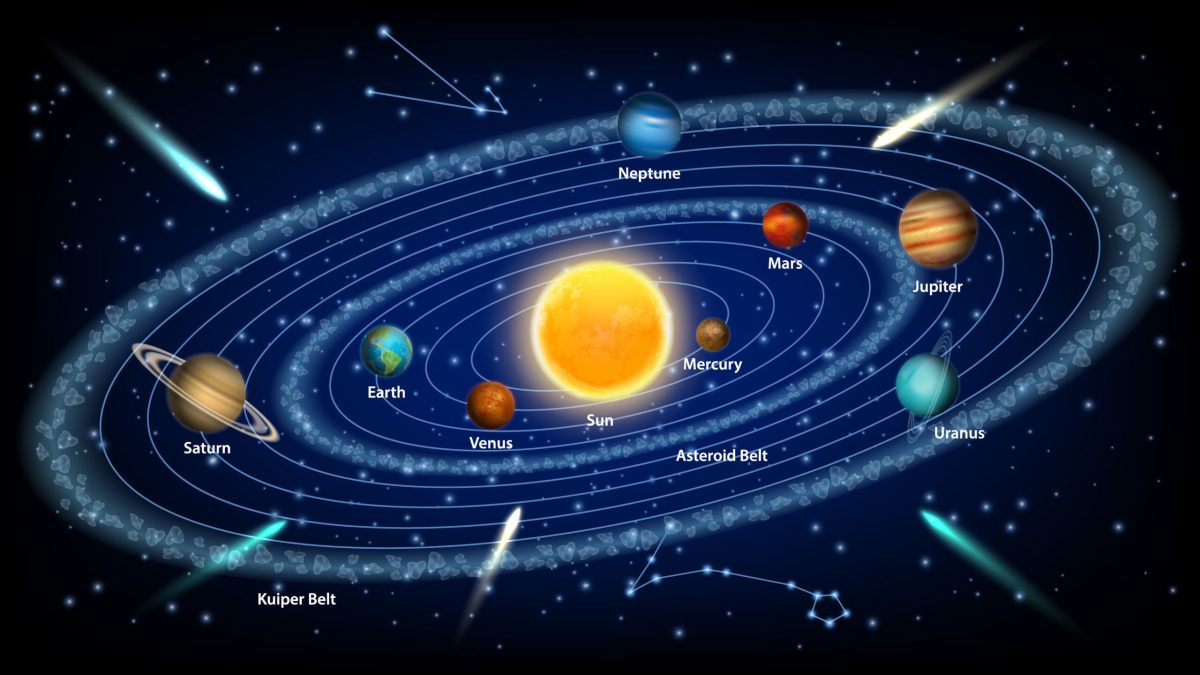
The eight giant planets
How do you envision the Solar System? It is likely depicted as the Sun accompanied by eight planets revolving around it. This is precisely the type of image that a search engine typically provides in response to this query. However, is this depiction entirely accurate? The accuracy of the representation depends on the desired level of precision and the definition employed for the term “Solar System.”
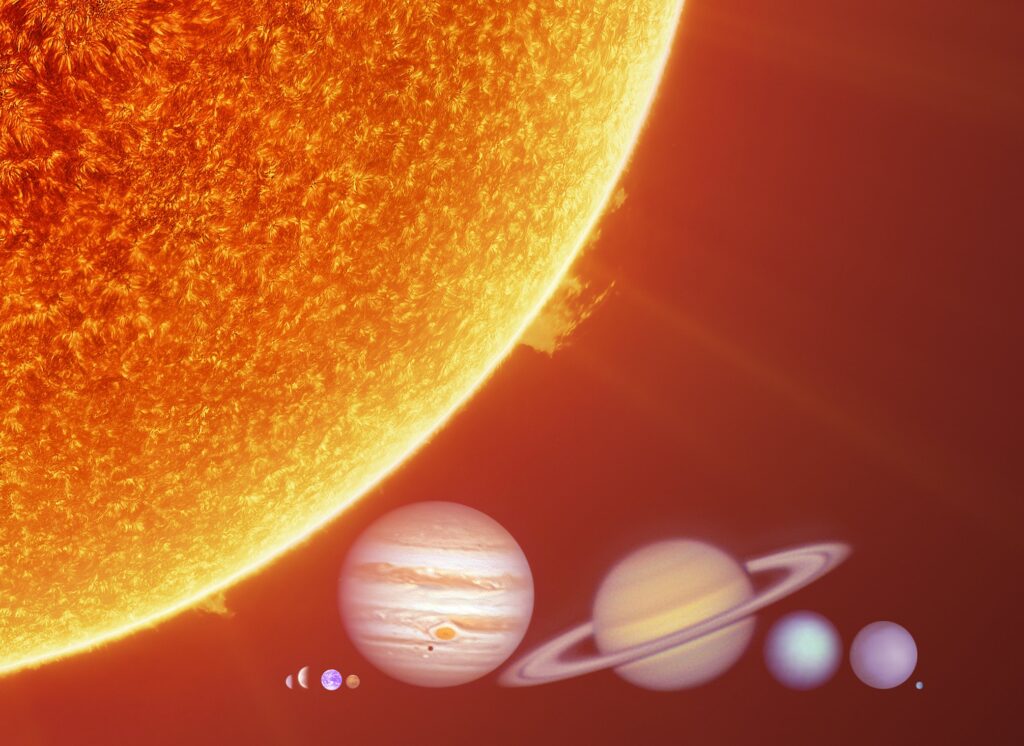
To be more precise, the Sun itself accounts for about 99.86% of the entire mass of the system, and the planets together account for about 0.14%. The rest is just a tiny fraction: asteroids, comets, dwarf planets, satellites, dust and other small bodies.
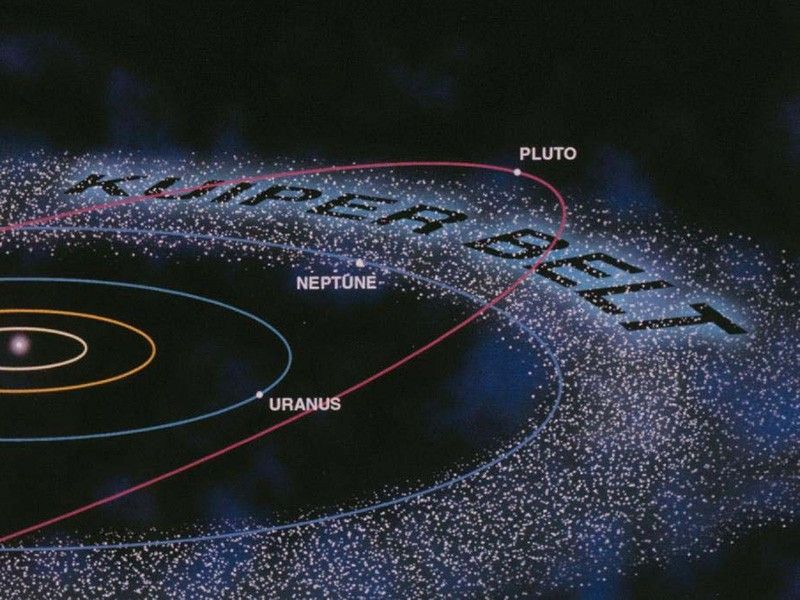
Therefore, the statement that the outer boundary of the Solar System is located approximately 4.498 billion km from the Sun, i.e. at a distance of 30.07 astronomical units (AU), is not entirely without basis. This is where the orbit of Neptune, the most distant of the eight planets, passes. However, it is incorrect to call it the outer boundary of the entire Solar System: beyond the orbit of Neptune are the Kuiper belt, the scattered disk, and, much further, the Oort cloud.
Kuiper belt
However, if we respond in that manner, then Pluto is located outside the Solar System, although it, as well as Eris, Makemake, and the other trans-Neptunian dwarf planets, also orbit the Sun. In fact, their combined mass, along with other objects in the trans-Neptunian population, is estimated to be about ten times that of all the objects in the Main Asteroid Belt. However, compared to the mass of the eight major planets, this is still a tiny fraction.
Nevertheless, this presents a challenging inquiry: where, then, ought the outer boundary of the Solar System to be defined? The reality is that numerous objects within the Kuiper Belt possess nearly circular orbits, thereby residing not far beyond Neptune’s orbit. However, there are also much more elongated orbits. For example, the perihelion of Sedna — the closest point to the Sun in its orbit — is about 76 AU, in Leleakuhonua — about 65 AU, and in 2012 VP113 — about 80 AU. At the same time, at the farthest point of their orbits, these bodies are separated by hundreds and even more than a thousand astronomical units. And all of them are gravitationally bound objects with the Sun, that is, they undoubtedly belong to the Solar System.
Nevertheless, a significant challenge exists in establishing the boundaries of the Solar System based on their aphelia. On one hand, it appears that extensive regions of near-vacant space have been encompassed within the Solar System solely due to the presence of a few relatively minor celestial bodies orbiting in those regions.
Conversely, it remains conceivable that the most remote objects within the Kuiper Belt have yet to be observed. Some of them may be in very distant, elongated orbits, hundreds of astronomical units away from the Sun. If such objects have not yet been discovered, their appearance may require a revision of our ideas about the spatial scale of the Solar System.
Oort Cloud
However, even the Kuiper Belt is not truly the most remote region of our Solar System from the Sun. Even further out, according to modern ideas, is the Oort cloud, a hypothetical spherical shell of icy bodies that may surround the Solar System on all sides. It is believed that it is from there that a significant portion of the long-period comets that occasionally leave the outskirts of the Solar System and head towards its inner regions originate.
However, it is important to note that Oort cloud has not yet been observed directly. We do not have a single direct image of its objects. Its existence is inferred from the characteristics of the orbits of long-period comets and models of the formation and evolution of the Solar System. If such a population of bodies really exists, it must be extremely sparse – the average concentration of matter there is probably even lower than in the Kuiper belt.
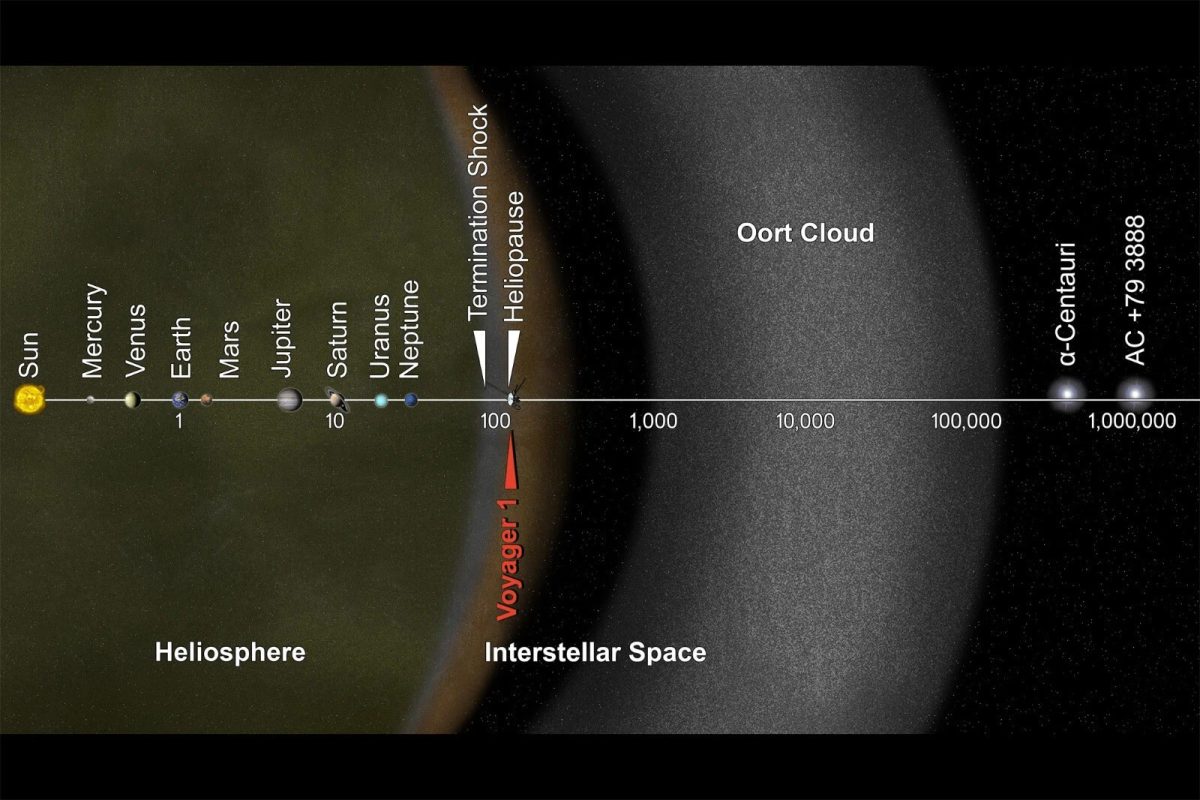
The outer diameter of the Oort Cloud continues to be a subject of debate.Some say 50,000 AU, some say 100,000 AU, and sometimes even a light year, and all this really just confuses people more. So it’s too early to talk about the exact size of the Oort cloud.
Indeed, in models that take into account the existence of this structure, it really appears as a giant cloud of bodies. However, even with the highest estimates of their number, this is an extremely sparse population: huge volumes of space remain practically empty, and individual bodies are separated by colossal distances. Moreover, in terms of size, they are mostly insignificant compared to the Earth.
Heliosphere
Nonetheless, besides estimating the mass of the celestial bodies orbiting the Sun, there exists an entirely alternative approach. Our Sun functions as a source of high-energy particles that emanate outward in all directions. These particles are referred to as the solar wind.
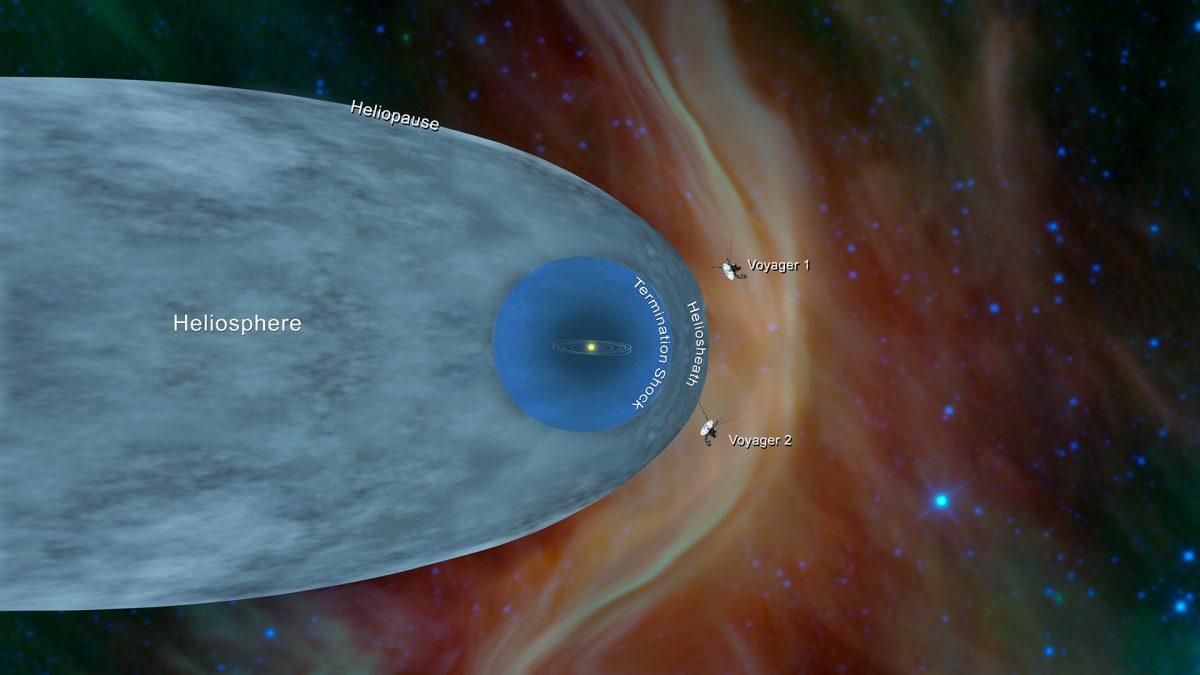
Consequently, a stream of charged particles comes to us from interstellar space. Its pressure is much weaker than the pressure of the solar wind near the Sun, but as it moves away from our star, the solar wind weakens. Eventually, it collides with the interstellar medium, forming a huge region dominated by the Sun, the heliosphere.
The boundary of the heliosphere is called the heliopause. It is not a perfect sphere: due to the movement of the Solar System through the interstellar medium and the interaction of particle flows, its shape is asymmetrical – it is compressed in the direction of the Sun’s movement, and a long tail forms behind it.
Voyager 1 crossed the termination shock in 2004 at a distance of about 94 AU from the Sun, and Voyager 2 in 2007 at a distance of about 84 AU. However, this was not the heliopause. They reached the boundary of the heliosphere itself much later: Voyager 1 crossed the heliopause in 2012, and Voyager 2 in 2018, at distances of about 121.6 and 119 AU, respectively.
The heliopause separates the region where the solar wind dominates the interstellar medium from interstellar space itself. The distance to the heliopause is about 120 AU in the directions where Voyager measured it.