

Scientists suggest that Neptune’s small inner moons may be fragments of much larger worlds that once orbited the planet. They may have been destroyed when the ice giant captured Triton.
Small Icy Moons
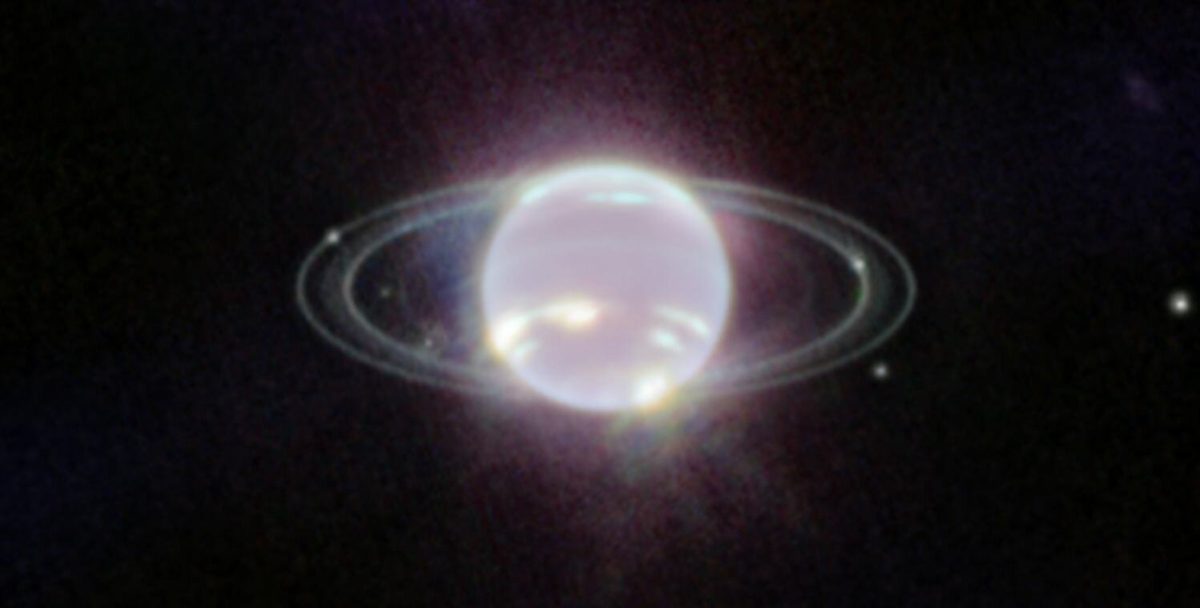
Neptune is the only gas giant in the Solar System that has just one very large moon and a group of small icy bodies instead of several medium-sized icy moons. According to a recent paper published in Science Advances by scientists working with the James Webb Space Telescope, this unusual arrangement may be the result of worlds being destroyed in the distant past, phys.org reports.
Scientists have long suspected that Neptune’s largest moon, Triton, which is approximately 4,000 kilometers in diameter, is a Kuiper Belt object that was captured by the planet. However, they previously could not explain why Neptune has no objects between 700 and 2,000 kilometers in diameter, even though moons of this size are common around the other giant planets.
Scientists now have a possible explanation for what happened. Triton itself may have been responsible. When it entered Neptune’s system, it caused genuine gravitational chaos. Smaller worlds began colliding with one another and breaking apart. Some of the material ejected into space during these collisions later came together and formed the small icy moons that exist today.
Material Evidence
This is an appealing theory, and calculations suggest that it is plausible. But is there any physical evidence supporting it? Scientists say there is. Using the James Webb Space Telescope, they conducted spectroscopic observations of three of Neptune’s inner moons: Larissa, Galatea, and Proteus.
The observations revealed mostly what scientists had expected to see: various forms of ice. However, they also detected one substance that greatly surprised them—phyllosilicates. These unusual minerals have not previously been observed anywhere in the outer Solar System except on Jupiter’s large moons. There is a reason for this: phyllosilicates are essentially clay, a sedimentary material.
Phyllosilicates can form only in the presence of large amounts of moving liquid water. Their presence on Jupiter’s moons is unsurprising because oceans almost certainly exist beneath their icy surfaces. Larissa, Galatea, and Proteus, however, are far too small to contain such environments. This supports the idea that they formed from material that once belonged to much larger worlds.
