

We have been in the “eclipse corridor” for nearly two weeks; however, on August 28, the Blood Moon will conclude this period. In essence, the Earth does not experience any specific effects during this interval. Nonetheless, attempting to understand the nature and causes of this phenomenon can facilitate the acquisition of valuable and intriguing knowledge.
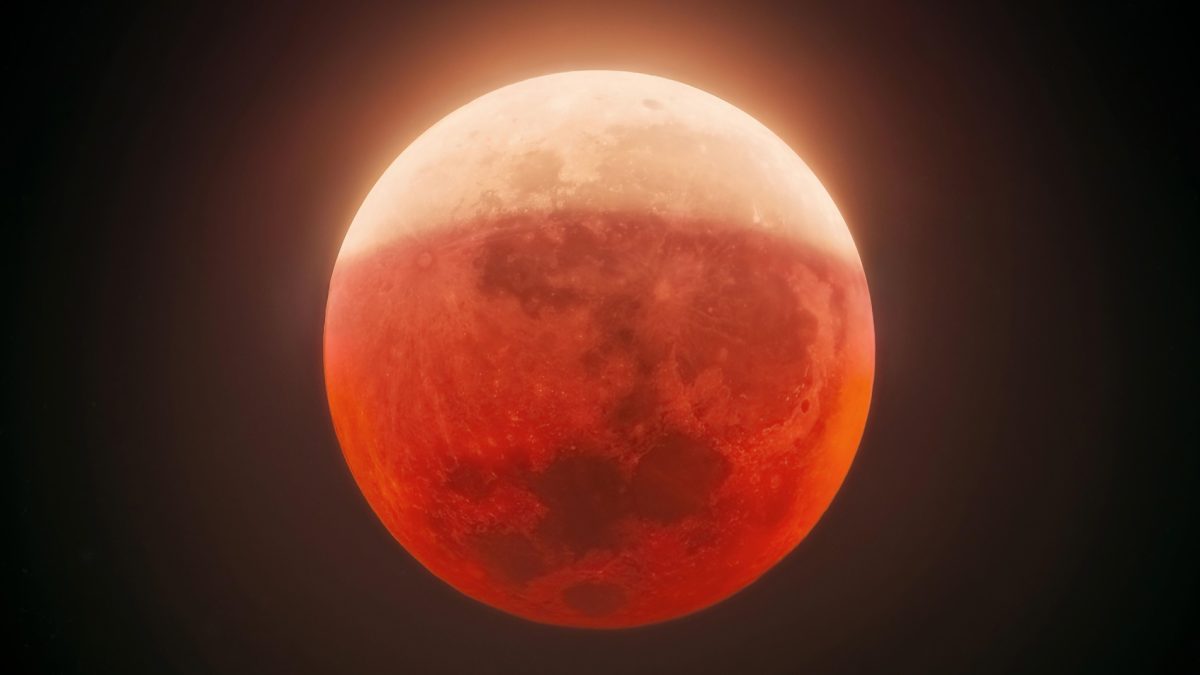
The August eclipse corridor
A lunar eclipse is scheduled to take place on August 28, 2026. Its peak phase is anticipated at 4:12 a.m. UTC. Given that this equates to 7:12 a.m. in Kyiv, it implies that if the event is visible in Ukraine at all, it will be observable solely in the far western regions shortly before dawn.
A lunar eclipse typically manifests as a darkening and reddening of the Moon’s surface. It may be partial, affecting only a segment of the lunar disk, or total, when the Earth’s shadow entirely covers the Moon for a duration. This particular eclipse will be nearly total, with a coverage of 96.7% during the total phase. For optimal viewing, it is advisable to be located outside Ukraine, preferably in Western Europe or, ideally, along the East Coast of the United States.
In Ukraine, however, only the initial phase of the eclipse will be observable; subsequently, the Sun will ascend, and the brightness will become too intense for such observations. The “eclipse corridor,” which astrologers historically employed to alarm the public throughout August, will ultimately conclude. However, this development will offer no solace, as in reality, it exerted no influence whatsoever on people’s lives.
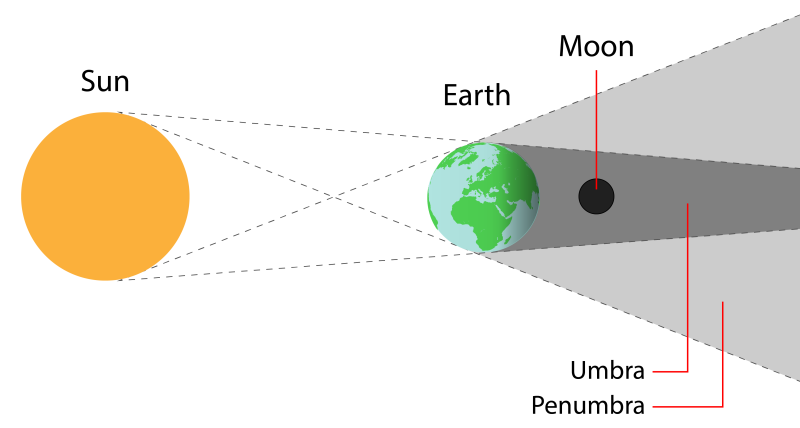
Solar and lunar eclipses
In general, astrologers refer to the “eclipse corridor” as the interval between a previously occurred eclipse and the subsequent upcoming eclipse. They regard this period as challenging and tense. However, astronomers do not employ this terminology, as eclipses typically occur in pairs or trios, and the positions of celestial bodies during these intervals are consistent with normal patterns.
To comprehend this entire subject, it is necessary to begin with fundamental facts. The Earth revolves around the Sun. Simultaneously, the planet also rotates on its own axis, resulting in the cycle of day and night. The fact that the axis of rotation remains fixed in position — rather than being perpendicular to the plane of the orbit — leads to the variation of seasons.
The Moon orbits the Earth, with its orbital period around the Earth and its rotational period on its own axis both measuring 27.32 days. Consequently, only one hemisphere of the Moon is visible from Earth at any given time; the variations in illumination degree and pattern are classified as lunar phases, including the new moon, first quarter, full moon, and last quarter.
However, unlike Earth’s orbit, the Moon’s orbit is somewhat elliptical. Its eccentricity measures 0.0549. A complete lunar phase cycle spans approximately 29.53 days. This duration is due to the fact that, within this same period, our planet completes nearly one-twelfth of its orbit around the Sun.
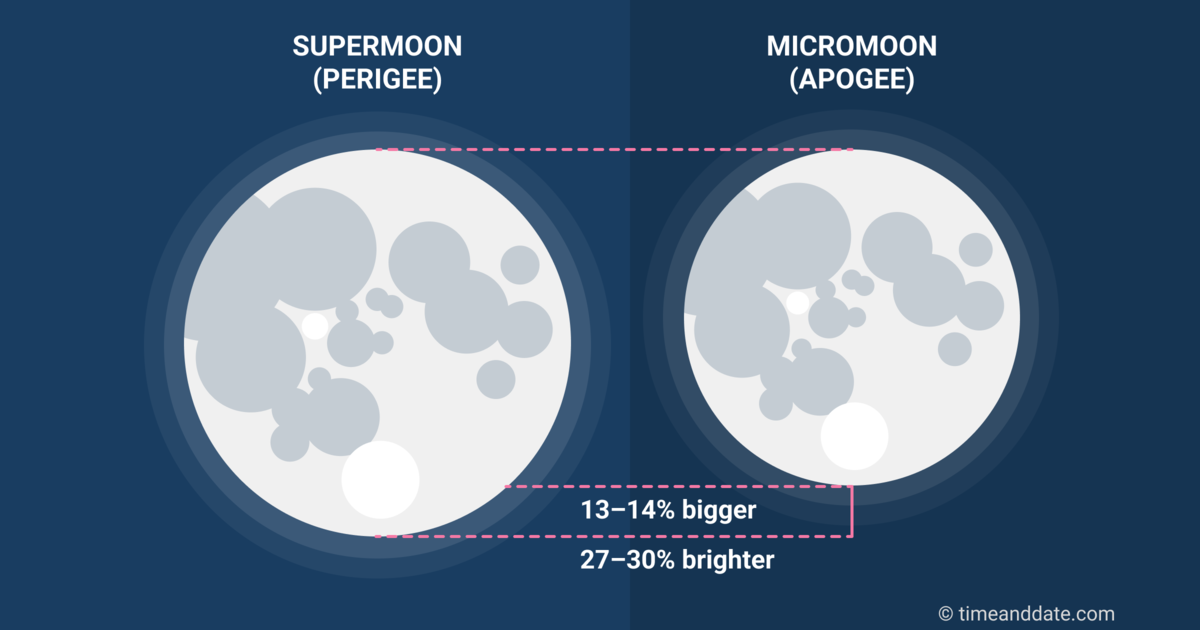
Consequently, the full moon continually varies in position relative to the most distant (apogee) and nearest (perigee) points of our moon’s orbit. When it appears near the former, it is referred to as a micro-moon; when it appears near the latter, it is termed a supermoon.
If the Moon’s orbit were aligned with that of the Earth, we would observe a solar and lunar eclipse at every new moon, effectively residing within an unending “corridor of eclipses.’ Consequently, our focus would shift from the supermoon to the new moon at apogee, as a solar eclipse during this period would manifest as a luminous ring of fire.
Why do eclipses occur in pairs?
Irrespective of the perspective, the Moon’s orbit is inclined relative to the Earth’s by approximately 5°. Consequently, during both the new moon and full moon phases, the Moon typically appears higher than the line connecting the Earth and the Sun. This implies that during a new moon, the Moon’s shadow traverses past the Earth, whereas during a full moon, the Earth’s shadow does not cast upon the Moon.
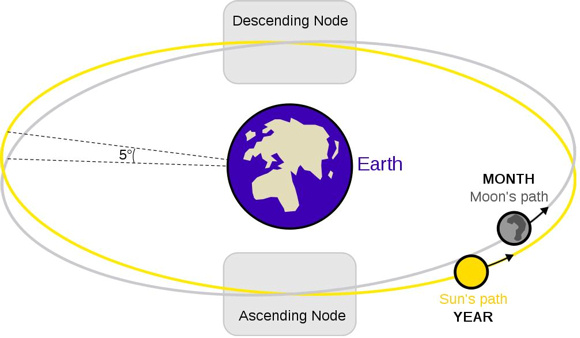
Nevertheless, there are two points at which the Moon’s orbit intersects the plane of Earth’s orbit, known as the nodes of the Moon’s orbit. In the simplest approximation, the orientation of the line connecting these nodes in space remains constant throughout the year. This implies that twice annually, its direction must align with the direction toward the Sun.
At this precise moment, conditions manifest for the Moon, Earth, and Sun to achieve a direct linear alignment. Specifically, over a span of approximately 35 days, each new moon coincides with a solar eclipse, while each full moon coincides with a lunar eclipse.
Given that a complete lunar cycle spans approximately 29.5 days, it is straightforward to determine that within the 35-day interval designated as the eclipse season, a maximum of three eclipses may occur. In essence, within a single eclipse season, the potential sequences of eclipses are either “solar—lunar—solar” or “lunar—solar—lunar.” However, this represents an idealized scenario which is seldom observed in practice.
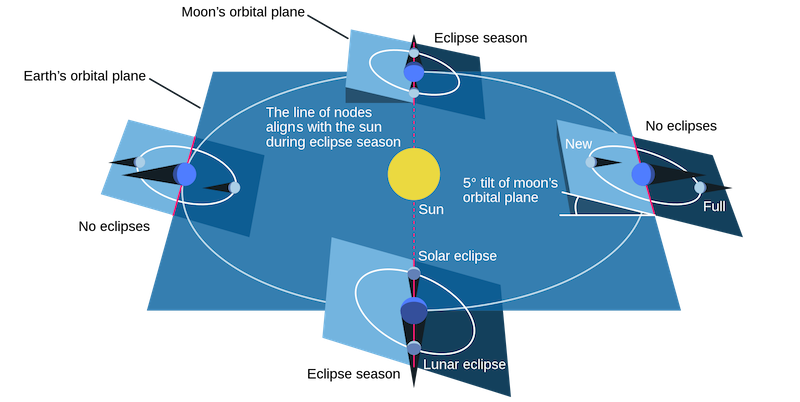
Typically, an eclipse season features only one new moon and one full moon. The sequence of events — whether a solar eclipse precedes a lunar eclipse approximately two weeks later or vice versa — depends on their relative positions to the lunar nodes. In any event, the term “eclipse corridor” used by astrologers designates the duration during which two successive eclipses may take place.
Should we be exceptionally fortunate to experience as many as three eclipses within a single season, it implies that the central eclipse is likely to be total or nearly total, whereas the initial and final eclipses are most probably partial.
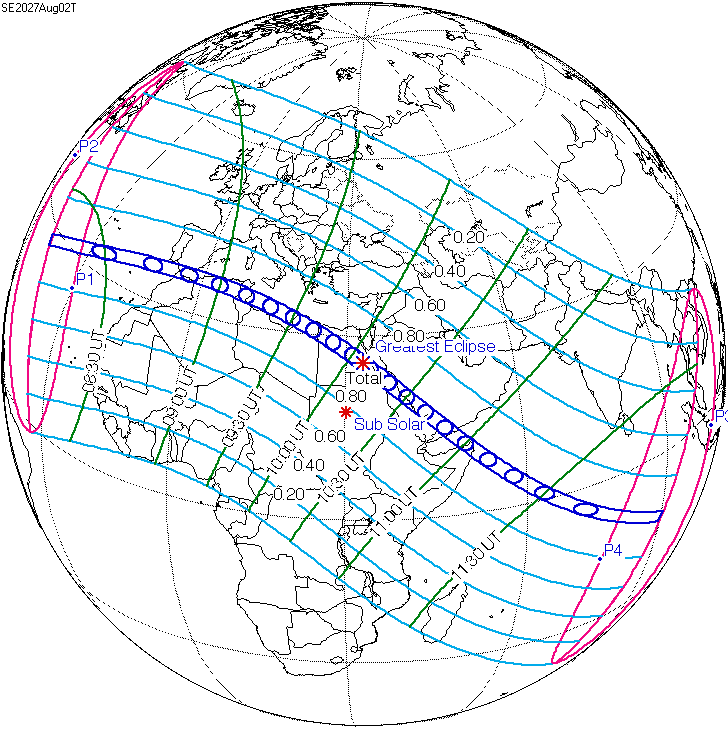
The next time this happens will be in just under a year: partial lunar eclipses will occur on June 18 and August 17, 2027, and right in between them, on August 2, there will be a total solar eclipse.
It is important to observe, however, that unlike a total lunar eclipse — which can be observed anywhere there is darkness at that time — a total solar eclipse is visible solely within a narrow band; in all other regions, it will only be partial. In August 2027, inhabitants of southern Spain, the Mediterranean coast of Africa, western Saudi Arabia, and Yemen are anticipated to experience this extraordinary event.
What is the maximum number of eclipses that can be observed within a calendar year?
However, this is not the entirety of the matter. Should the pattern outlined above be accurate, eclipse seasons would manifest precisely twice annually, approximately at the same periods, with a cycle lasting approximately 182–183 days. Within a single calendar year, the occurrence of no more than five eclipses could be observed.
However, the interval between the commencements of the two eclipse seasons is approximately 173 days. This phenomenon occurs because the Moon’s orbit experiences two types of precession concurrently. Precession is characterized as a slow alteration in the orientation of the axis of rotation, during which it delineates a conical path. The most prominent example is the precession of the Earth’s axis, attributable to the Earth’s rotation about its own axis. Nonetheless, the primary axis of the Moon’s elliptical orbit and the orbital plane can also undergo precession.
On the one hand, the Moon demonstrates precession of the line of apsides (the line connecting the perigee and the apogee), which is aligned with its rotational direction. Its complete period spans 8.85 years. This phenomenon can be conceptualized as a rotation in the direction of the Moon’s orbit when it is most distant from Earth.
Conversely, there exists a precession of the line of nodes, which refers to the shifting of the points where our satellite’s orbit intersects the plane of Earth’s orbit. This precession occurs in the direction opposite to the Moon’s rotation, with a full cycle being completed in 18.8 years.
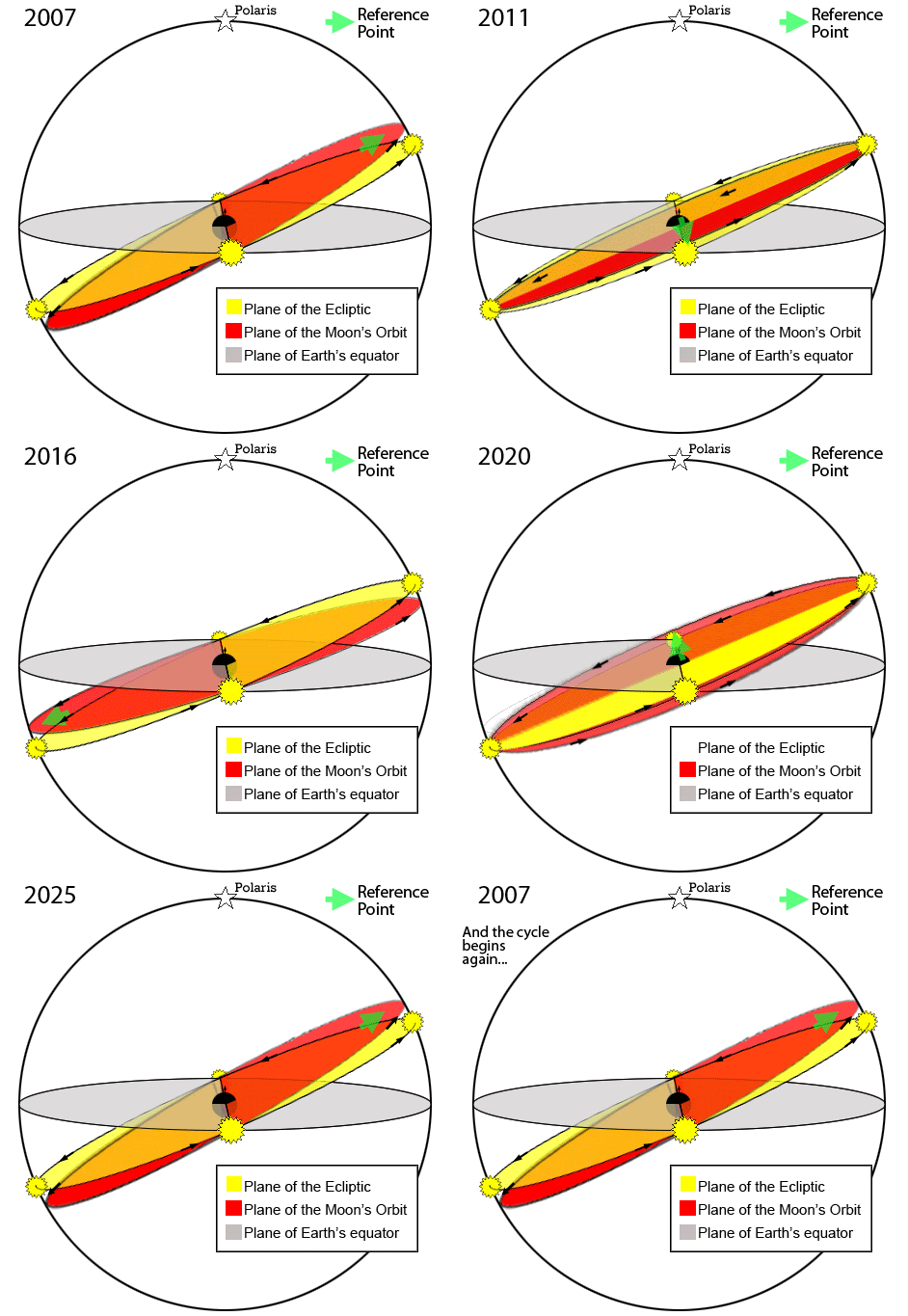
Superimposing these two cycles onto the Earth’s rotation period yields the same interval of 173 days between the two starts of the eclipse season. Therefore, theoretically, there could be even more than two such seasons in a year. If the first eclipse season begins at the very start of January, then after the second one — which will occur in early summer — there will still be enough time for a third to take place. Although this third season won’t end by the end of December, it is entirely possible that two eclipses could occur during it.
Therefore, the maximum number of eclipses that can occur in a single calendar year is seven. The minimum is four — fewer than this is not possible — and consequently, 2026 is identified as the year with the fewest of these astronomical phenomena. A year featuring seven eclipses is exceedingly uncommon. The most recent instance was in 1982, and the subsequent occurrence will not be until 2038.
Do we observe every eclipse?
Why do we perceive eclipses as such a dramatic event when they occur multiple times annually? Primarily, this is due to the nature of human memory: within the nearly six months that pass since the previous pair of eclipses, our recollections of these events have substantially diminished.
Furthermore, an individual who remains exclusively within their local region is unable to observe all the eclipses occurring throughout the year. Lunar eclipses are visible only in locations where it is nighttime at the time of the eclipse, despite the possibility that they may occur when it is already dark elsewhere on the planet.
The same applies to solar eclipses; however, the restrictions are even more stringent due to the shadow’s movement along a relatively narrow path. Consequently, it is entirely feasible that out of four to five eclipses, only one or two may be observable within a specific region. There are also possibilities that no solar or lunar eclipses will be visible throughout an entire year, thereby enhancing the event’s distinctiveness.
In reality, every adult has experienced a solar eclipse on multiple occasions, and consequently, they have also encountered the “corridor of eclipses.” Therefore, there is no reason to fear any of these phenomena.