

Following Starlink disruptions on the front lines, journalists asked the European Commission about a European alternative. In response, officials described negotiations to connect Ukraine to a shared governmental satellite communications system. Commercial capacity could be added later. Brussels declined to comment on whether these systems would replace Starlink. No ready-made solution is currently available for Ukrainian forces.
Connectivity at Speed
The problem was reported by the Ukrainian side. Defense technology adviser Serhii “Flash” Beskrestnov said that overnight on October 13–14, SpaceX restricted the operation of Starlink terminals in motion. According to him, Ukraine’s Defense Forces received no warning, and the restrictions disrupted several combat missions.
According to Ukrainian military personnel, terminals lost connectivity at speeds above 160 kilometers per hour. The restrictions affected strike drones and interceptor drones, which need communications precisely while in flight. Ukraine’s Ministry of Defense added that some systems were also disconnecting at lower speeds and said it was investigating the causes.
Elon Musk offered a different account on X. He said that Starshield systems—SpaceX’s service for government customers based on Starlink technology—belong to the U.S. government, and that speed or usage restrictions are determined by the U.S. military and, ultimately, the U.S. president. The sources do not clarify whether the affected systems were specifically Starshield.
What the European Union Is Offering
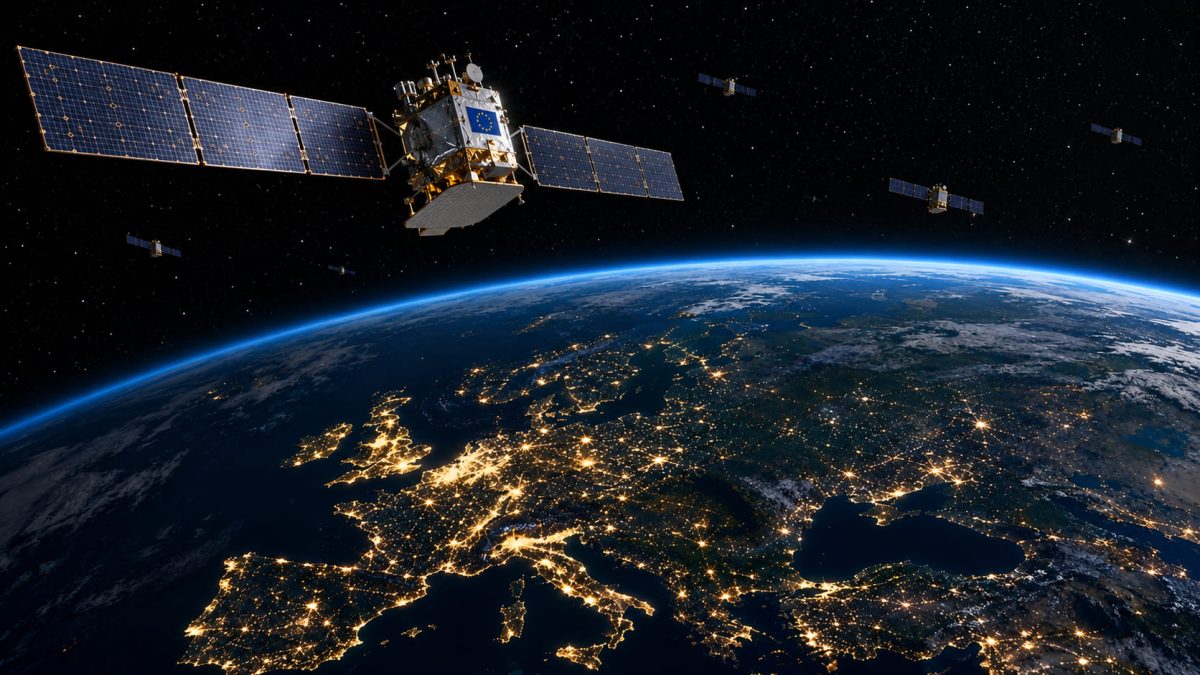
The question of an alternative to Starlink was raised at a European Commission briefing on October 14. Defense and space spokesperson Thomas Regnier pointed to Govsatcom. This system pools existing governmental satellite resources from EU countries. It began operating in January 2026. As of March, France, Greece, Italy, Luxembourg, and Spain were providing capacity, according to the European Union Agency for the Space Programme.
According to Thomas Regnier, the European Commission is seeking a way to fully integrate Ukraine into Govsatcom and is holding negotiations on the matter. This requires a separate international agreement because sensitive governmental services are involved, as noted on the European Commission’s website.
The spokesperson said basic communications needs could be met by satellite systems already owned by EU member states. Military services could potentially be provided through commercial satellite capacity, which the European Commission wants to add to Govsatcom in early 2027. Regnier described this as an interim solution until 2029, the year scheduled for the launch of Europe’s IRIS² constellation.
What Was Not Said at the Briefing
Asked directly about replacing Starlink, a European Commission spokesperson said the Commission was not comparing its efforts with the systems Ukraine already uses. She also declined to comment on the disruptions without complete information. The briefing provided no timeline for connecting Ukraine, no details about terminals, and no indication of which commercial capacity would be added to Govsatcom.
Discussions about a European alternative have been ongoing for years. Back in March 2025, Militarnyi, citing the Financial Times, reported that the EU was discussing a Starlink replacement for Ukraine’s Defense Forces with four satellite operators. They included Luxembourg’s SES, Spain’s Hisdesat, Viasat, and Eutelsat OneWeb. Regnier noted at the time that Ukraine was specifically interested in Govsatcom. Only Eutelsat OneWeb has a publicly confirmed outcome. According to Reuters, Germany was paying for Ukraine’s access to the network. In April 2025, fewer than a thousand Ukrainian terminals were connected to it.
Most of the national governmental satellites pooled through Govsatcom operate in geostationary orbit, approximately 36,000 kilometers from Earth. Starlink satellites fly at altitudes of a few hundred kilometers—many tens of times closer to Earth—and signals reach them much faster. Low orbit offers an advantage for rapid data exchange with moving vehicles.
The Scale of the Constellations
The number of satellites mainly determines network capacity: how many terminals in a given region can operate simultaneously. Coverage also depends on orbital altitude, because a higher satellite can see a larger portion of Earth. OneWeb satellites orbit higher than Starlink’s, allowing the network to cover the entire planet with fewer spacecraft. However, as RFI reports, it cannot quickly replace Starlink because the two systems’ terminals are incompatible.
According to azmth.space, using the CelesTrak catalog, there were 11,152 active Starlink satellites and 651 OneWeb satellites in orbit as of October 15. Under the European Commission’s plan, the European IRIS² constellation will consist of 348 spacecraft in low and medium Earth orbits, with the first launches scheduled for 2029. By satellite count, Starlink is approximately 32 times larger than the planned IRIS² constellation.
Meanwhile, China is deploying two systems of its own. The catalog already lists 220 satellites in the Guowang network operated by state-owned China SatNet and 257 spacecraft in the Qianfan, or “Thousand Sails,” system, although some newly launched satellites have not yet begun operating. In early October, according to China in Space, Guowang was tested at polar latitudes. Chinese officials said Arctic expedition vessels conducted a video call with an Antarctic station with a delay of less than one second.
Until IRIS² launches, the European Commission proposes relying on member states’ satellites and commercial capacity. The former are already operating within Govsatcom; the latter could be added to the system in early 2027.
