

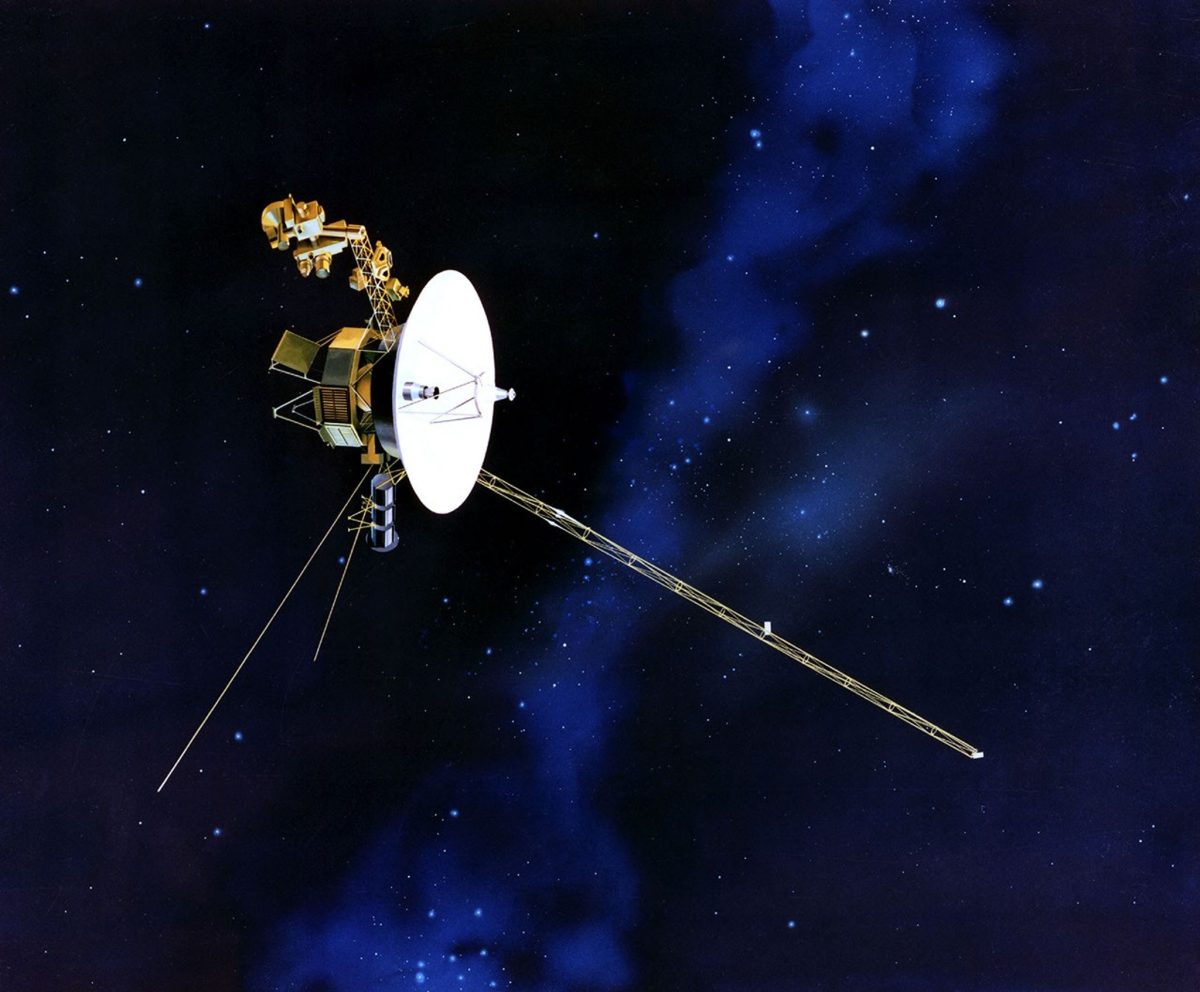
At the time of publication, the Voyager 2 space probe is about 21.35 billion km from Earth. Its “twin,” Voyager 1, is even farther away, at 25.4 billion km. Launched just a few weeks apart in 1977 for a groundbreaking exploration of the planets of the Solar System, these spacecraft have become the most distant operational human-made objects. They left the heliosphere long ago and are now exploring deep interstellar space, where ionized gas from giant stars that died millions of years ago predominates.

The probes were originally expected to operate for only five years. To keep them functioning for nearly half a century, engineers have had to demonstrate remarkable ingenuity. Both Voyager spacecraft are powered by radioisotope thermoelectric generators, which convert heat from the decay of plutonium into electricity. Over the years, these power sources have gradually weakened: the probes are estimated to lose about 4 watts of power each year.
Because of this, the mission team has been forced for years to gradually switch off various systems. By the end of 2026, Voyager 2 was expected to lose another scientific instrument. However, scientists were determined not to give up the valuable data the probe transmits from its unique location.
Operation Big Bang
To save Voyager 2’s instruments, engineers sent commands to switch several systems in a synchronized sequence. The idea was to shut down certain power-hungry devices and activate more energy-efficient alternatives. At the same time, maintaining the correct temperature balance was critically important. In the extreme cold of interstellar space, excessive cooling could cause the fuel lines to freeze. If that happened, the probe would lose the ability to point its antenna toward Earth, effectively ending the mission.
In May and June, specialists tested the algorithms. Since a signal takes almost 20 hours to reach Voyager 2 and nearly the same amount of time for a response to return, every step required exceptional caution and precise calculations.
On July 9, the update became fully operational. Two specialized heaters and a digital tape recorder, which had been used solely to generate residual heat, were switched off. In their place, other, much more energy-efficient heating elements were activated. After confirming that no anomalies had occurred, engineers updated the onboard software. Now, if Voyager 2 enters safe mode, these energy-saving devices will be activated by default.
According to Kareem Badaruddin, Voyager mission manager at JPL, this marked the culmination of a year-long team effort, and the spacecraft now has enough power to keep its three remaining instruments operating for at least another year.
The Next Target — Voyager 1
Encouraged by the flawless results, the team is preparing a similar rescue operation for Voyager 1. Although the probes were built according to the same design, there are certain differences between them, and communicating with the first spacecraft takes even longer—the signal travels almost 24 hours one way.
At the end of July, Voyager 1 successfully completed a power-consumption test, while a thermal test is scheduled for late August. Saving energy will not only extend the spacecraft’s operational lifetime, but may also make it possible to reactivate the low-energy charged particle experiment, which had to be switched off in April to conserve power.
For nearly half a century, this instrument, equipped with a telescope and an analyzer, collected unprecedented data on ions, electrons, and cosmic rays originating both within our Solar System and from the Milky Way galaxy. To preserve the possibility of bringing it back online, engineers deliberately left the tiny stepper motor of its rotating platform switched on. The motor provides a 360° field of view and consumes only 0.5 watts. If the next tests are successful, the instrument will once again begin transmitting the unresolved mysteries of interstellar space back to Earth.
We previously predicted when the Voyager spacecraft will finally shut down.
According to NASA
