

Scientists in California say that if Venus once had a moon of its own, the planet would inevitably have “eaten” it. The moon would have gradually lost angular momentum, eventually ending with a fall onto the planet’s surface. However, no traces of such an event have yet been found.
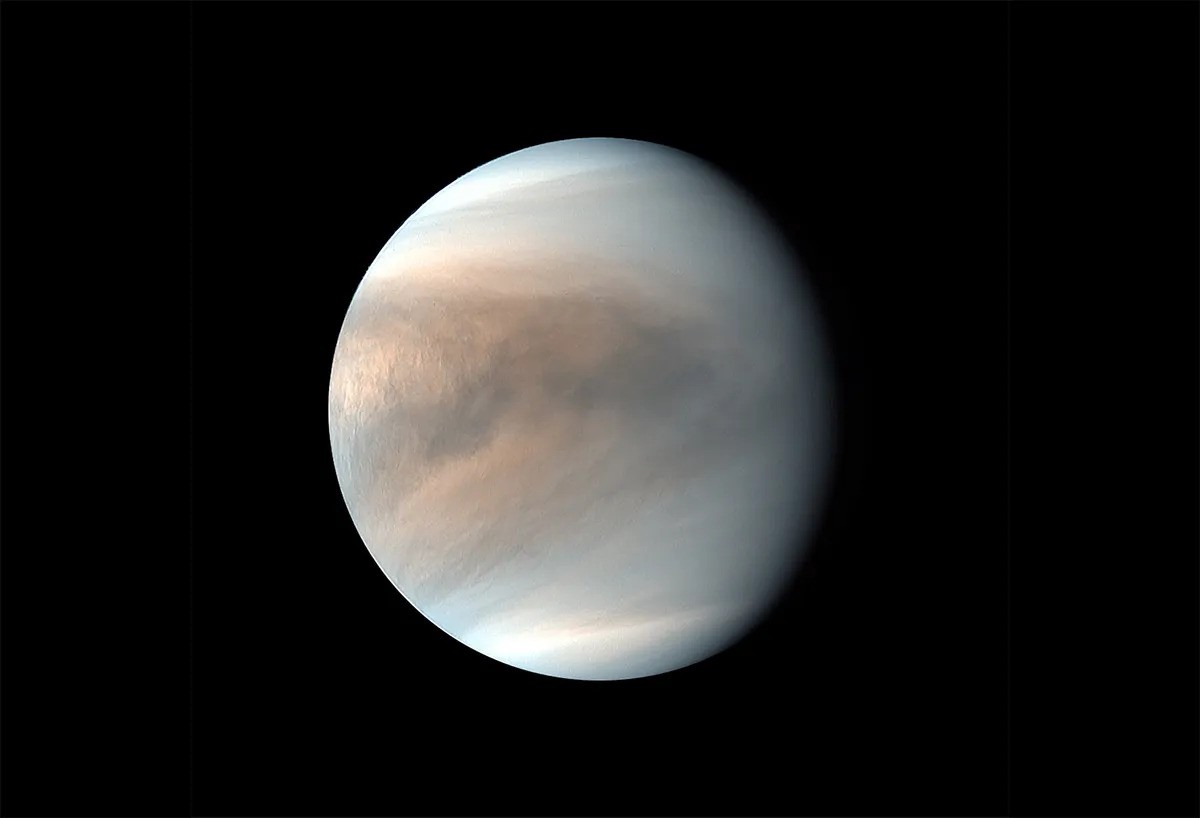
A Moon of Venus
Recently, people on Earth were able to watch the Moon “eat” Venus. Of course, this was only an illusion caused by the fact that the two objects happened to line up from Earth’s point of view. However, as phys.org reports, scientists from the University of California, Riverside suggest that Venus may once have had a moon of its own, which it later consumed. A paper on the subject has been published in The Astrophysical Journal.
Astronomers have long been puzzled by the question of why Venus, which is very similar to Earth in mass and size and lies right next to us, has nothing comparable to the Moon. The new paper proposes looking for the answer in what is happening to our own moon.
Earth’s Moon is thought to have formed shortly after a large body collided with the very young planet. Some of the debris gathered in orbit, much closer to the surface than the Moon is today. Since then, the “jewel of the night” has been moving very slowly away from us.
This happens because Earth itself rotates around its axis much faster than the Moon orbits it. It is known that the Moon transferred its rotational momentum until its rotation became synchronized, so that it always faces us with the same side. But the reverse is also true: Earth very slowly transfers part of its daily rotational momentum to the Moon, causing it to gradually move farther away.
Venus “Ate Its Moon”
For Earth, one possible scenario for losing the Moon would be for it to escape the planet’s gravitational influence. For Venus, however, the new study suggests the opposite. Venus rotates around its own axis extremely slowly, once every 243 Earth days. If it had a moon, that moon would orbit the planet in a much shorter period than this. Instead of gaining angular momentum, the moon would lose it.
As a result, the orbital period of a hypothetical Venusian moon would continue to shrink until the moon eventually crashed into the planet. Scientists carried out computer simulations with different moons, first for Earth to verify that they always move outward, and then for Venus, where they consistently fell toward the planet. The more massive the moon, the sooner the collision occurred.
Doubts and Implications
The idea is elegant and plausible, and the study’s authors suggest that our neighboring planet may indeed have had a moon in the past. However, there are no signs that such a moon ever existed, and most scientists doubt that Venus could ever have had anything massive in orbit.
The problem is that if Earth’s large Moon originated from a giant impact, then something similar would also have had to happen to Venus early in the history of the Solar System. Two such events within a single planetary system would be quite a coincidence.
Nevertheless, the new study is important. It shows that large moons orbiting slowly rotating planets are doomed eventually to fall onto them. This matters when considering what we should expect from Earth-like planets orbiting other stars.
As for the absence of impact traces on Venus, the explanation may be that the planet’s entire surface underwent a major resurfacing event in the relatively recent past, around a billion years ago. So even if such an event was caused by the fall of a moon, no traces would remain — just as no remnants remain of the oceans in which life may once have existed.