

Usually, a galaxy contains only one supermassive black hole. Only rarely is a pair of such objects found there. But recently, three were discovered at once in a system very far from us.
Three Supermassive Black Holes in One Galaxy
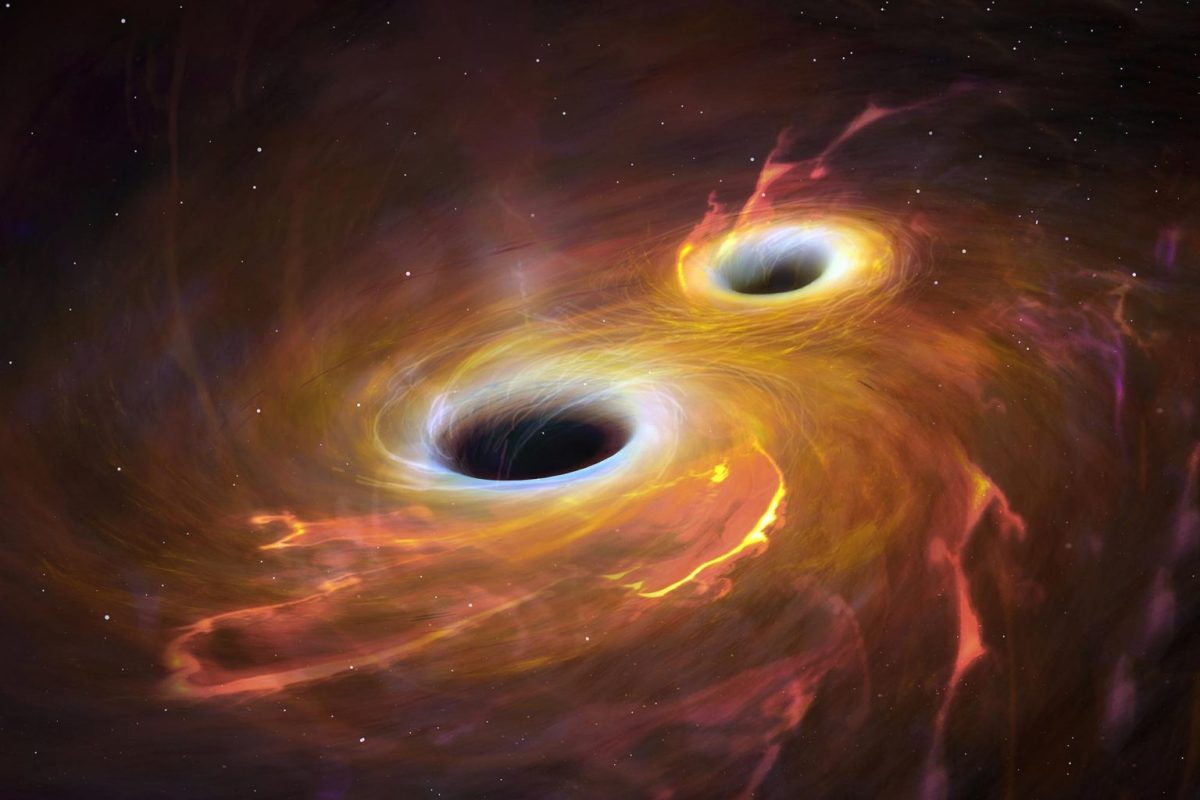
Recently, an international team of astronomers led by scientists from the Max Planck Institute for Extraterrestrial Physics reported the discovery of the galaxy J0148-4214. In it, they found signs of the presence of as many as three supermassive black holes. This was reported by Phys.org.
Supermassive black holes are some of the heaviest individual compact objects in the Universe. They are usually located at the centers of large galaxies and grow mainly by accretion of gas, although mergers can also play an important role in their evolution. When two galaxies collide, their central black holes may also come close together and eventually merge.
But the discovery of three massive black holes in the galaxy J0148-4214 is a truly remarkable discovery. What’s especially interesting is that this system is so far away, at a redshift of about 5.02. We see it as it was about 12.5 billion years ago, when the universe was only about 1.2 billion years old.
Why Three Black Holes Are So Important
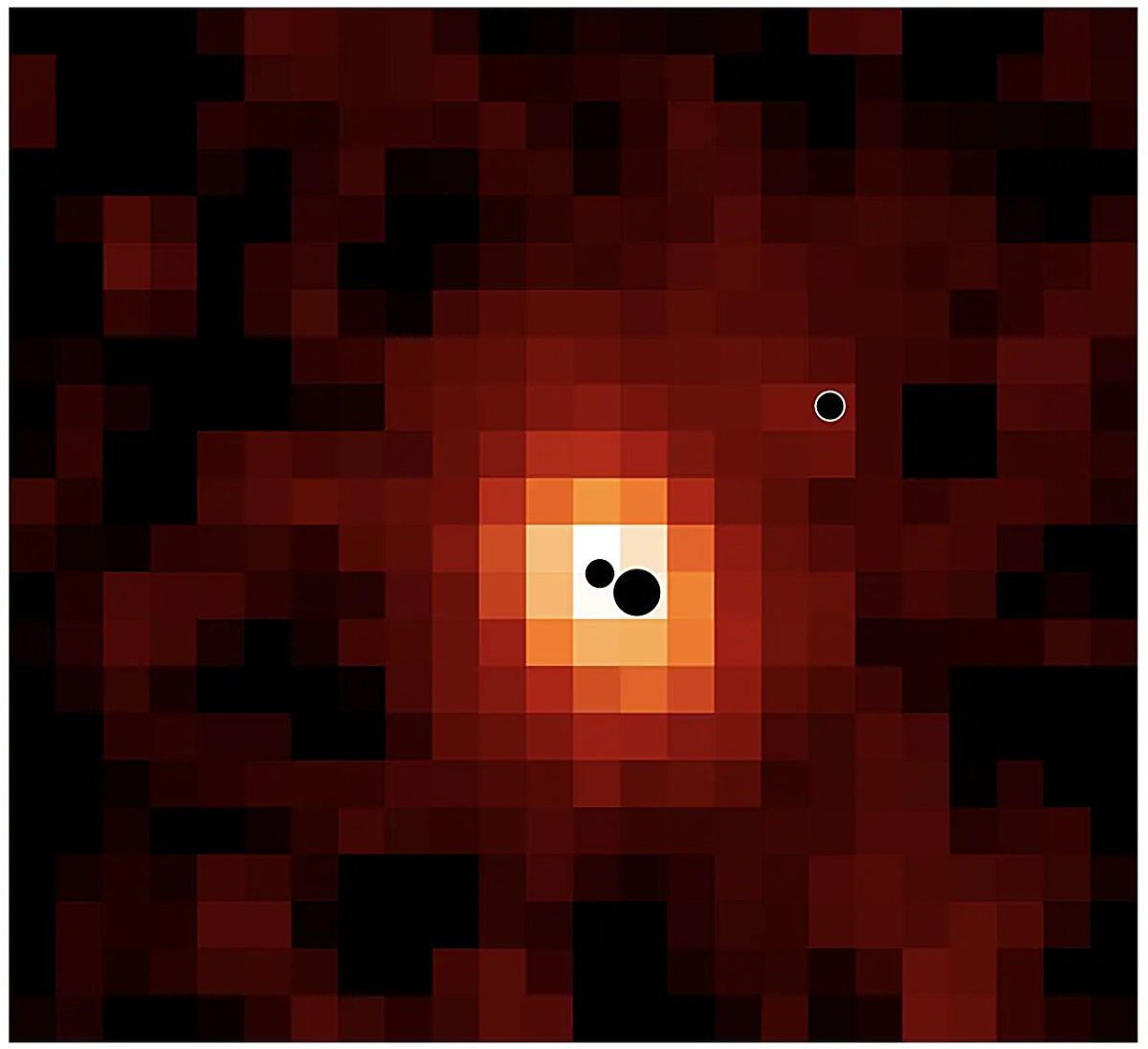
To understand that galaxy J0148-4214 could contain three massive black holes at once, scientists used spectroscopy. It showed several areas with broad hydrogen emission lines – a sign of gas moving at enormous speeds under the influence of strong gravity. Two such areas are located near the center of the galaxy, and the third is closer to the edge of the galaxy’s disk. It is the spatial separation of these spectral signals that suggested the presence of three active black holes.
To distinguish the two central objects, scientists had to measure the relativistic shift of the lines in their spectra with particular precision. It turned out that the pair in the center consists of a large black hole with a mass of 80 million solar masses and a much smaller one with a mass of 0.6 million solar masses, separated from it by a distance of 620 light-years.
The third black hole has a mass of about 2 million solar masses. It is believed to be the remnant of a relatively recent merger and is expected to remain a separate object for quite a long time. The first two, however, are expected to merge within the next several hundred million years.
But the most important aspect of this story is the presence of as many as three supermassive black holes in a very early galaxy. This indicates that mergers occurred much more frequently at that time than they do today. And this could provide a good explanation for the excessively large masses of these objects in the modern Universe.
