

Every August, individuals venture outdoors, gaze upwards, and anticipate a meteor shower. However, no stars actually descend from the sky. These luminous streaks can appear as bright as actual stars, which historically led to the misconception that stars were falling.
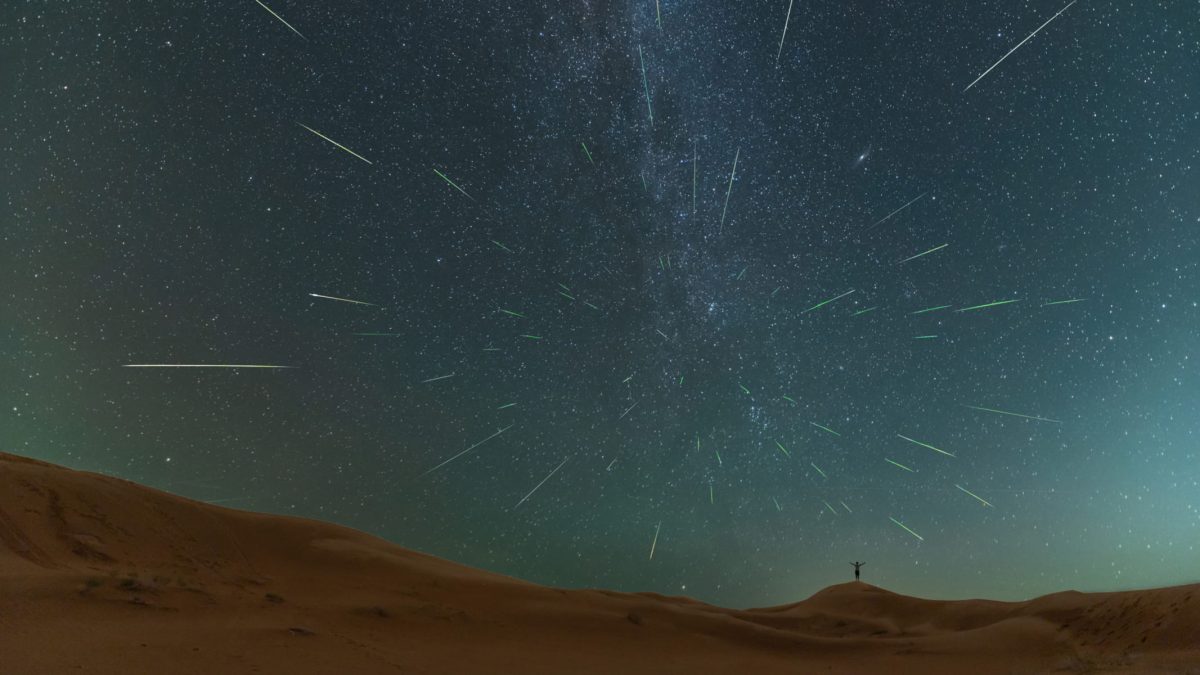
What is the origin of the luminous trail?
Particles that leave such a trail are typically approximately the size of a grain of sand, ranging from 0.1 to 1 millimeter. They enter the Earth’s atmosphere at velocities between 11 and 72 kilometers per second, and it is this extraordinary speed that causes the particle to metamorphose into a luminous meteor. The air ahead of it does not have sufficient time to diffuse; thus, it compresses rapidly and reaches temperatures of several thousand degrees.
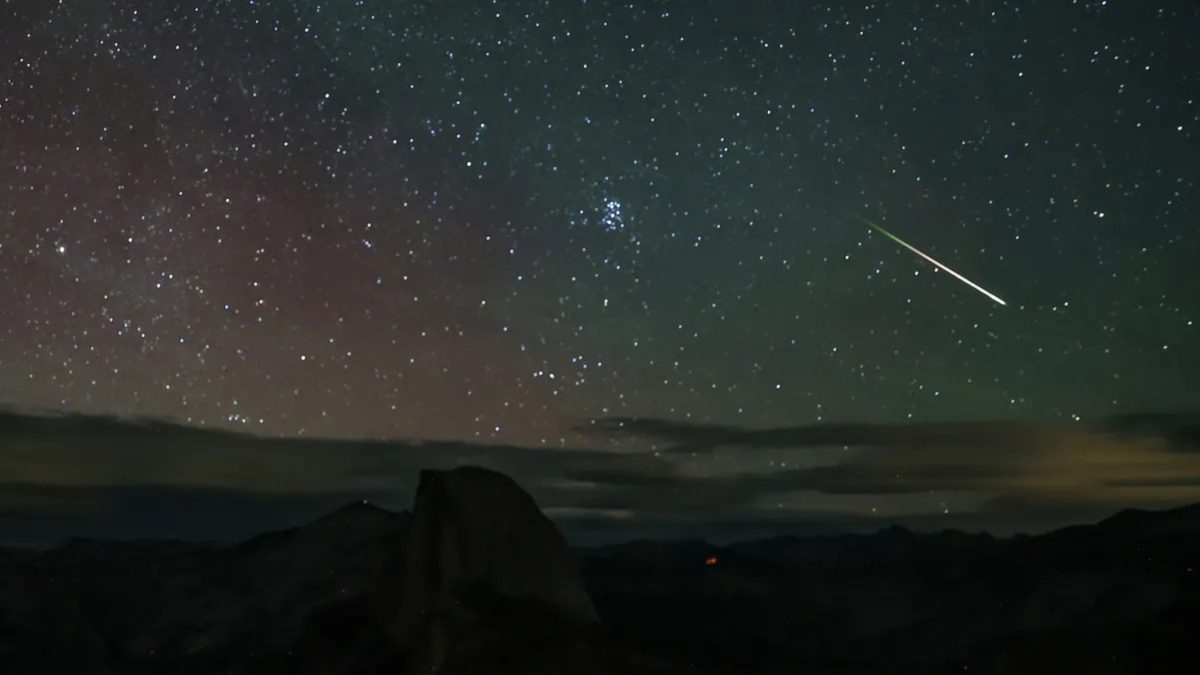
The luminous effect is not produced by the particle itself; rather, it emanates from the superheated gas enveloping it and the atoms vaporizing from its surface. This phenomenon typically transpires at an altitude of approximately 70-120 km above the Earth’s surface — that is, within the upper regions of the atmosphere. Virtually no material survives to reach the Earth’s surface, as the diminutive body fully vaporizes during its descent.
The comet’s trail
The source of this substance is Comet 109P/Swift-Tuttle. It orbits the Sun approximately every 133 years, and its nucleus measures about 26 km in diameter. Each time it approaches the Sun, the surface ices warm and sublimate, releasing gas and minute solid particles. The dust gradually disperses along the comet’s orbit, creating a debris stream that Earth intersects annually from mid-July to late August. This stream is responsible for producing the Perseids. The comet’s last perihelion passage occurred in 1992, with its next perihelion approach scheduled for 2125.
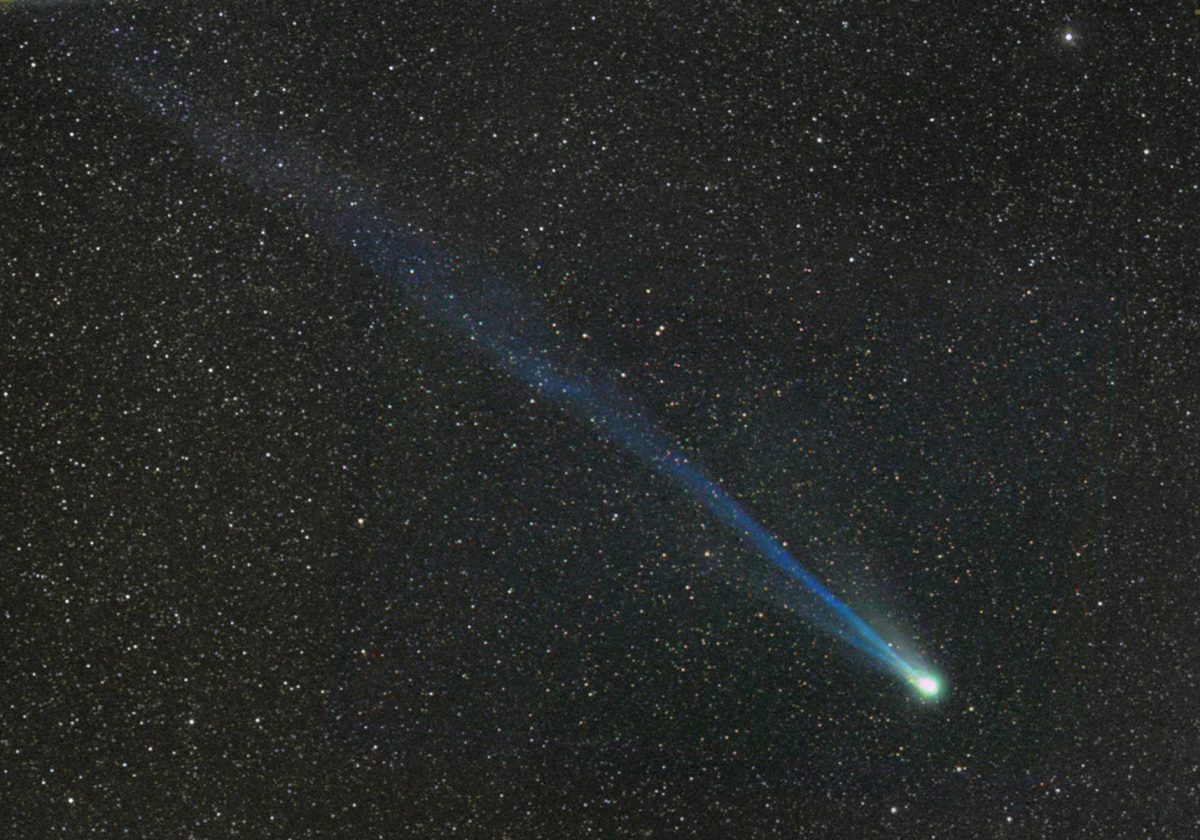
The comet was discovered in 1862 by American astronomers Lewis Swift and Horace Tuttle. Three years thereafter, Italian astronomer Giovanni Schiaparelli ascertained that the orbit of the comet closely coincided with that of the particles responsible for the August meteor shower. This represented one of the earliest instances in which meteors were correlated with a specific comet, thereby offering compelling evidence that meteor showers may originate from comets.
Why do meteors appear to originate from a single point?
Meteor trails in the sky are not arbitrary. If one mentally extends several of them in the opposite direction, they appear to converge at a single point. A comparable phenomenon can be observed when traversing a snowstorm: snowflakes descend towards the vehicle from various directions, yet their perceived trajectories seem to emanate from a single point ahead of the observer. In this analogy, the Earth functions as the vehicle, while the snowflakes symbolize particles of a meteor shower.
The point from which the meteors appear to originate is referred to as the radiant. For the August meteor shower, it is situated within the constellation Perseus; consequently, it is known as the Perseids. The greater the altitude of the radiant above the horizon, the more meteors are observable. This is the reason why the latter half of the night provides optimal conditions for viewing the Perseids — the radiant typically reaches its zenith immediately prior to dawn.
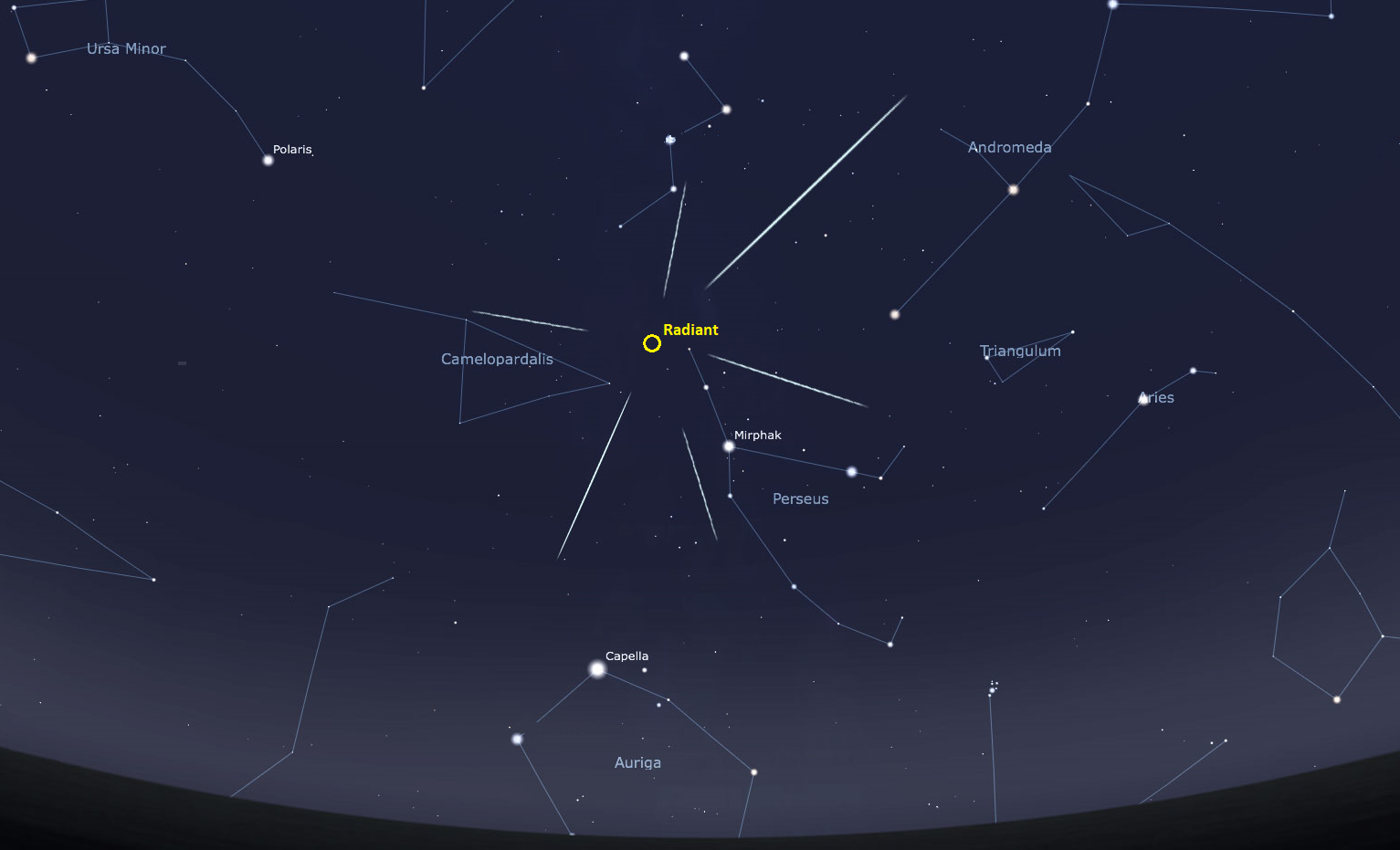
The meteors are entirely unrelated to the constellation itself. The stars of the constellation are located hundreds of light-years distant from us, whereas the meteors incinerate approximately 100 kilometers above the Earth’s surface.
The quantity of meteors observable, along with the methodologies for their observation
Forecasts for the Perseids typically cite a figure of 100 meteors per hour. In practice, this does not necessarily mean that one will observe precisely that number. Instead, it serves as a means of comparing the activity levels of various meteor showers. This figure, known as the zenith hourly rate or ZHR, represents the maximum number of meteors potentially visible under ideal conditions: a completely dark sky, with the radiant positioned at the zenith, allowing meteors to be seen across the entire sky. However, actual observing conditions are seldom perfect. Part of the sky may be obscured by the horizon, urban light pollution can interfere, and the radiant often remains below the zenith. Consequently, even in rural areas away from cities, the number of observed meteors will be substantially lower than the ZHR. Under a clear, dark rural sky during the peak activity, it is possible to observe dozens of meteors per hour; nevertheless, the precise count is heavily influenced by observing conditions.
In 2026, the conditions for observing the Perseids will be notably advantageous. The apex of activity is anticipated on the night of August 12-13. During this period, the Moon will be in its new moon phase on August 12, thereby minimizing its brightness and reducing potential interference with observations. Observations may commence at approximately 11:00 p.m. Nonetheless, early in the evening, the radiant will still be low on the horizon, resulting in a lower frequency of meteors. The most favorable conditions are expected during the latter half of the night, when the radiant ascends higher in the sky. It is not necessary to locate the radiant explicitly; meteors can appear in any region of the sky, and their trails often appear to originate from a common point within the constellation Perseus.
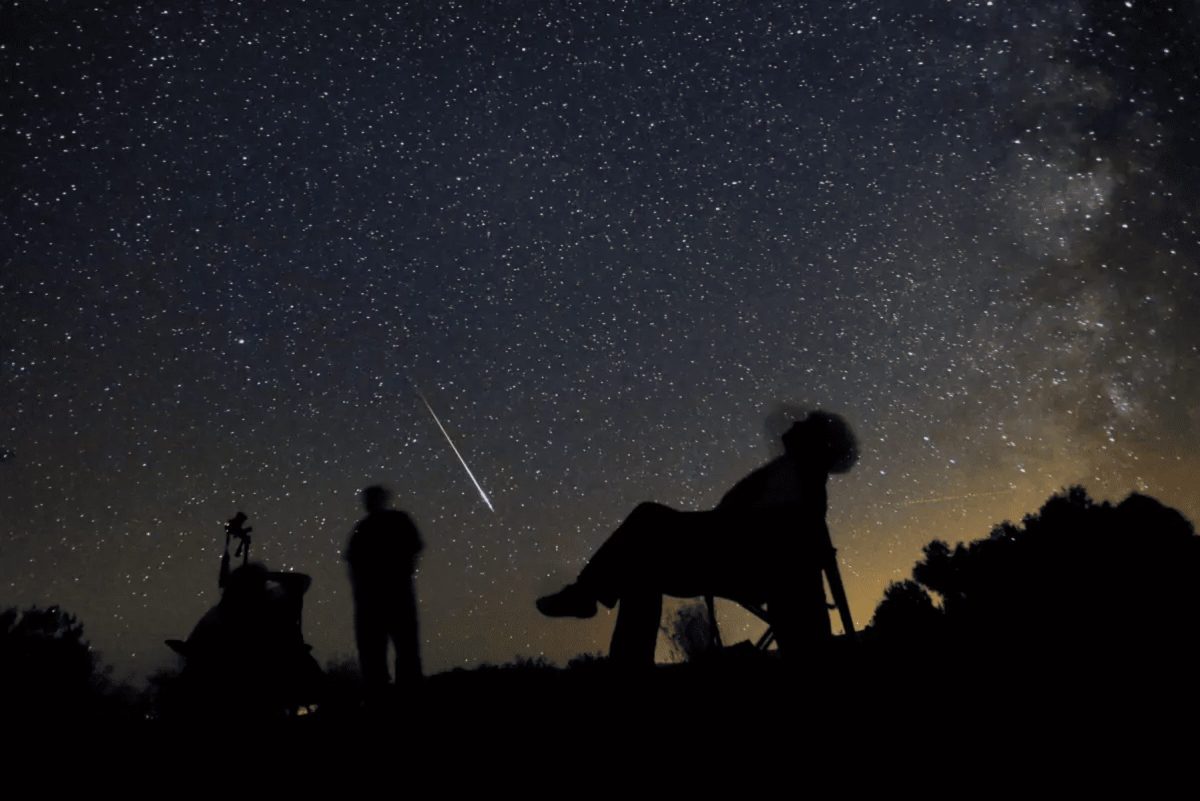
A telescope and binoculars should be avoided in this context, as they restrict the field of view. It is advisable to drive to a location distant from city lights, lie down or recline in a chair, and allow approximately twenty minutes for the eyes to adapt to the darkness. A bright smartphone screen can significantly disrupt this adaptation; therefore, it is recommended to abstain from using the phone or to utilize it at the lowest brightness setting with a red filter. An observation period of at least one hour is recommended, given that meteors appear sporadically — after a period of silence, several meteors may be observed appearing in rapid succession.
Greetings regarding the map and the scheduled meeting in Kyiv
The tradition of making a wish when a “shooting star” falls has persisted for a considerable duration. This year, it has been adapted into an online format for the first time. Universe Space Tech, in collaboration with the nonprofit organization “Noosphere Association,” has introduced an interactive map allowing individuals to submit their name, city, and wish. On the evening of August 12 at 8:30 p.m., all submitted wishes will be illuminated in the virtual sky above Ukraine on the project’s animated webpage, enabling participants to locate their respective star and dream.
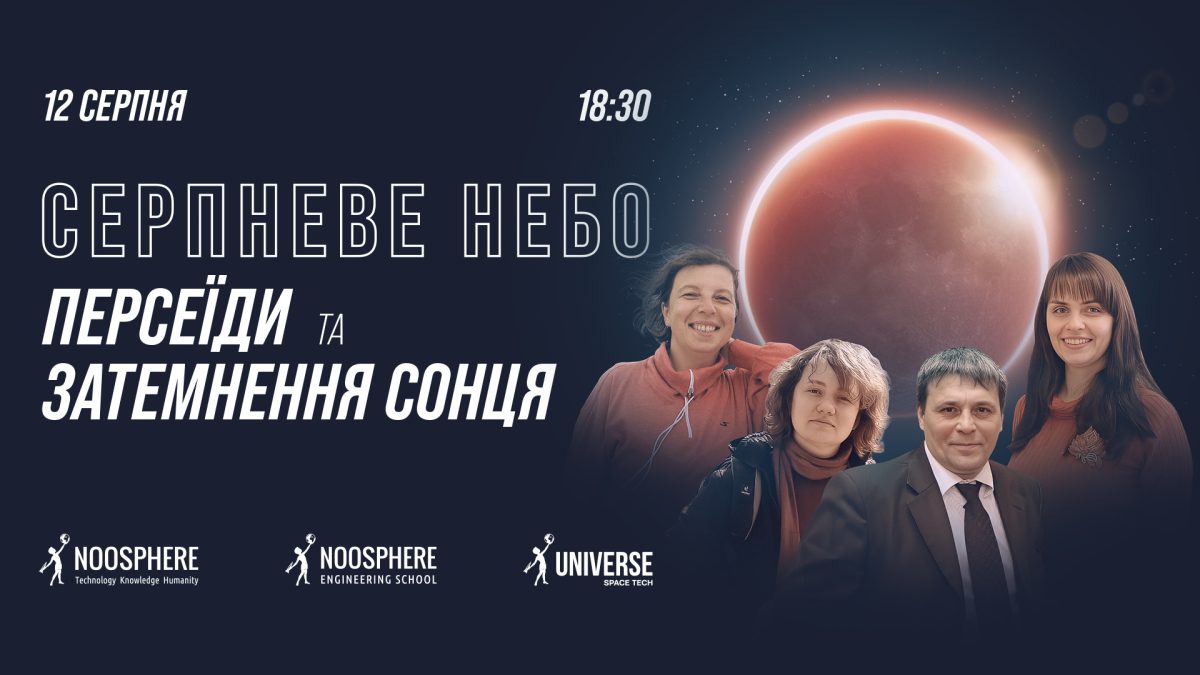
On the same day at 6:30 p.m., both organizations, in conjunction with the Noosphere Engineering School, will host an event entitled “The August Sky: The Perseids and the Solar Eclipse.” The event will feature two lectures dedicated to the phenomena of meteor showers and solar eclipses. These lectures will be delivered by esteemed astrophysicists Yuliana Kuznietsova and Iryna Vasylieva, alongside astronomers Oleksandr Holubaiev and Alona Mozghova — recognized experts in meteor research. The venue for this event is located in Kyiv at 9/16 Akademika Yangelia Street. An online livestream will be available for remote participants. Attendance is complimentary; however, prior registration is mandatory.
