

The Milky Way’s disk grew thinner in two stages at very different rates. At first, its thickness decreased rapidly, then much more slowly over billions of years. Astronomers uncovered this pattern by precisely determining stellar ages using data from the Gaia space observatory. The findings support one of two widely discussed explanations for how the disk formed.

A Turning Point 10.8 Billion Years Ago
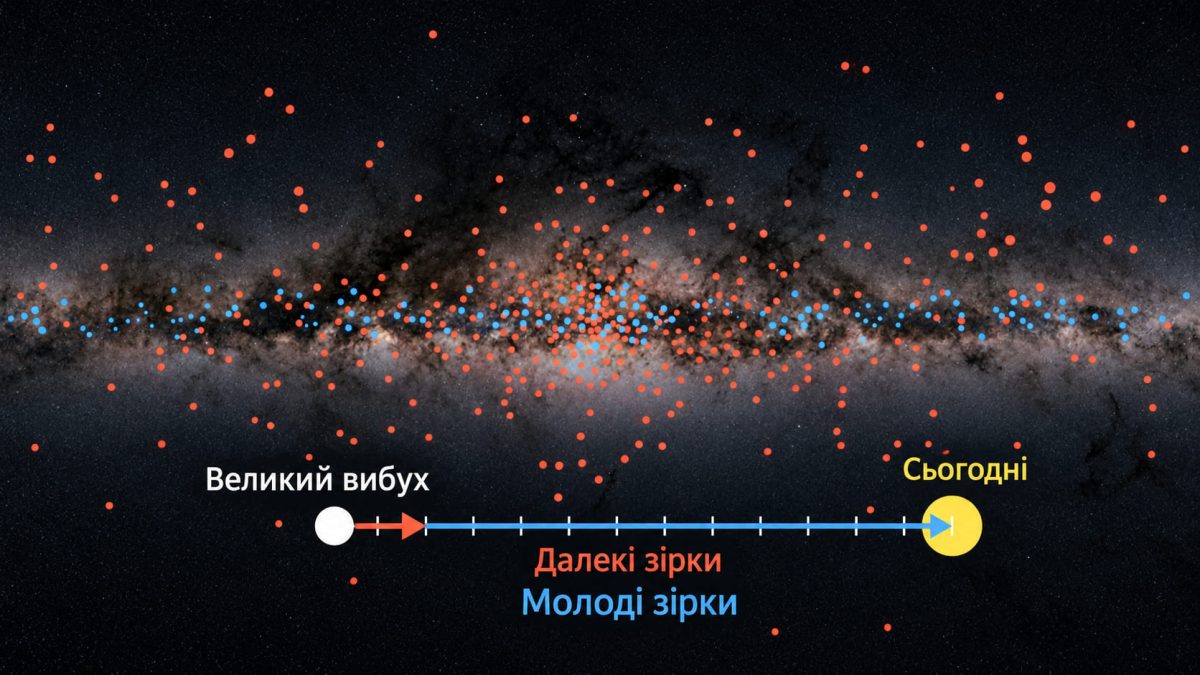
The younger the stars, the closer they lie to the Galactic plane. But this relationship is not uniform, with a turning point approximately 10.8 billion years ago.
Before that, the disk grew thinner very rapidly. In just 2 billion years, its thickness decreased from more than 4,100 to approximately 1,600 light-years.
The changes then slowed. Stars forming today occupy a layer approximately 400 light-years thick. The disk’s diameter is about 100,000 light-years, making it 250 times wider than the thickness of this layer. A pancake with these proportions and a diameter of 25 centimeters would be just one millimeter thick.
Two Scenarios
Most stars in the Milky Way are concentrated in two disks: a thin disk containing younger stars and a thick disk containing older ones. Astrophysicists have long debated how they formed because observations were consistent with both scenarios.
In the first scenario, stars always form in a thin disk. The gravity of gas clouds, spiral arms, and the Galaxy’s central bar then repeatedly alters their orbits, causing the stars to stray increasingly far from the plane.
This process is slow, so the disk should thicken gradually. But the data show something different. Early on, the layer in which new stars formed became thinner very quickly, and a slow process cannot explain such an abrupt transition.
The new data are consistent with the second scenario, known as the “upside-down” model. In this model, the disk’s thickness depends on the state of the gas from which stars form. Initially, the gas was turbulent and occupied a thick layer. Over time, it became calmer and settled closer to the plane, so each new generation of stars formed in a thinner layer. According to the authors, this first produced the thick disk, now dominated by old stars, followed later by the thin disk, where younger stars are concentrated.
Ages with Uncertainties of No More Than 5%
Choosing between the scenarios requires precise knowledge of stellar ages, which are hardest to determine for the oldest stars. Within the ChronoGal project, uncertainties do not exceed 5%, or approximately 500 million years even for the oldest stars. The analysis used measurements from Gaia, the space observatory launched by ESA.
According to the Instituto de Astrofísica de Canarias, the study was led by David Mirabal, a doctoral student at the institute and the University of La Laguna. He explains that computer models allowed both scenarios, and this is the first clear observational evidence favoring one of them for the Galaxy’s early history. The paper was published in the peer-reviewed journal The Astrophysical Journal Letters.
The End of the Early Stage
The transition between the stages coincides with the era astronomers associate with the Milky Way’s last major merger. Estimates suggest that between 8 and 11 billion years ago, it merged with the dwarf galaxy Gaia-Enceladus, whose remnants were identified in 2018 using Gaia data. The available data cannot establish whether these events are connected.
The fourth Gaia data release will help investigate this coincidence. It will cover 5.5 years of observations, compared with the 34 months used in the previous release.
