

The protective shell of charged particles encompassing the Solar System has periodically contracted to a size smaller than Earth’s orbit, leaving our planet outside this shell and exposed to the interstellar medium during such periods. This phenomenon is addressed in one of two recent studies conducted by the U.S. space agency. The second study provides an explanation for the contrasting question: why the young Earth did not succumb to freezing, despite the Sun’s significantly weaker state at that time.
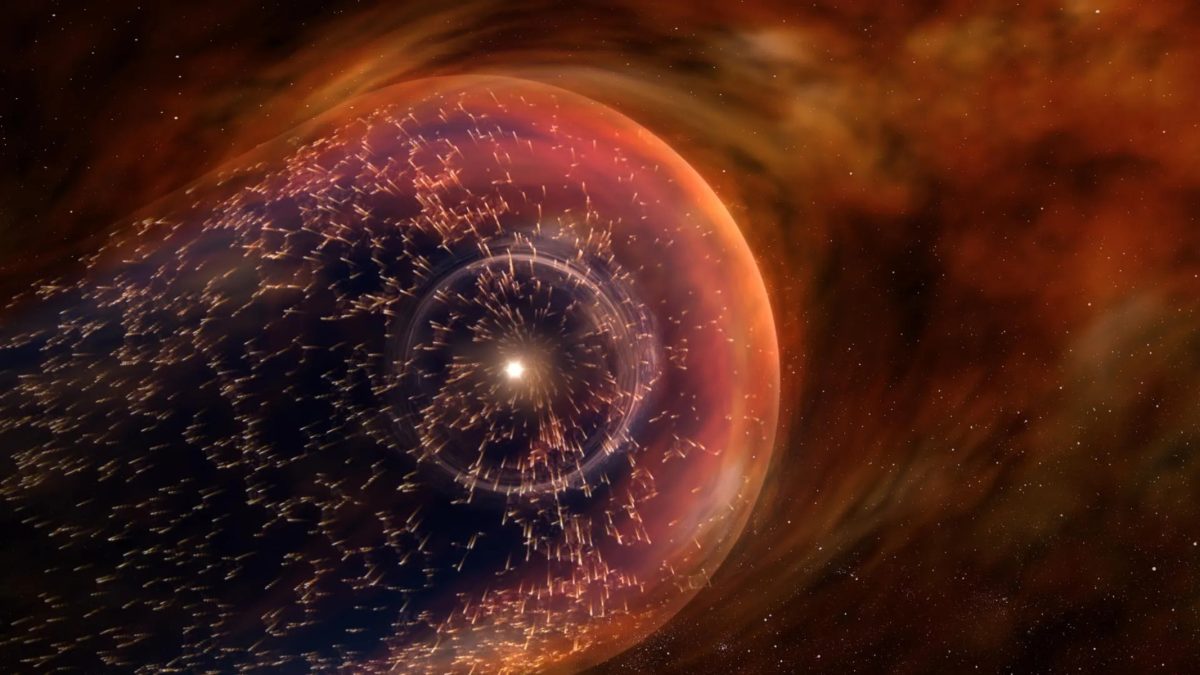
A bubble around the system
The solar wind persistently transports charged particles in every direction. At a certain distance, they come into contact with the material of interstellar space. This process results in the formation of the heliosphere — a vast shell within which all the planets are situated.
Alongside the Sun, this bubble orbits the nucleus of the Milky Way galaxy. Over approximately four and a half billion years, it has traversed numerous regions within the galaxy. Currently, its boundary is situated at a distance approximately 120 times farther from our star than Earth’s orbit, and it was at this location that the Voyager 1 spacecraft crossed in 2012.
Three encounters with clouds
A team led by Merav Opper of Boston University reconstructed the heliosphere’s past trajectory using computer modeling. The results were published in the peer-reviewed journal Annual Review of Astronomy and Astrophysics.
Based on these calculations, over the course of several million years, the Solar System has traversed extremely cold clouds of gas and dust on at least three occasions. The pressure exerted by such clouds has compressed the heliosphere beyond Earth’s orbit, resulting in a temporary loss of planetary protection from the interstellar medium, as reported by NASA.
Traces in bottom sediments
The modeling indicates three periods: approximately two to three million years ago, six to seven million years ago, and thirteen to fourteen million years ago.
These dates align with geological data. Chemical elements characteristic of interstellar dust have been identified in deep-sea sediment cores, Antarctic snow, and lunar samples of precisely this age.
In the calculations, contact with a dense, cold cloud of hydrogen increased the concentration of water vapor in the atmosphere and altered processes in the upper layers of the atmosphere. The effects gradually reached the surface and, as a result, may have influenced past climate fluctuations, particularly ice ages.
The paradox of the faint young Sun
Approximately three billion years prior, our Sun emitted merely 70 percent of its current luminosity. Under these illumination conditions, the Earth would have been entirely frozen, as reported by ScienceDaily.
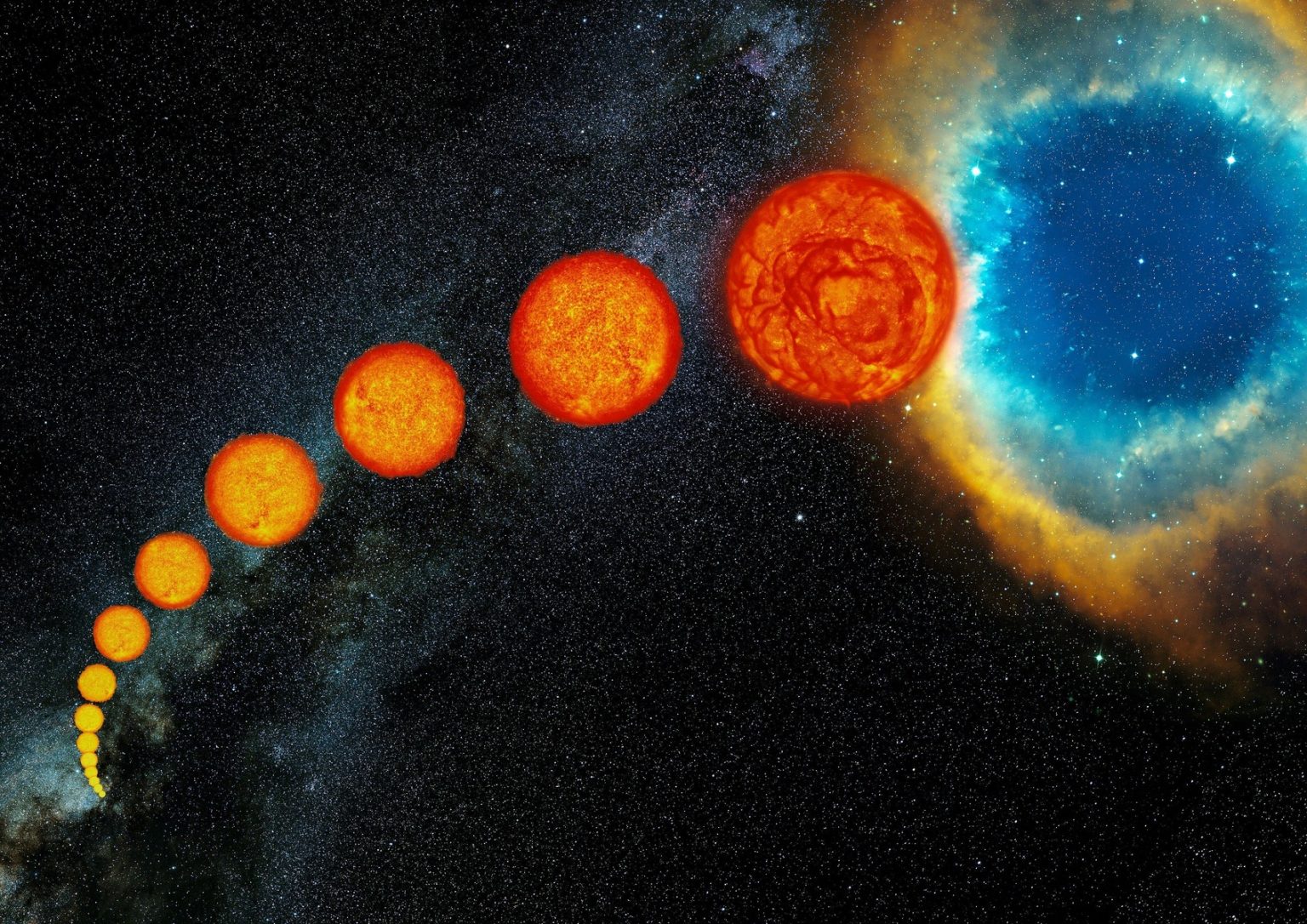
Geological evidence indicates otherwise. Stable liquid water existed on the planet well before that period. This discrepancy is recognized as the “weak young Sun” paradox.
An experiment with protons
Astrophysicist Volodymyr Airapetian of NASA’s Goddard Space Flight Center has highlighted research concerning young stars analogous to the Sun. Data obtained from the Kepler space telescope indicate that these stars produce exceptionally intense flares daily and release streams of high-energy particles.
The team replicated the environment of ancient Earth within a sealed chamber by combining molecular nitrogen, ammonia, carbon dioxide, and carbon monoxide. The mixture was subjected to proton bombardment to emulate the effects of solar flares. This process yielded nitrous oxide, a greenhouse gas that is 300 times more potent than carbon dioxide. The research was documented in the peer-reviewed journal The Astrophysical Journal Letters.
Certain molecules were eradicated by intense ultraviolet radiation. Nevertheless, calculations indicated that even a tenth of these molecules would suffice to raise the temperature of the equatorial regions by five degrees Celsius above zero. Moderately elevated temperatures, marginally above the freezing point, were found to be even more favorable for the formation of lengthy chains of amino acids than higher temperatures.
