

Following a duration of eight years dedicated to space exploration, the BepiColombo dual-mission is now underway with its critical phase — the separation of the interconnected spacecraft in proximity to the smallest planet and the closest to the Sun. This collaborative initiative between the European Space Agency (ESA) and the Japan Aerospace Exploration Agency (JAXA) has reached the stage of direct maneuvering toward Mercury. The intricate separation procedure will be transmitted live via ESA’s official YouTube platform on September 3.
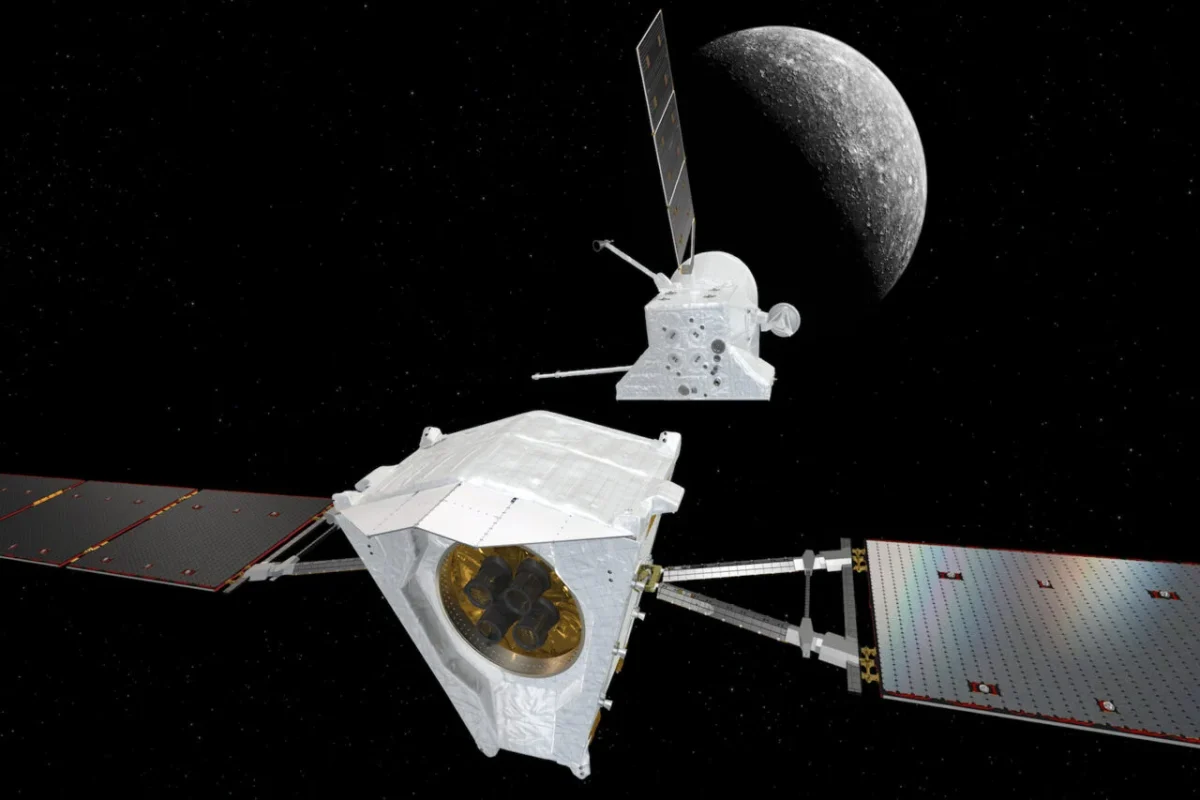
Illustration: ESA BepiColombo.
BepiColombo was initially scheduled to arrive in December 2025. However, owing to a technical malfunction, the spacecraft’s engines were unable to operate at full capacity. This necessity compelled the team to adjust the trajectory and defer the final phase of the mission by 11 months.
A complex maneuver sequence in space
Launched in October 2018, BepiColombo was initiated to investigate Mercury’s surface, subsurface, and magnetic field. The mission comprises two scientific modules: the Mercury Planetary Orbiter (MPO), developed by the European Space Agency (ESA), and the Mercury Magnetospheric Orbiter (MMO), produced by the Japan Aerospace Exploration Agency (JAXA). During this period, both modules were transported by the Mercury Transfer Module (MTM).
The initial critical phase involves the separation of the MTM module from the two scientific spacecraft. Subsequently, the paired probe assembly will proceed in free fall until it achieves a polar orbit around the planet utilizing the MPO’s chemical propulsion systems.
Separating the “twins”

In December, the MPO’s small thrusters will execute a series of maneuverings to finalize the orbital placement. During this period, the second twin probe, MMO, will detach and commence its individual research trajectory. Ultimately, the MPO module will discard its protective sunshield and initiate its scientific operations.
Navigating in proximity to Mercury is regarded as one of the most formidable challenges in space exploration due to the Sun’s intense gravitational influence. BepiColombo has thus become only the third spacecraft in human history to attain this elusive planet. Despite encountering technical difficulties during its extended trajectory, the mission has been transmitting detailed images and valuable scientific data regarding Mercury to Earth since October 2021.
We previously documented the effects of gravitational forces and solar wind interactions on Mercury as recorded by BepiColombo.
Provided by ESA
