

Deep beneath the planet’s surface, six previously unlisted regions have been identified. These areas are situated near the boundary between the mantle and the core. Their detection resulted from vibrations induced by substantial earthquakes. The material composition or temperature of these regions differs from that of the surrounding mantle.
Indirect method
Direct study of the lower mantle is unfeasible. The Kola Superdeep Borehole, which holds the record for penetrative depth into the Earth’s crust, ceased at slightly over 12 km. The structures in question are situated nearly 250 times deeper, at an approximate depth of 3,000 km beneath the surface.
This is the reason why geophysicists employ indirect methods. The velocity of seismic waves varies as they traverse materials with different temperatures, compositions, or densities, and these variations are utilized to generate images of the subsurface.
Leading oscillations
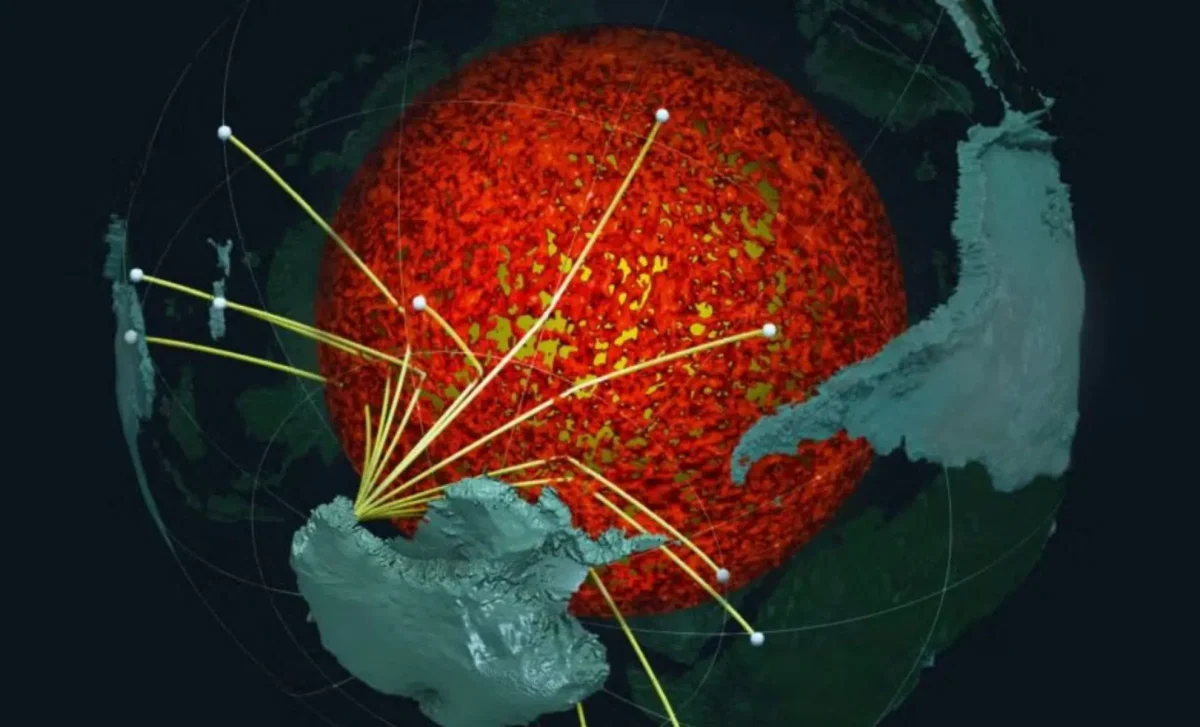
The work was based on what are known as PKP precursors. These waves traverse the liquid outer layer of the nucleus, do not interact with the solid core, and arrive at the stations prior to the waves that have traversed the solid core.
Their appearance indicates that there were irregularities along the path that scattered the energy. Scientists have compiled a comprehensive dataset of such measurements and developed a catalog that surpasses previous models in detail.
Priority areas for searches
The authors designate the regions indicated by the indices B1 through B6 as potential clusters of deep scatterers. In a publication featured in the peer-reviewed Journal of Geophysical Research: Solid Earth, these regions were identified as priority zones for further subsurface investigation.
The nature of these formations remains uncertain. Some may prove to be remnants of ancient oceanic crust subjected to subduction into the Earth’s interior, whereas others could have originated from the gradual mixing of geological materials within the planet.
The existence of such anomalies suggests that the lowest layer of the mantle is not homogeneous. Its composition retains evidence of events that transpired hundreds of millions of years ago.
The significance of a boundary with a core
The boundary region between the mantle and the core dictates the transfer of heat from the Earth’s interior to its surface. According to the Daily Galaxy, this phenomenon is associated with volcanic activity, the formation of mountain ranges, and the movement of tectonic plates.
The expanded catalog offers geophysicists precise coordinates for guiding their subsequent observations. A denser array of seismic stations enhances the ability to discern more intricate details at such depths.
Comparable methodologies are likewise employed beyond Earth. The seismometer on the InSight spacecraft detected vibrations within Mars’s interior; however, a solitary station is insufficient to delineate specific anomalies, necessitating a network of instruments. The collected data enabled the estimation of the size of our neighboring planet’s core.
