

The James Webb Space Telescope (JWST) continues to deliver surprises while studying deep space. While analyzing high-resolution infrared images, an international team of astronomers led by Takumi Tanaka of the University of Tokyo’s Kavli Institute discovered four candidate pairs of Little Red Dots (LRDs). These objects are separated by only a few thousand to several tens of thousands of light-years and existed when the Universe was about 1 billion years old.
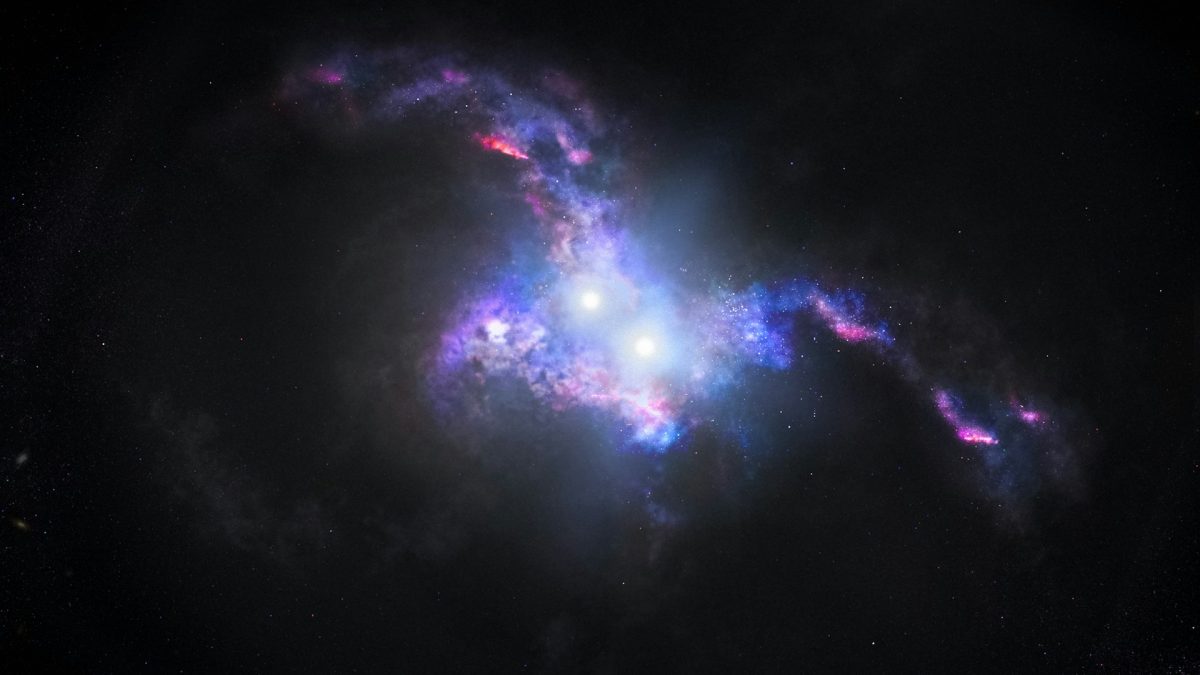
The study results, published in the Publications of the Astronomical Society of Japan, indicate that rapidly growing black holes in the early Universe may often have formed close pairs through interactions between their host galaxies.
A Pixel-by-Pixel View
LRDs are one of James Webb’s greatest mysteries. They combine blue ultraviolet emission with a sharp rise in the red optical spectrum. Most evidence suggests that LRDs are young supermassive black holes hidden inside dense cocoons of gas.
Previously, astronomers searched for LRDs based on an object’s overall brightness and compactness. However, this approach had a significant blind spot: if two objects are located too close together, their light blends, and the system no longer has the parameters of a single point source, causing algorithms to overlook it.
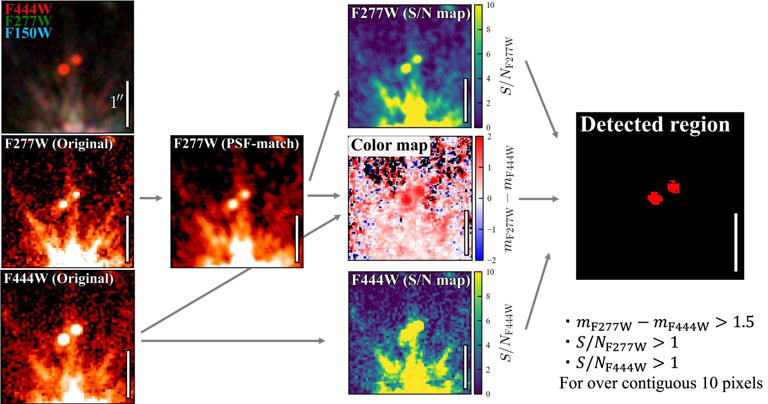
To overcome this limitation, Tanaka’s team applied a new method to NIRCam data from the COSMOS-Web survey. The scientists analyzed the color of each individual image pixel. This made it possible to identify nearby structures that independently display LRD spectral signatures and to filter out possible contaminants, such as brown dwarfs.
A Similar Address
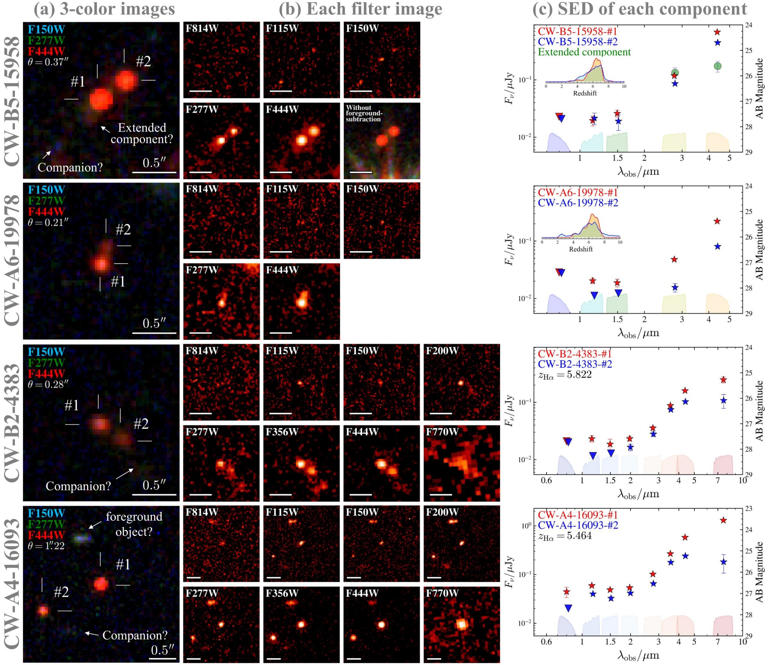
As a result of the analysis, the researchers identified four systems with projected separations between their components ranging from 1 to 7 kiloparsecs. For comparison, the diameter of the Milky Way is about 30.6 kiloparsecs, or 100,000 light-years.
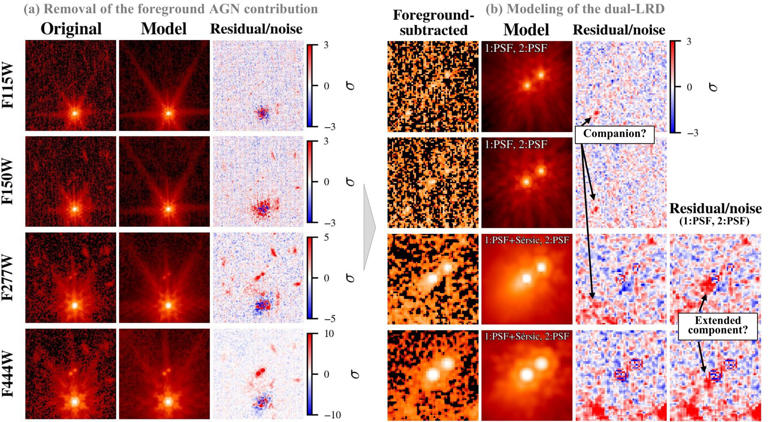
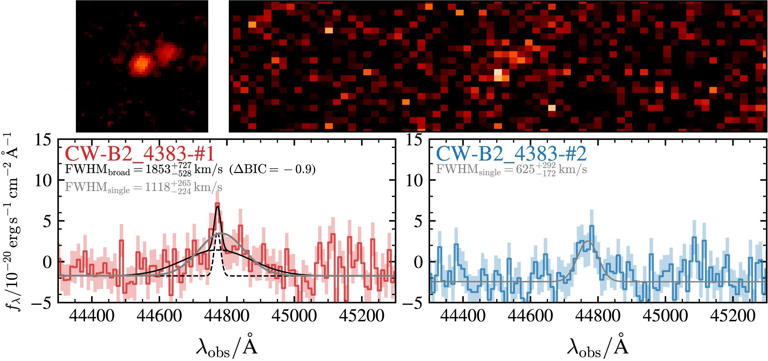
To rule out accidental optical superpositions of objects located at different depths in space, the researchers used James Webb’s slitless spectroscopy. For two pairs, they were able to confirm identical redshifts — 5.822 and 5.464, respectively. This proves that the objects are genuine physical neighbors, separated by 1.64 and 7.36 kiloparsecs. Modeling showed that such close clustering is tens of times more likely than would be expected by chance.
A Path Toward the Birth of Giants and Gravitational Waves
Close encounters and collisions between galaxies in the early Universe funneled enormous amounts of gas toward their centers. This material simultaneously “fed” their central black holes and drew them closer together through gravity.
The detected systems capture an early stage of this process. If the black holes inside the LRDs eventually merge, this could help explain how supermassive black holes managed to grow to enormous sizes in a surprisingly short amount of cosmic time. In addition, such cataclysms will generate powerful gravitational waves, which future next-generation space observatories such as LISA will be able to detect.
For now, two of the four systems are still awaiting spectroscopic confirmation, while the team plans to expand the pixel-based search to larger JWST datasets in order to determine the true scale of black hole mergers at the dawn of cosmic time.
Previously, we reported on how James Webb challenged science over the age of the Universe.
According to bioscience.com.pk
