

Centaurs — a distinctive category of minor planets within the Solar System — reside in the transitional zone between the orbits of Jupiter and Neptune. They occupy an intermediate position, bridging the rocky asteroids of the inner Solar System and the icy objects of the Kuiper Belt. Due to the persistent gravitational perturbations exerted by the gas giants, the orbits of the centaurs are highly unstable: they undergo chaotic oscillations until the object is either ejected into interstellar space or migrates inward toward the Sun.
It is precisely this orbital instability that renders centaurs exemplary laboratories for investigating the transformation of icy celestial bodies into active comets.
Saturn’s gravitational push
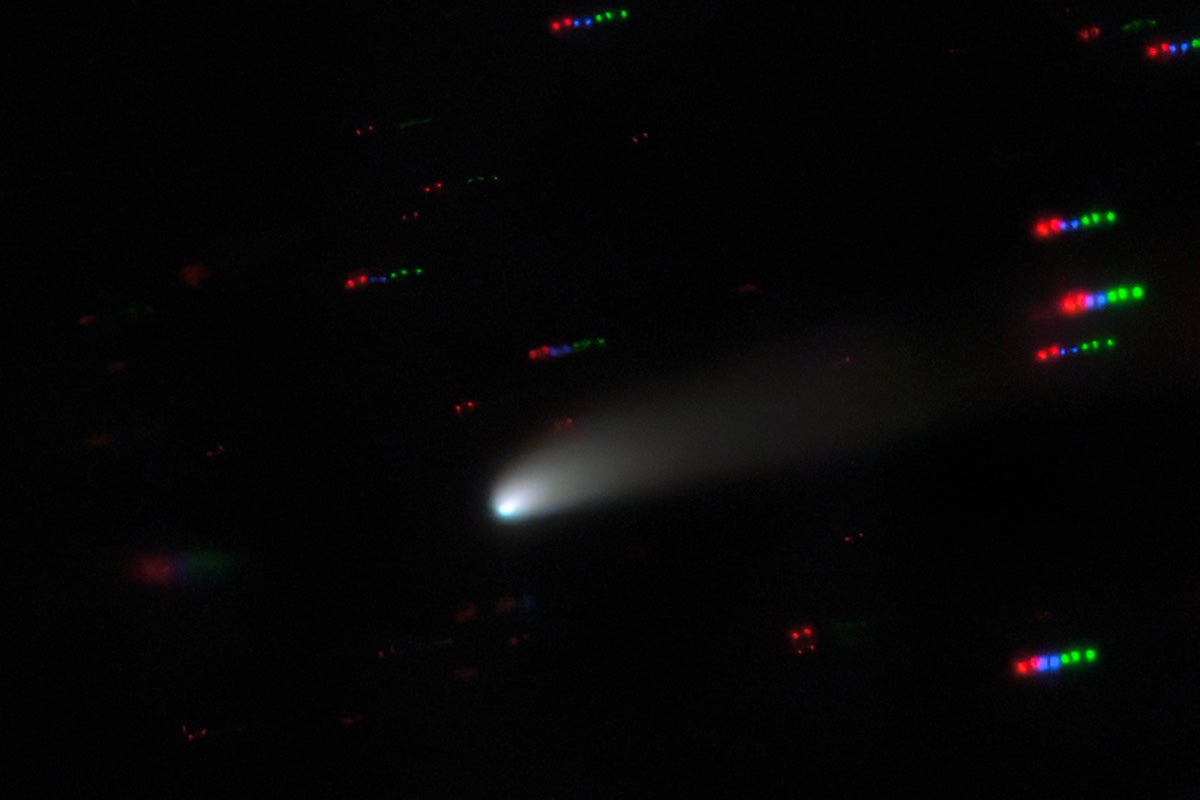
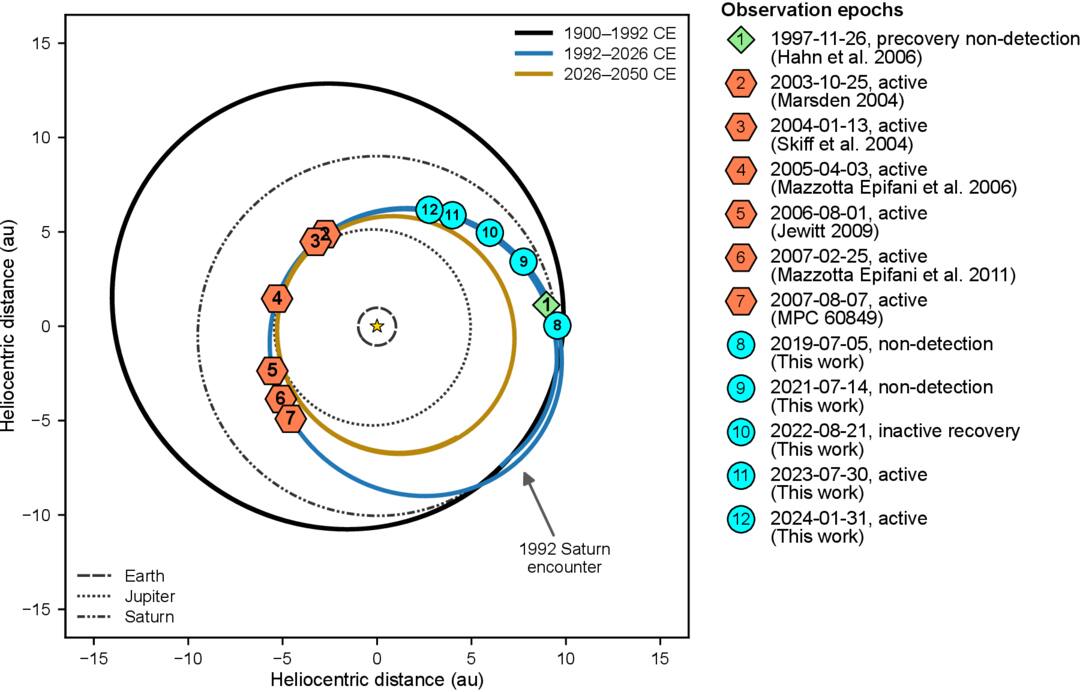
An international team of scientists utilized the James Webb Space Telescope and the Gemini North Observatory to carry out an extensive analysis of the centaur object 450P/LONEOS. The trajectory of this object was significantly impacted in 1992 when it passed at a perilously close distance to Saturn. The formidable gravitational pull of the giant planet modified its course, resulting in its perihelion moving nearer to Jupiter’s orbit.
As it absorbed additional solar heat, 450P/LONEOS commenced emitting volatile gases and developed a dust tail. The object effectively initiated its transition into a fully developed comet.
The comet tail paradox
As the centaur approached its new perihelion, astronomers conducted spectral analyses of its newly formed coma and tail. Comets are traditionally considered “dirty snowballs,” so scientists expected to find water vapor as the main component of the gaseous emissions.
Instead, the JWST spectrometers revealed an intriguing finding: there is virtually no water vapor in the tail. Carbon dioxide (CO2) was identified as the primary contributor to gas emission.
Scientists interpret this phenomenon as resulting from the fact that the majority of the ice within 450P/LONEOS exists in a distinctive amorphous and porous state. During initial heating, this ice converts into a crystalline structure, releasing carbon dioxide and minute water crystals encapsulated within. The existence of these crystals in the dust tail has previously been validated through observations.
The future development of the space explorer
Scientists estimate that 450P/LONEOS remains in the initial phases of its transformation. Should a future close approach to Jupiter result in an orbit that brings it closer to the Sun, the increased temperatures would be adequate to vaporize the solid water ice crystals. This process would enhance the comet’s tail with water, thereby imparting a characteristic “cometary” appearance.
Even without an additional gravitational boost, after numerous orbits, a centaur will exhaust its reserves of readily accessible dry ice, and water will become the predominant gas in its coma. The case of 450P/LONEOS distinctly exemplifies the evolutionary trajectory that icy objects undertake en route to becoming comets. The observational findings were published in The Planetary Science Journal.
We previously discussed how rings form in a tiny centaur literally “before our very eyes.”
Provided by Universe Today
