

NASA’s Psyche spacecraft, which is heading toward the metal-rich asteroid Psyche, performed a gravity-assist maneuver near Mars in May. The encounter with the planet provided not only an increase in speed. Scientists also used the opportunity to test the onboard systems under real conditions. The tests confirmed that the equipment is ready for the main phase of the mission.
A Testing Ground for the Instruments
The spacecraft flew past Mars on May 15, using the planet’s gravity to accelerate and slightly adjust its trajectory. At the same time, the team carried out a full rehearsal of the observations planned for the final part of the journey, phys.org reports.
All instruments operated normally. Lindy Elkins-Tanton of the University of California, Berkeley, the mission’s principal investigator, noted that no major discoveries were expected. Even so, the collected data added several new details thanks to the unusual viewing angle.
Neutrons from the Surface
The gamma-ray and neutron spectrometer was designed to determine the chemical elements in the asteroid’s surface material. Cosmic rays constantly bombard celestial bodies, and in response, matter emits neutrons and gamma rays of different energies. These signals make it possible to determine what the studied object is made of.
For gamma rays, the flyby altitude of 4,609 kilometers was too high, but the instrument was able to detect neutrons emitted from the Martian surface and atmosphere. David Lawrence of the Johns Hopkins University Applied Physics Laboratory, who is responsible for the spectrometer, said that near the point of closest approach, the counter registered a spike close to predictions. The equipment passed the test with excellent results.
A Magnetic Signature
Another sensor, the magnetometer, has been operating continuously since launch in 2023. During the flight, it was used to monitor the solar wind, including coronal mass ejections that swept over the spacecraft.
Mars was the first alien world whose magnetic signature the team was able to detect with this instrument. The signal increased sharply near the main shock wave, where the supersonic flow of the solar wind is sharply slowed by interaction with the induced magnetosphere and upper layers of the Martian atmosphere. Ben Weiss of the Massachusetts Institute of Technology, who leads the magnetometer investigation, explained that the results confirmed the accuracy of the measurements under dynamic conditions.
The main task of this sensor still lies ahead. Studying the magnetic field of asteroid Psyche will help test the hypothesis that it is the metallic core of a planetesimal, one of the building blocks of planets from the early Solar System.
Mars as a Crescent and Its Craters
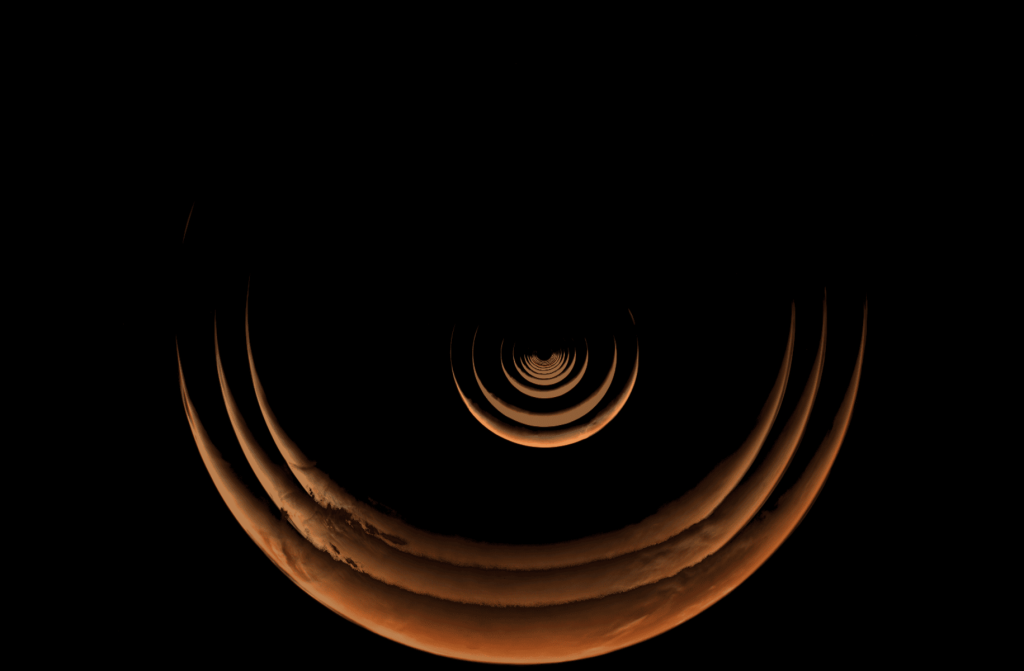
Images from the multispectral imager, which combines two identical cameras, have been publicly released since early May. Because of the large phase angle during approach, Mars initially appeared as a thin, bright crescent. According to NASA, sunlight in these frames was scattered by the atmosphere.
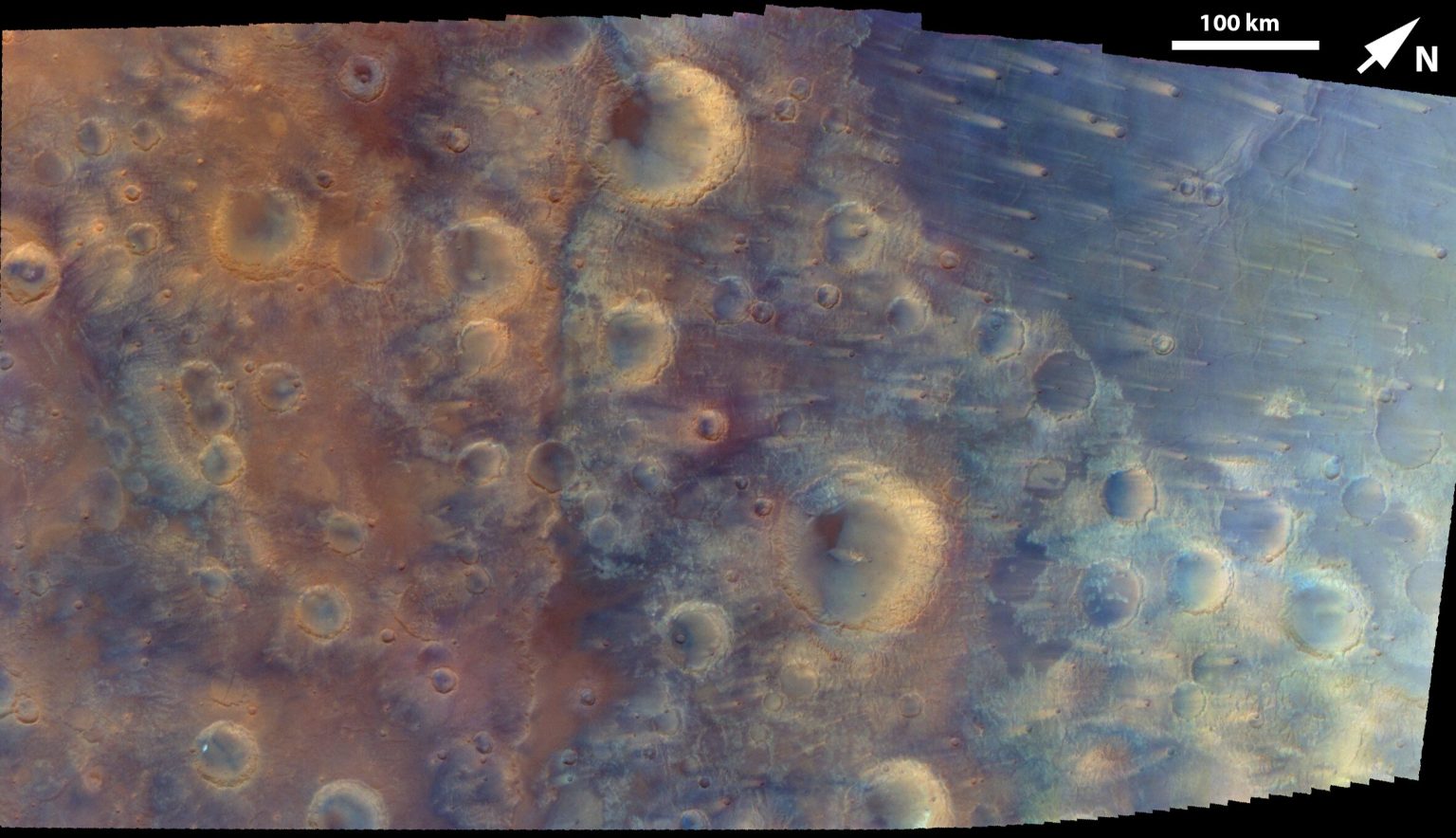
During closest approach, specialists obtained detailed views of the surface, including the southern polar cap, craters bearing traces of wind erosion, and the double-ringed Huygens basin. This impact structure is nearly 470 kilometers in diameter and is one of the largest on the planet. It was named after the 17th-century Dutch astronomer Christiaan Huygens. The full sequence of images from the maneuver was included in a time-lapse.
The optics were also tested for sensitivity to stray light by searching from afar for the tiny moons Phobos and Deimos. A similar search will be conducted near the asteroid to determine whether small moons are orbiting it.
The time-lapse shows Psyche’s approach to Mars, closest approach, and departure from the planet. Mars’ gravity was used to accelerate the spacecraft on its way to asteroid Psyche. Credit: NASA/JPL-Caltech/ASU/True Story Films
Course Set for Psyche
The spacecraft is now heading directly toward its target in the main asteroid belt between Mars and Jupiter. Project manager Bob Mase of NASA’s Jet Propulsion Laboratory confirmed that navigators placed the spacecraft precisely on the required trajectory.
In the fall, engineers plan to resume long-duration operation of the solar-electric propulsion system. Arrival at the asteroid is scheduled for the summer of 2029.
