

A space telescope for observations in the far-infrared range has received approval from NASA to proceed to the next stage of development. The PRIMA project has become the first mission in the agency’s new class of astrophysics missions. The observatory is intended to close the gap between James Webb and radio telescopes. German astronomers have proposed creating precision opto-mechanical components for it.
A Cold Mirror and the Year 2033
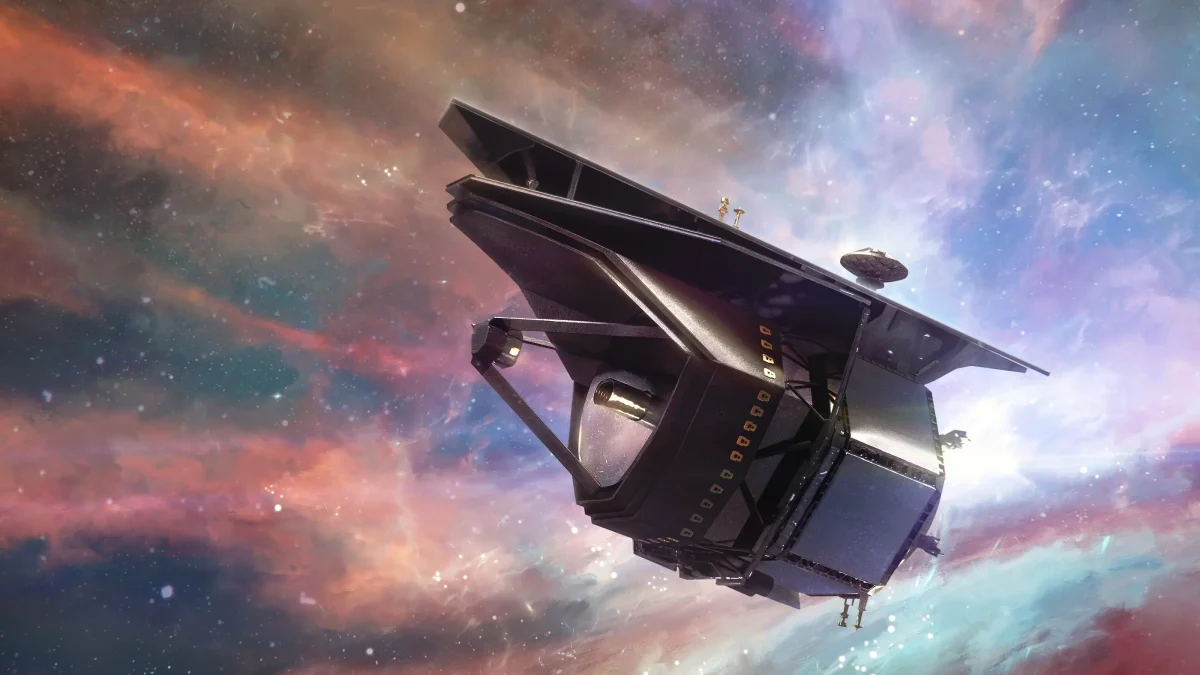
The core of PRIMA (PRobe far-Infrared Mission for Astrophysics) will be a 1.8-meter-diameter primary mirror made of aluminum. It will be actively cooled because, in far-infrared light, any warm body emits radiation, including the instrument itself. The launch is planned for 2033, and the spacecraft is designed to operate for five years.
The decision was announced in a NASA press release. Development has moved into Phase B, where the preliminary design and required technologies are refined. PRIMA will then be evaluated according to technical, programmatic, and cost criteria. Only after this review will implementation begin. If the mission is confirmed, its cost will be capped at $1.2 billion, excluding launch expenses.
Its predecessor in this wavelength range was the European Herschel Space Observatory, with a 3.5-meter mirror. The liquid helium used to cool its instruments ran out in 2013. Since then, no instrument operating in far-infrared light has been active in space. PRIMA’s active cooling does not rely on a consumable supply of coolant, so the duration of observations will not depend on it.
Light Through Dust
Cold dust and gas, from which stars and planets form, glow in the far-infrared range. Such radiation passes freely through dense clouds that hide these regions from optical instruments. With James Webb, astronomers observe mainly near- and mid-infrared light, while radio telescopes operate at much longer wavelengths. The PRIMA observatory is designed for deep, sensitive sky surveys in the gap between these parts of the spectrum.
Its scientific goals include the origin of exoplanets, the growth of galaxies, the evolution of their central black holes, and the accumulation of heavy elements in the Universe. Nicky Fox, NASA’s Associate Administrator for Science Missions, also linked PRIMA to the question of where Earth’s water came from.
Mirrors from Heidelberg
The contribution proposed by the Max Planck Institute for Astronomy (MPIA) consists of two high-precision actively controlled mirrors, known as two-axis focal-plane choppers. Each of the observatory’s two scientific instruments is expected to receive one. These are the PRIMA imaging camera (PRIMAger) and the Far-Infrared Enhanced Survey Spectrometer (FIRESS).
These mirrors rapidly direct the instrument’s field of view toward the required areas of the sky and keep it fixed there. The control electronics for them are also proposed to be developed in Heidelberg, while this part of the work is funded by the German Aerospace Center (DLR).
The mission’s co-investigators include Oliver Krause, who heads MPIA’s Infrared Space Astronomy group, and the institute’s emeritus director Thomas Henning. Thomas Henning also helped formulate PRIMA’s scientific program.
From Explorer-1 to a New Class
MPIA specialists previously worked on ESA’s Infrared Space Observatory (ISO), Herschel, and Euclid, as well as on James Webb and Nancy Grace Roman. Myriam Benisty, director of the institute and head of the Planet and Star Formation Department, called PRIMA a logical continuation of these projects.
The creation of the Probe Explorers class was recommended by the 2020 Decadal Survey of the U.S. National Academies of Sciences, Engineering, and Medicine. The new category is part of Explorers, NASA’s oldest continuously operating program. Since the launch of Explorer-1 in 1958, more than one hundred spacecraft have been sent into space under the program, and researchers from two of them, Uhuru and the Cosmic Background Explorer, received Nobel Prizes.
NASA’s Jet Propulsion Laboratory will manage the mission. Contributions are being made by the space agencies of France, Italy, Canada, Japan, and the United Kingdom, as well as by the Korea Astronomy and Space Science Institute.
