

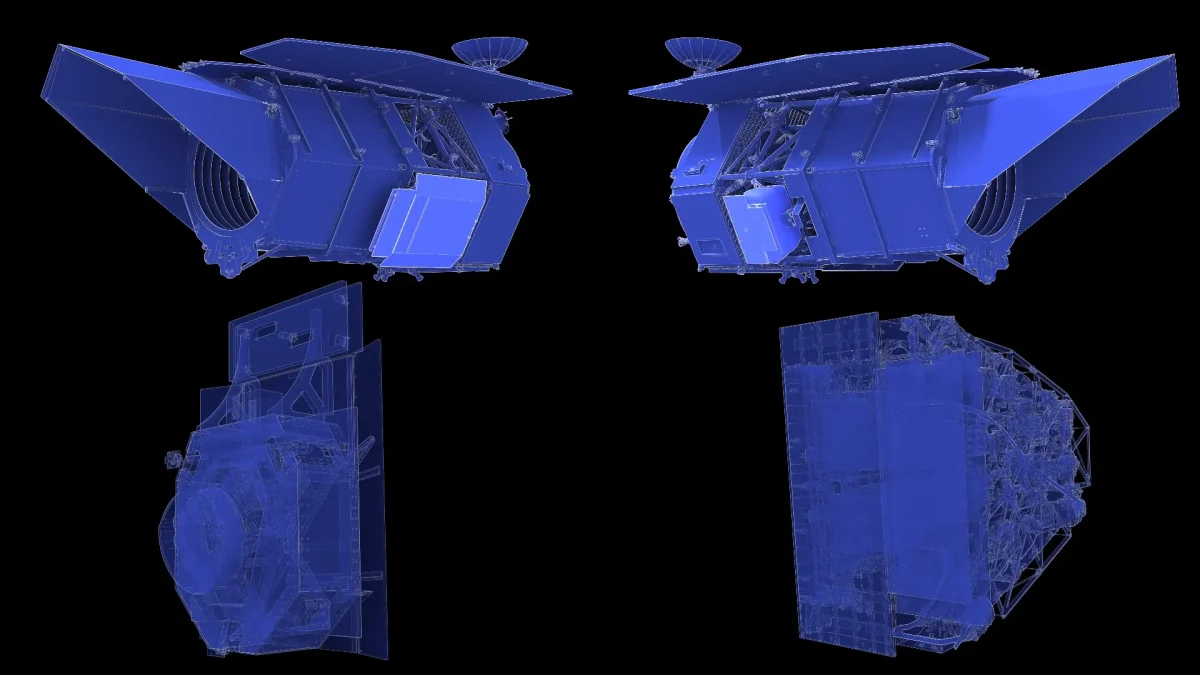
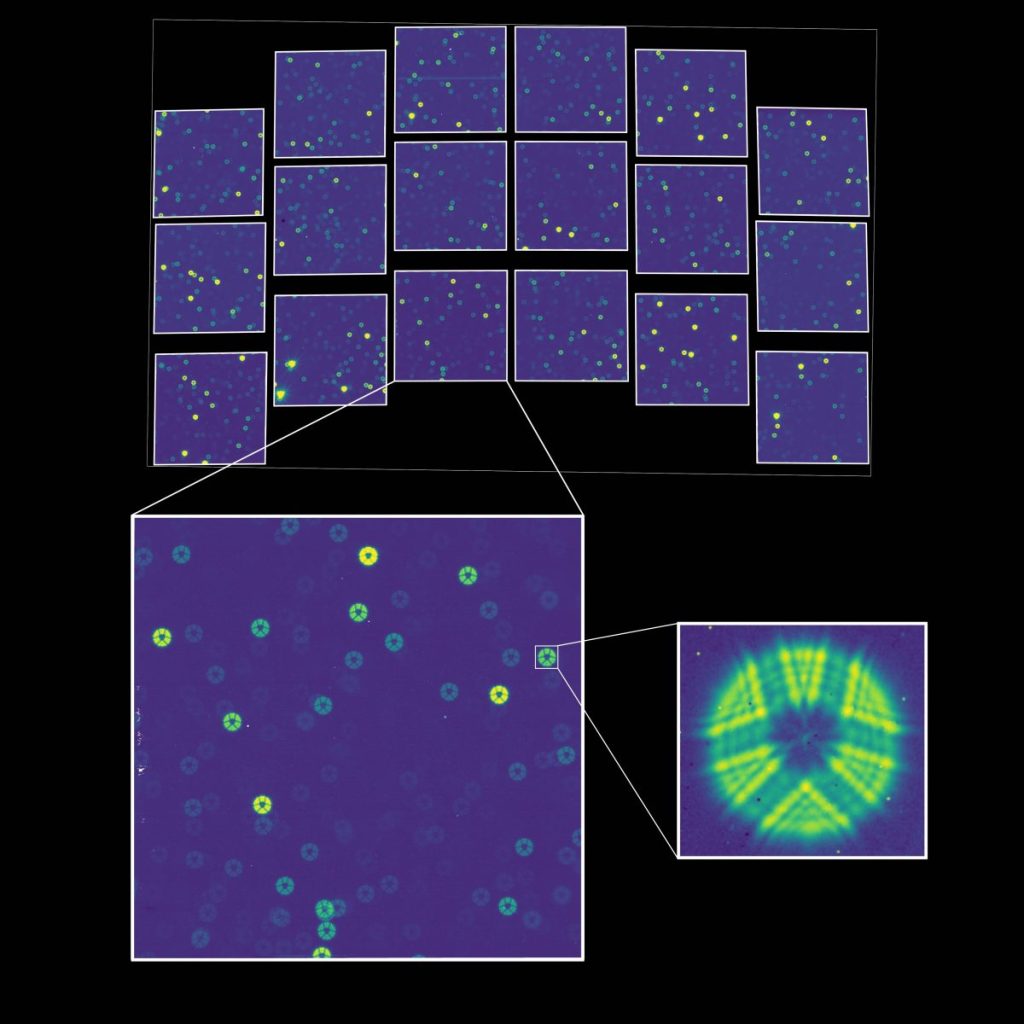
The main camera of NASA’s new space telescope has received light from distant stars for the first time. The image came out blurry — exactly as expected, since the detector array is still in its initial position. At the same time, engineers assessed the condition of the coronagraph, an instrument designed for directly observing planets near other stars. Both tests were completed successfully while the spacecraft continues on its way to its operating point beyond Earth’s orbit.
The Main Camera Is Operational
Each image from the Wide Field Instrument covers an area of the sky larger than the apparent disk of the full Moon. At the same time, its sharpness remains at the level of Hubble.
The detector array has 300 megapixels and operates in the infrared range. This combination makes it possible to image large areas of the sky quickly without losing fine detail.
Video about the Wide Field Instrument of the Nancy Grace Roman Space Telescope. Source: NASA’s Goddard Space Flight Center; music: “Horizon Ahead,” Universal Production Music
The First Photons of Starlight
The test image was taken before the optics were aligned, so the light from each star was spread across thousands of pixels and took on a ring-like shape. The image serves as a zero-point reference from which the team will proceed while adjusting the telescope.
The fine-guidance system will be switched on next, after which the spacecraft will be able to keep a target in its field of view. Focusing will then begin, and the light from each star in the image will become a sharp point. NASA plans to release the first scientific images in early 2027.
The Coronagraph Passed Its First Check
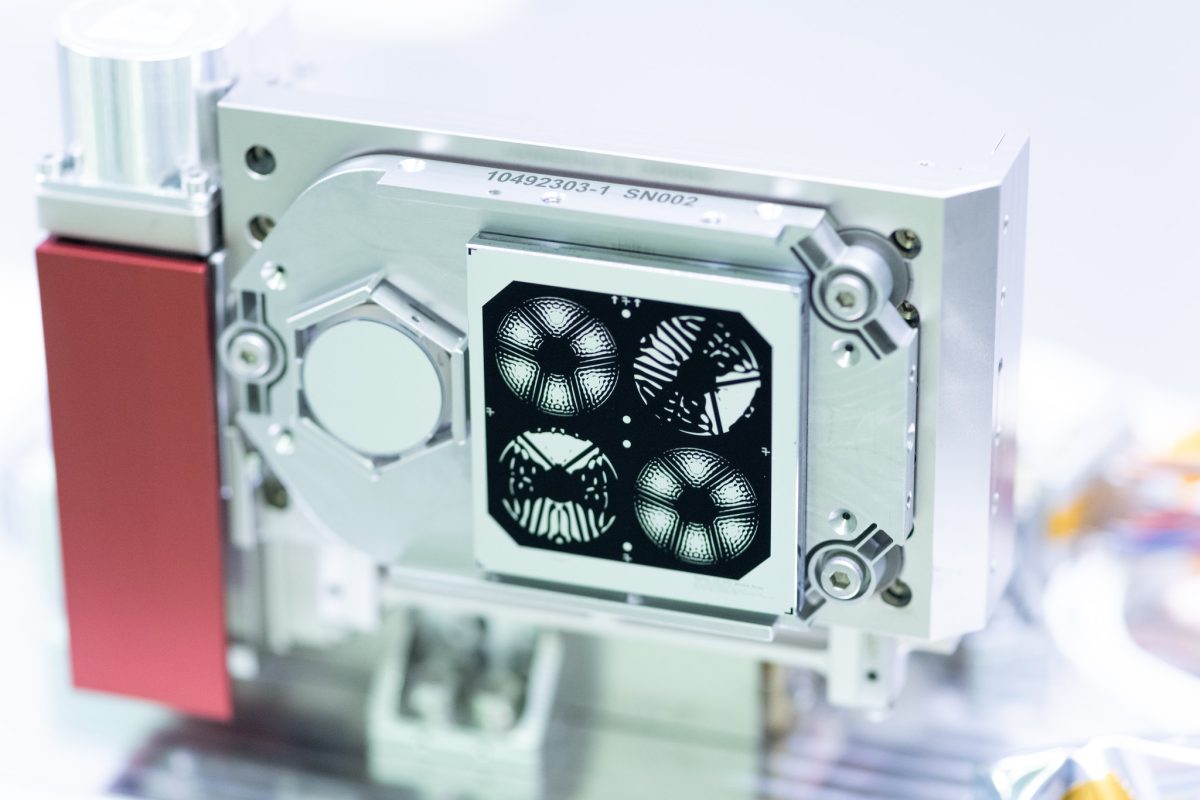
Power was supplied to the coronagraph in early September, and its digital, electronic, and mechanical systems have now been tested, according to the Roman mission blog. The instrument consists of optics, masks, sensors, and mirrors capable of changing their shape. All of this is needed to suppress a star’s glare and reveal the faint reflected light of nearby planets.
Direct imaging of planets around other stars has so far been achieved mainly for young, hot gas giants on wide orbits. NASA views technologies like these, tested in space, as a foundation for future telescopes capable of detecting Earth-like planets.
The Journey to Its Operational Orbit
The spacecraft’s full journey to the second Lagrange point (L2) covers about 1.5 million kilometers. Calibration and testing will continue for several more months in parallel with the flight.
Once it reaches its operational orbit, wide-field sky surveys will begin. They are expected to provide data on planets beyond the Solar System and on the nature of dark energy. Another major goal will be to map the distribution of matter in the Universe.