

For more than a century, art historians believed that Vincent van Gogh’s legendary painting The Starry Night (1889) was a product of imagination, invention, and fragmented memories, inspired by the view through the barred window of his room at an asylum in Saint-Rémy-de-Provence in southern France.
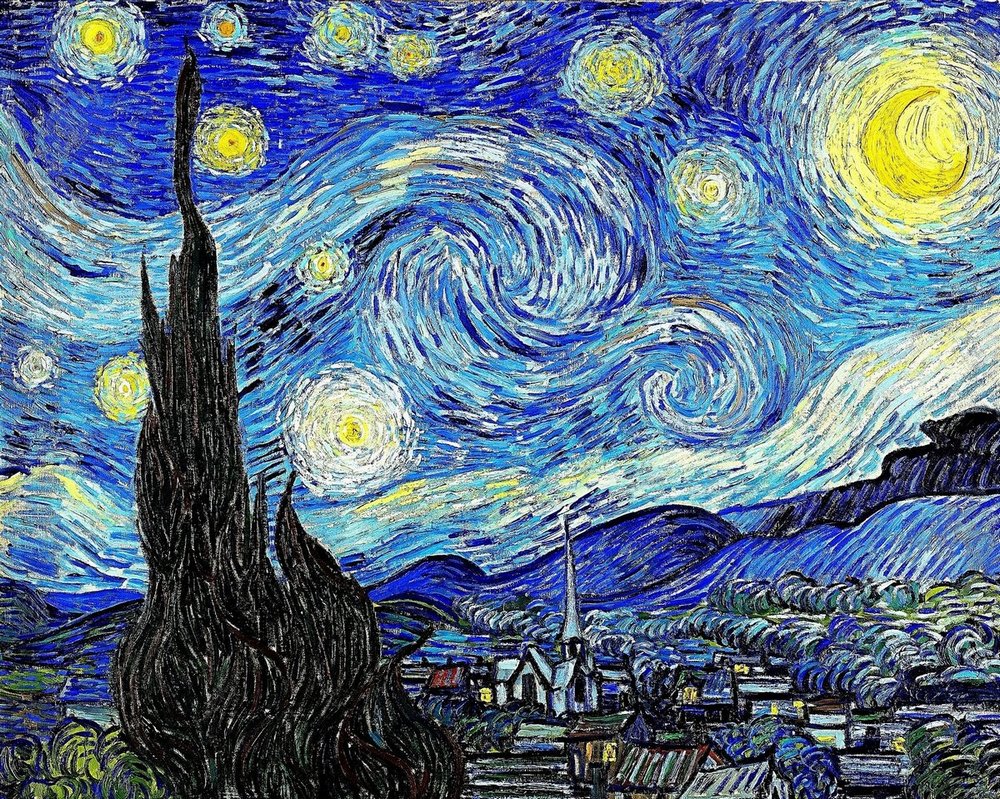
However, a new study by South Korean researchers from the space company SLLAB and Kyung Hee University argues that the turbulent predawn sky, with its crescent Moon and bright stars, is far more deeply rooted in actual astronomical observations than previously thought.
A Symphony of the Hyades and Venus
Using a separate landscape drawing, the researchers identified the precise location southwest of the asylum where the painter worked. Simulations of the sky above this spot showed that the painting’s composition almost perfectly matches the astronomical scene before dawn on July 22, 1889.
At that time, Venus appeared on the left side of the sky, the Moon was in the upper right, and the Hyades star cluster in the constellation Taurus lay between them. To demonstrate this, the scientists used Procrustes shape analysis, a mathematical method that removes differences in scale and rotation. It confirmed that the relative positions of five key stars in the painting preserve the “skeleton” of the actual star cluster.
“Van Gogh translated a real observation onto the canvas through stylistic amplification,” said lead researcher and astronomer Elijah Jeong Hyun Kim.
Revisiting the Medical History and Dating
The proposed late-July date contradicts the traditional account of the Museum of Modern Art in New York, where the painting is housed. The masterpiece was previously thought to have been created in mid-June, when the artist wrote to his brother Theo about a “new study of a starry sky.” However, the Moon in June was almost full, and such bright stars do not rise in the east near the summer solstice. In July, by contrast, the lunar phase and the positions of the Hyades and Venus matched the scene depicted.
It was long believed that van Gogh suffered a severe episode in mid-July that incapacitated him for several weeks. However, the researchers examined original letters and weather records from the period, finding that the episode may have occurred later, in late July, and lasted only a day or two. Analysis of the canvas also indicates that the artist deliberately left unpainted spaces for the stars, supporting the idea that the composition was planned.
Art Versus Exact Science
Despite the persuasive mathematical models, independent researchers urge caution in interpreting the findings. Professor Yongxiang Huang of Xiamen University points out that van Gogh was a master of Post-Impressionism, not a scientist trained in observing the stars.
Astronomer Ulrike Kuchner adds that the artist could freely blend imagination and reality: if he disliked June’s full Moon, he was entitled to exercise artistic license and paint a crescent instead. Nevertheless, researchers agree that deciphering the astronomical code of The Starry Night offers a fresh perspective on the great Dutch painter’s creative method, in which precise calculation and observation intertwined with an expressive vision of the world.
We previously explored how Copernicus changed our understanding of the Universe.
Based on material from CNN.