

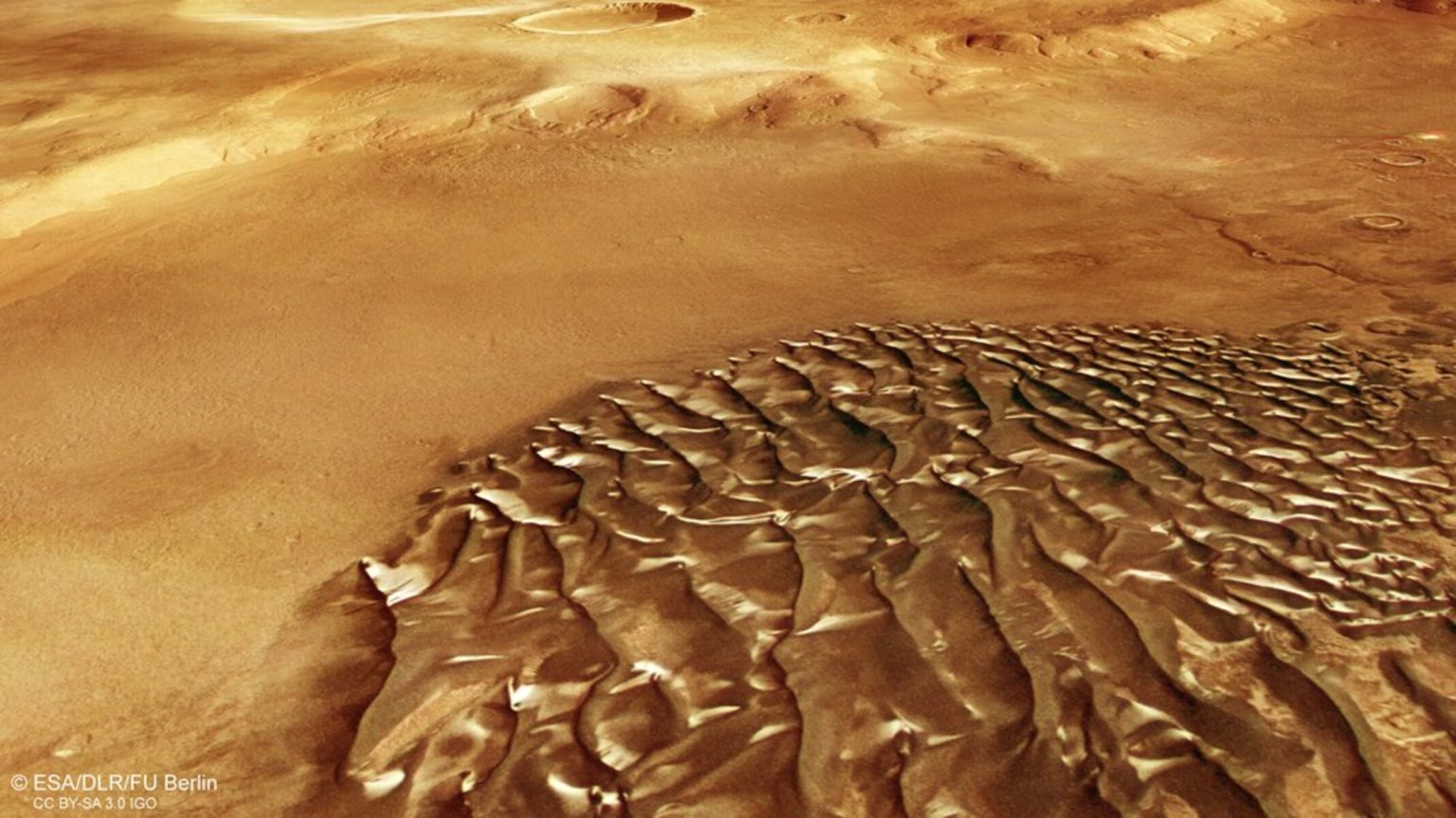
At the bottom of an ancient Martian crater, waves resembling polished metal can be seen. In reality, they are made of dark sand covered with light-colored frost. The contrast between the two colors creates an optical illusion visible only during the cold season.
The Crater Has Survived for Billions of Years
The Kaiser impact crater is 180 kilometers wide and approximately two kilometers deep. It is located in the southern highlands of Noachis Terra, which experienced intense bombardment during the early period of the planet’s history.
According to Universe Today, the region gave its name to the Noachian period of Martian geological history. The crater itself was named after Dutch astronomer Frederik Kaiser.
Mars has neither plate tectonics nor a dense atmosphere, so its landscape is rarely renewed. Traces of ancient impacts remain on the surface almost unchanged.
The Illusion of a Metallic Sheen
The waves on the crater floor consist of dunes, the tallest of which rise more than 100 meters and extend for several kilometers. Their height is roughly equal to that of the Motherland Monument in Kyiv, which reaches 102 meters together with its pedestal.
The material forming these features is volcanic and dark, with a high concentration of pyroxene and olivine. The images were taken during the second half of winter in the southern hemisphere, when frosty deposits from the polar cap reach the middle latitudes and settle as bright patches on the slopes.
The white glow of the frost stands out sharply against the nearly black background. According to the German Aerospace Center, this contrast creates the impression of a smooth, polished surface.
What the Shapes of the Dunes Reveal
At the edges of the dune field are isolated crescent-shaped formations similar to those found in deserts on Earth. They are known as barchans, and the horns of these dunes always point in the direction in which the wind is blowing.
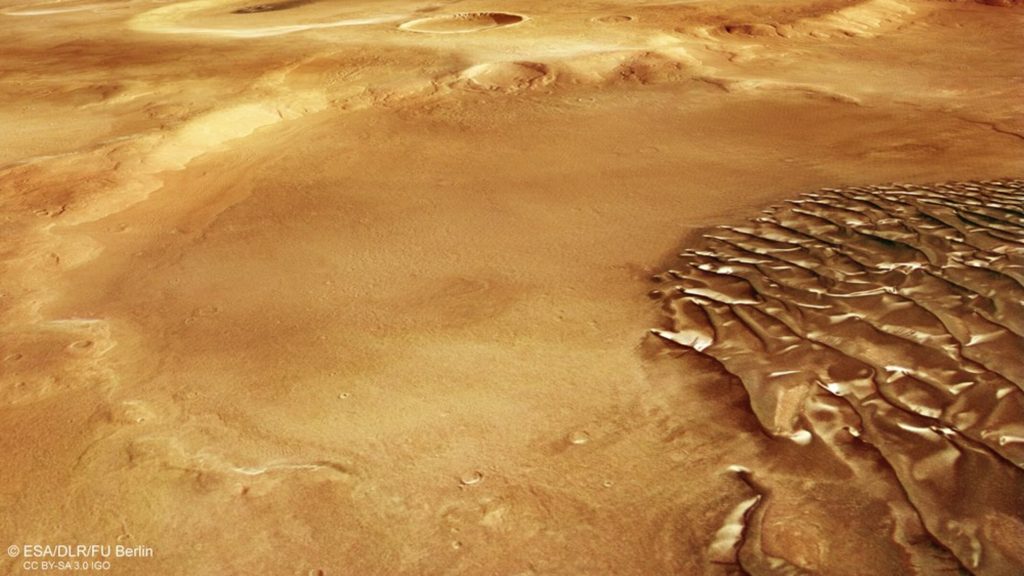
Closer to the center, the barchans merge into long parallel ridges arranged perpendicular to this direction. Based on the orientation of the ridges, researchers determined that the air inside the crater moves from the west.
Bright Streaks on the Crater Floor
Nearby, the wind has removed the upper layer of soil, exposing paler deposits. These are most likely clay minerals, which form in the presence of liquid water.
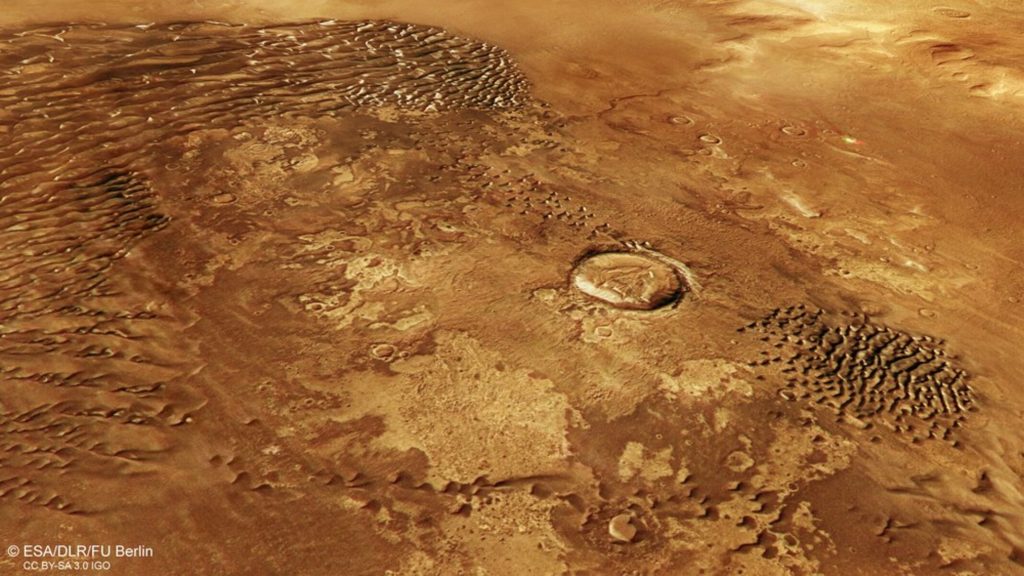
Narrow grooves can be seen on the steep inner walls of the depression. Some may have been carved by dry landslides, while others may have formed as ice melted during an era when the planet was wetter.
More Than Twenty Years of Research
The images were captured using the High Resolution Stereo Camera (HRSC) aboard the Mars Express orbiter. The spacecraft has been operating in orbit around Mars since 2003.
The materials were published by specialists from the Free University of Berlin in cooperation with DLR. The German institutions have been responsible for the instrument since the beginning of the mission.
The equipment has long exceeded its originally planned operating lifetime. The new images demonstrate that it continues to retain its scientific value.