

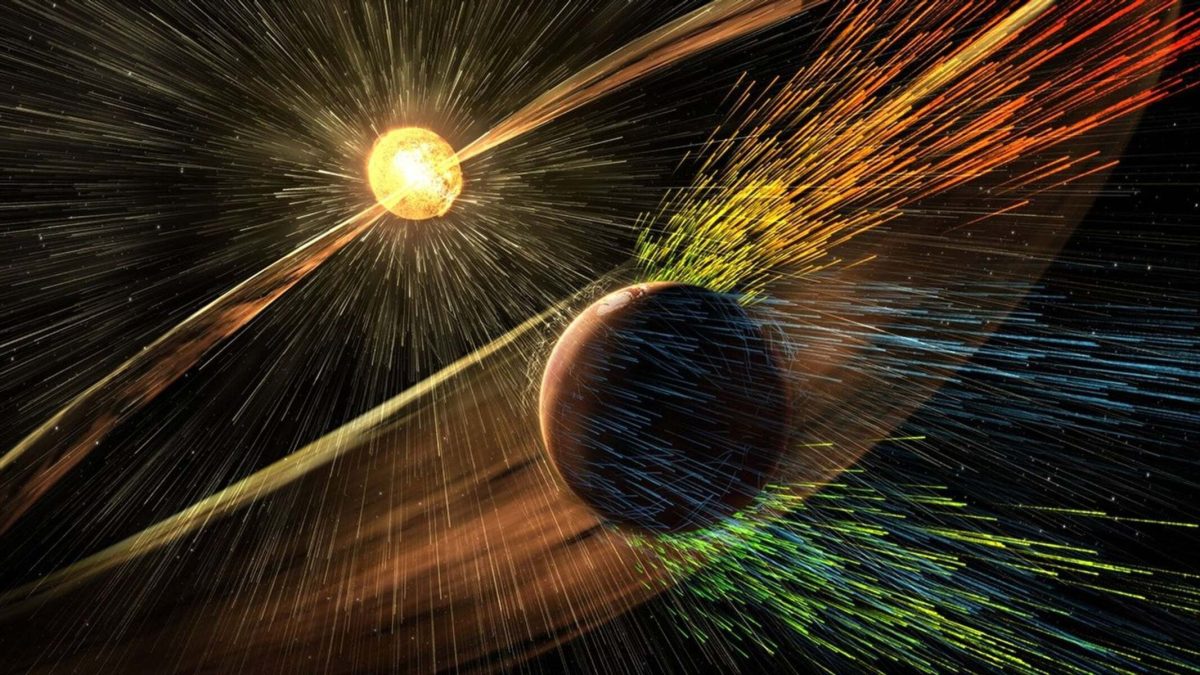
The glow in the Martian atmosphere arises through the same mechanism as auroras on Earth. The difference lies in scale. On the neighboring planet, the phenomenon covers only small patches of sky above particular regions of the surface. Data from a spacecraft whose mission has already ended helped scientists understand its nature.
A Familiar Mechanism
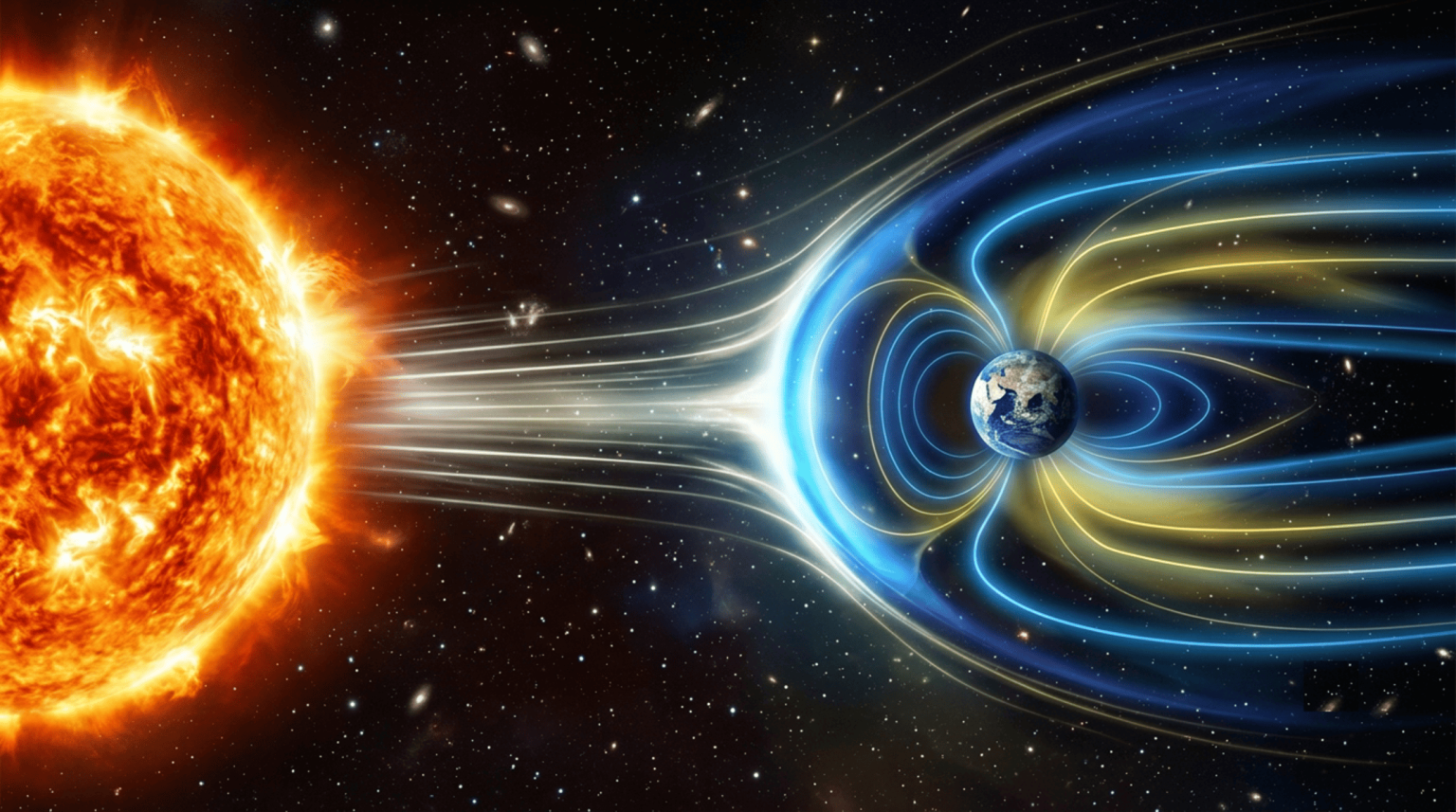
More than six decades ago, British space physicist James Dungey described how particles of the solar wind penetrate Earth’s magnetosphere. Magnetic field lines carried by the solar wind encounter the planet’s magnetosphere on the dayside and reconnect with it. The newly connected field lines are then swept toward the long tail stretching behind the planet, where reconnection occurs again.
From there, electrons are accelerated along magnetic field lines that converge near the poles and collide with the upper atmosphere. There they excite gas atoms and molecules, producing the familiar auroral glow. The same cycle drives electric currents in the magnetosphere and plasma circulation in the upper atmosphere.
Magnetic Patches in the Crust
The Red Planet lacks global protection from the solar wind. About four billion years ago, the dynamo in its interior that sustained its magnetic field shut down. The core probably remains liquid even today, but the movement of material within it is no longer capable of generating a protective magnetic shield.
What remains from that era are regions of crust that solidified from lava while the ancient magnetic field was still present and retained their magnetization. Tiny magnetospheres form above them. Local flashes of atmospheric glow in these regions had been detected before, but the physics behind their formation has only now been understood, Universe Today reports.
Data from Three Instruments
To reconstruct the full picture, researchers compared data from three scientific instruments aboard the MAVEN spacecraft. A magnetometer was used to determine the configuration of the magnetized regions, while the Solar Wind Electron Analyzer (SWEA) was used to calculate the electric currents in these zones.

The most challenging measurements came from the third instrument, the SupraThermal and Thermal Ion Composition instrument (STATIC), which measured plasma flows in the ionosphere. According to Shaosui Xu of the Space Sciences Laboratory at the University of California, Berkeley, the team had to push the instrument to the limit, and these measurements became the final piece of the puzzle.
The results were published on July 23 in the peer-reviewed journal Nature Communications. Magnetic reconnection near Mars had been expected, but its similarity to the terrestrial cycle came as a surprise, according to NASA.
A Guide for Future Missions
Understanding how electrons gain energy above magnetized patches of the Martian crust changes our view of how space weather interacts with Mars. Shannon Curry of the Laboratory for Atmospheric and Space Physics at the University of Colorado Boulder, the mission’s principal investigator, described the study as a step toward answering why two worlds governed by the same physics evolved so differently.
The strongest magnetized regions are concentrated in Mars’s southern hemisphere, so manifestations of the mechanism described above should be most noticeable over that part of the surface. For instruments aboard future spacecraft, this provides a ready-made target. A mechanism of this type may also operate elsewhere in the Solar System where similar conditions exist.
