

Whenever the news forecast predicts a geomagnetic storm, millions of people anticipate experiencing health issues. For power grid engineers and satellite operators, it may pose a risk to valuable equipment.
The well-known colloquial expression “magnetic storm” actually pertains to several distinct physical phenomena. Each phenomenon has its own cause, mechanism, and implications. Some are merely components of typical background radiation, whereas others can interfere with GPS signals within minutes or sever power supplies to entire regions. To comprehend why the Sun induces storms on Earth, it is prudent to initially examine the processes occurring on the Sun itself and their interactions with our planet.
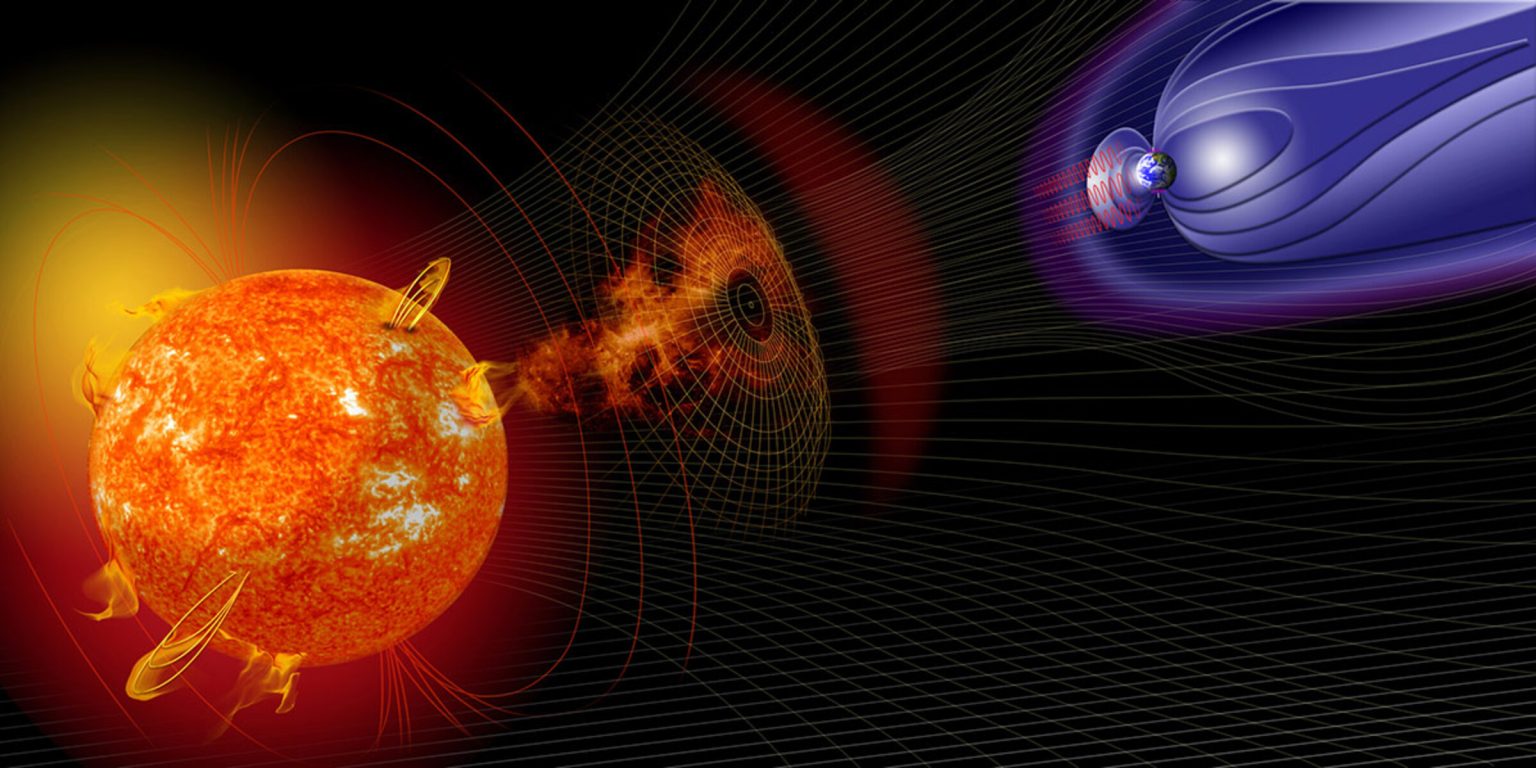
What is the origin of storms?
Daylight, or visible light, refers to the electromagnetic radiation within a narrowly defined portion of the solar radiation spectrum that the human eye can perceive. Furthermore, the Sun consistently emits infrared, ultraviolet, X-ray, gamma radiation, and radio waves, each consisting of photon streams with varying wavelengths and energies. These radiations arrive on Earth approximately eight minutes and twenty seconds after emission.
In addition to electromagnetic radiation, the Sun persistently emits a stream of charged particles into space — primarily protons (hydrogen nuclei) and electrons, along with a minor quantity of helium nuclei. This phenomenon is known as the solar wind. During periods of solar quiescence, it propagates at velocities ranging from 300 to 400 km/s. The magnetic field of our planet effectively deflects these particles, thereby preventing their arrival at the Earth’s surface. In the polar regions, this interaction results in the formation of the aurora. Elsewhere on the planet, it does not pose a threat.
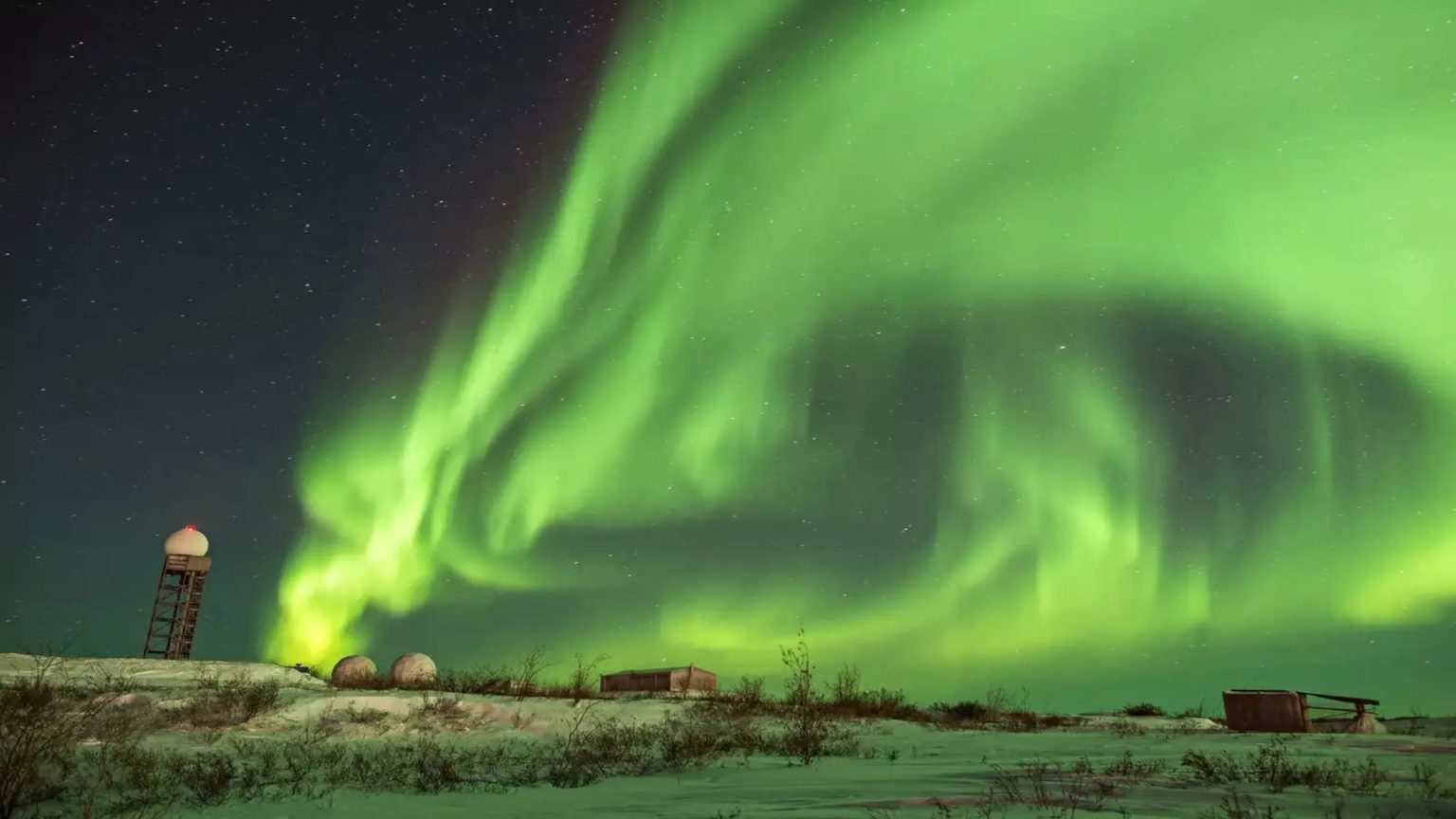
When news outlets report on a geomagnetic storm, solar flares are frequently referenced. Unlike persistent background radiation and the solar wind, a solar flare is characterized by a sudden and brief increase in radiation across the entire spectral spectrum. Furthermore, it propagates at the speed of light and does not inherently induce a geomagnetic storm.
The most powerful magnetic storms usually cause coronal mass ejections. The volume of expelled material is quantified in billions of metric tons and comprises plasma, which also transports a magnetic field that is frozen into the plasma. The velocity of such eruptions can vary from several hundred kilometers per second to over 2,000 km/s, with isolated documented cases surpassing 2,500 km/s. The most dangerous are fast and massive ejections whose magnetic field is oriented southward relative to the Earth’s. In this case, they transfer energy to the magnetosphere most efficiently and can cause a strong geomagnetic storm. In contrast, slow ejections or fast solar wind streams with speeds close to the background solar wind usually cause only weak disturbances.
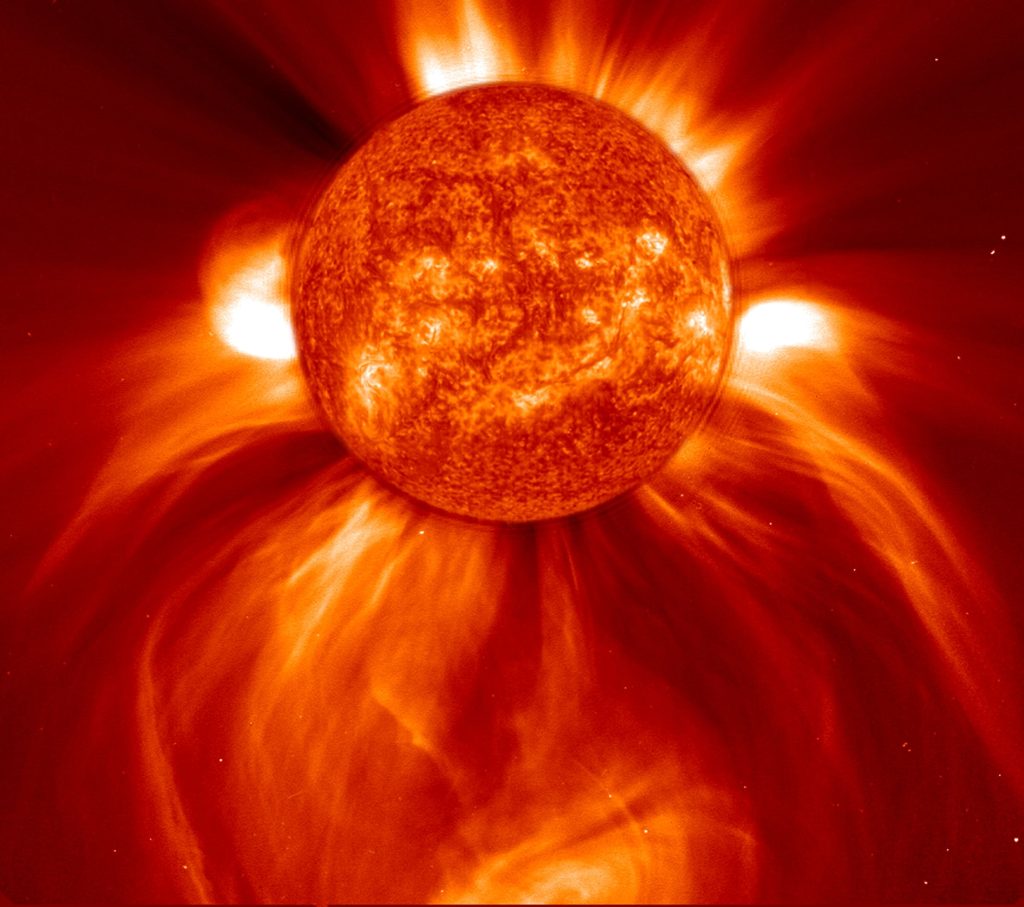
A solar flare and a coronal mass ejection may both manifest in the same active region of the Sun when magnetic loops become twisted, accumulate tension, and then abruptly snap and reconnect, thereby releasing stored energy. Nevertheless, there exists no direct cause-and-effect relationship between these phenomena. A powerful solar flare can occur independently of a coronal mass ejection, and a significant CME can sometimes take place without the presence of a bright solar flare. For the formation of a magnetic storm, it is ultimately the interaction between the ejected plasma and Earth’s magnetosphere that is of critical importance.
What is occurring on Earth?
Our planet possesses a robust magnetic field that creates a magnetosphere around it. This protective layer functions as an invisible shield for Earth and deflects streams of charged particles originating from the solar wind, thereby preventing them from reaching the surface. On the day side — that is, the side facing the Sun — it is compressed to approximately 65,000 km from the planet’s center. Conversely, on the night side, it extends into a magnetic tail that can reach hundreds of thousands of kilometers, and some estimates suggest it may exceed one million kilometers.
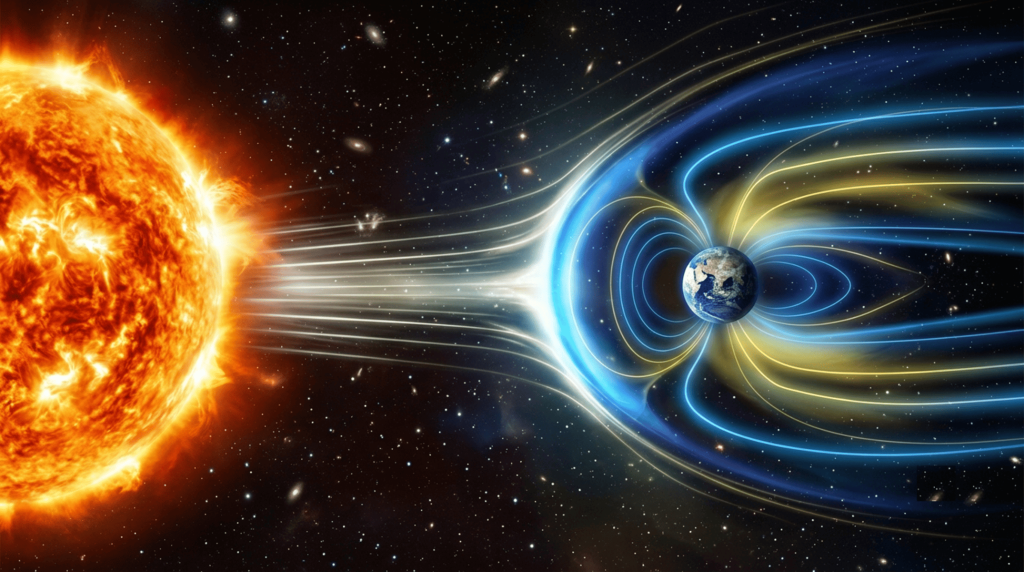
When a coronal mass ejection from the Sun reaches Earth, the plasma cloud collides with the magnetosphere on the daytime side and compresses its boundary toward the surface. A portion of the energy from this ejection is transmitted to Earth’s magnetic field via magnetic reconnection. The magnetic field lines of the Earth break, connect with those of the plasma cloud, and subsequently rearrange themselves. The accumulated energy is discharged, resulting in a sudden disturbance in the planet’s magnetic field — commonly referred to as a magnetic storm.
Storm intensity is evaluated using the scale established by the U.S. National Oceanic and Atmospheric Administration (NOAA). Levels G1 and G2 are classified as minor disturbances that are imperceptible to humans outside polar regions, although they can be detected by instruments. A G3 storm has the potential to cause disruptions in satellite operations and radio communications. G4 events may be associated with severe disruptions to power grids and navigation systems. G5 represents an extreme phenomenon capable of disabling transformers across entire power grids and producing auroras as far south as the Caribbean.
Levels G3, G4, and G5 are uncommon. According to official NOAA statistics, G5 conditions are documented for only a few days throughout an 11-year solar cycle. Most daily “magnetic storm” alerts relate to G1 or G2 levels.
The most notable incident took place on March 13, 1989, in the Canadian province of Quebec. A G5-level geomagnetic storm induced significant fluctuations in the Earth’s magnetic field, resulting in the disruption of transformer operations. These transformers overheated and subsequently failed. As a consequence, the entire Hydro-Québec power grid was incapacitated within ninety seconds, leaving nearly seven million individuals without electrical power for a duration of nine hours.
In May 2024, a significant storm, the most powerful in over two decades, occurred, reaching G5 intensity. At least seven coronal mass ejections impacted Earth, resulting in the visibility of the aurora borealis as far south as Florida, Mexico, and the Bahamas. NASA and other operators were compelled to place numerous satellites into safe mode. GPS systems encountered disruptions, with positioning inaccuracies ranging from tens of centimeters to several meters. Airlines rerouted polar flights due to radio communication disruptions. Power grids in Northern Europe and North America experienced voltage surges; however, large-scale blackouts were successfully avoided.
And what about people’s well-being?
Regarding power grids and satellites, the subject is relatively straightforward, as there are physical processes and metrics that can be measured directly. However, when considering the human body, the situation becomes more complex. Do magnetic storms genuinely influence our sensations? While there is a substantial body of scientific data, it remains contradictory.
One of the most extensive studies was published in 2025 in the journal Communications Medicine. Its authors analyzed over 500,000 blood pressure measurements collected over a six-year period and determined that blood pressure exhibits greater fluctuations during geomagnetic disturbances. Additionally, a study conducted in 2022 as part of the U.S. National Aging Study demonstrated a decline in heart rate variability among older men subsequent to magnetic storms, which serves as an indicator of physiological stress. Corresponding correlations were also observed in the incidence of myocardial infarctions.
Nevertheless, there is an additional perspective to consider. When the identical data set is examined employing more rigorous statistical methodologies, some of the previously observed correlations no longer persist. For instance, in a limited 2019 study involving twenty healthy volunteers, the association between geomagnetic activity and heart rate variability nearly vanished after accounting for autocorrelation. In essence, what initially seemed to be an effect of a geomagnetic storm may have simply been a coincidental occurrence.
Recent years have seen no significant or definitive research regarding headaches and sleep quality. The proposition concerning the influence of magnetic fields on the pineal gland and melatonin synthesis remains merely a hypothesis. The World Health Organization (WHO) has not issued an official stance concerning the potential harm of magnetic storms to healthy individuals. Furthermore, most national medical organizations do not acknowledge meteorological sensitivity as an official diagnosis.
The current findings indicate the existence of correlations between geomagnetic activity and specific physiological indicators, particularly in individuals suffering from chronic cardiac or vascular conditions. However, the scientific community has yet to establish a definitive causal mechanism. It is possible that the fatigue experienced upon waking this morning was directly attributable to geomagnetic disturbances, or it may simply be coincidental.
