

Asteroid 44 Nysa was initially discovered in the mid-19th century; however, its precise shape had not been determined until recently. Nonetheless, recent investigations have revealed that it is composed of three distinct lobes interconnected.
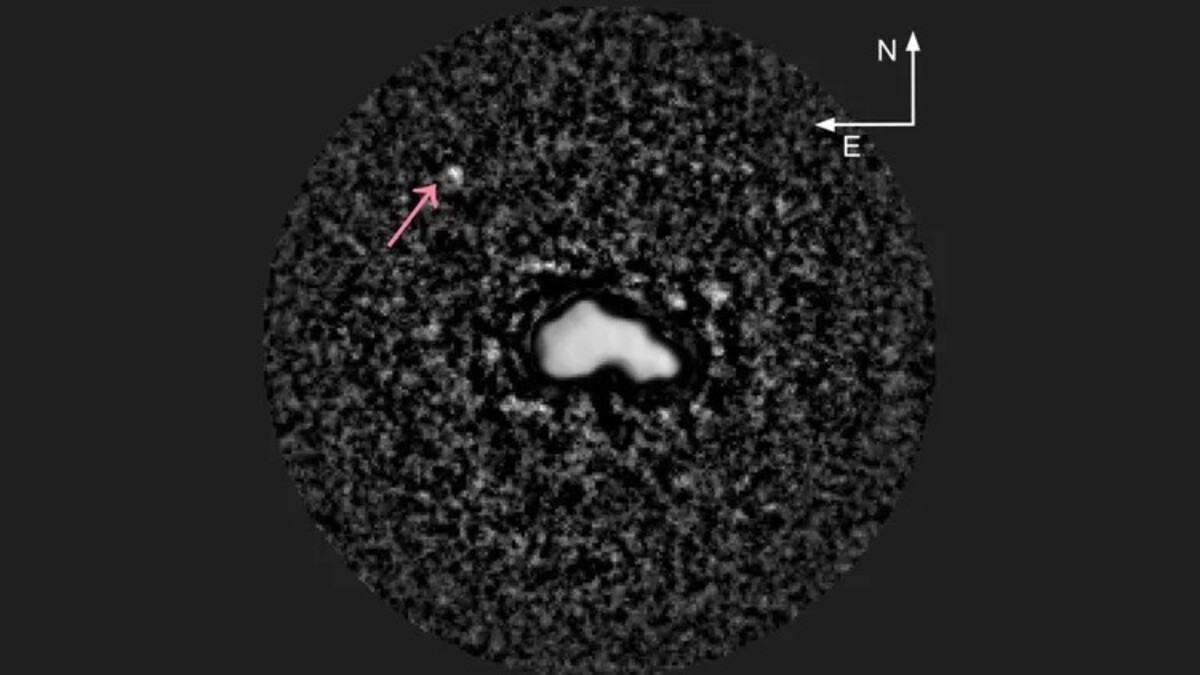
Three-headed Nysa
Historically, scientists have encountered instances of “two-headed” asteroids, which comprise two bodies that previously merged into a single entity through the processes of melting and solidification. Nonetheless, according to a report available on the website www.space.com, researchers have now identified the first “three-headed body.” An article detailing this discovery has been published on the arXiv preprint server and subsequently submitted to the journal Astronomy & Astrophysics.
Generally speaking, it is not entirely precise to refer to this as a “discovery.” We are discussing asteroid 44 Nysa. Scientists identified it in 1857; however, until now, only a small, indeterminate shape has been perceivable. Nonetheless, prior research has demonstrated that it cannot be composed of two interconnected fragments, yet it maintains a highly irregular form.
Scientists have now successfully ascertained the morphology of Nysa. They employed data obtained from the Large Binocular Telescope (LBT) at Mount Graham in Arizona and the Very Large Telescope (VLT) at Mount Paranal in Chile. This methodology facilitated the determination of the asteroid — named after the country associated with the ancient Greek myth concerning Apollo’s upbringing by the nymphs — actual appearance.
The formation of the asteroid
It has now been officially announced that Nysa comprises three blocks that appear to have gradually come into contact and fused together at that moment by molten rock. The total dimensions of the object are approximately 113 × 67 × 65 km, indicating that it is not particularly small.
The primary question currently facing scientists is how Nysa could have initially formed. The likelihood that three randomly traveling rocks through space would approach each other sufficiently closely — progressing slowly enough to avoid disintegration but to fuse into a single entity — is essentially negligible.
Scientists suggest that these may be fragments of a singular large celestial body. It is postulated that it experienced a significant collision, resulting in disintegration; however, some fragments persisted in traveling collectively and ultimately reassembled. While this hypothesis could potentially elucidate the phenomena observed, it also entails an implication that has yet to be verified.
Such collisions typically result in the formation of asteroid families — that is, groups of distinct bodies sharing similar orbital paths. However, in the case of Nysa, no such grouping has been identified to date. Nevertheless, it remains possible that further investigation may reveal such associations in the future.