

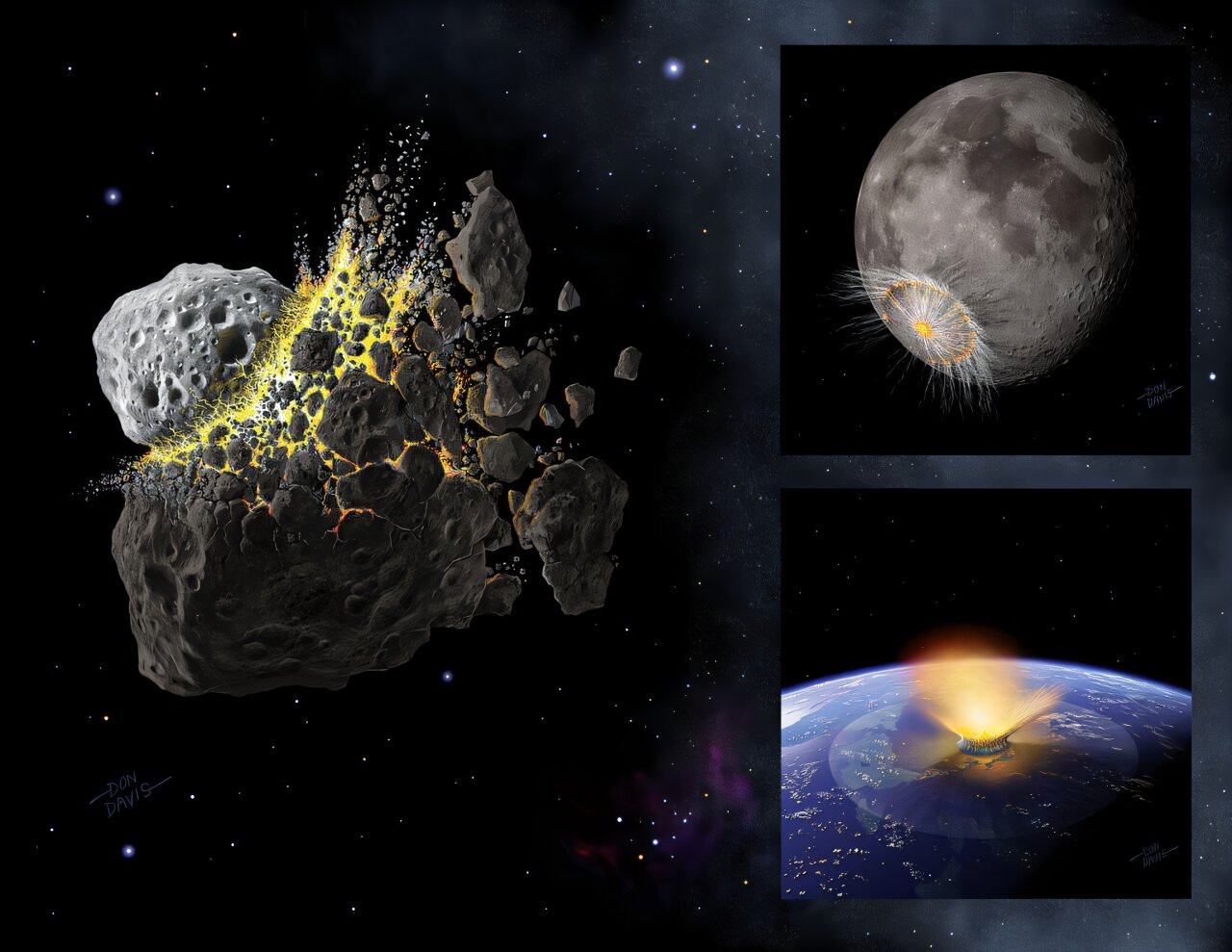
An unusually high concentration of craters approximately 800 million years old has been observed on the Moon. Scientists recently suggested that these craters may have been created by the breakup of a large body in the outer part of the asteroid belt, which triggered a genuine bombardment of the inner planets of the Solar System.
Asteroid Bombardment 800 Million Years Ago
At the very dawn of our planet’s existence, several billion years ago, it was subjected to massive asteroid bombardment. However, this does not mean that only isolated collisions occurred afterward. Even the Chicxulub asteroid was neither the largest nor the last object our planet encountered. Yet, as phys.org reports, something unusual happened in the Solar System about 800 million years ago, causing an intense bombardment of Earth and the Moon.
The study was conducted by a team of scientists led by researchers from the U.S. Southwest Research Institute. Its preprint has been published on the arXiv server. The authors report that an unexpectedly large number of lunar craters formed approximately 800 million years ago.
One might ask how many similar structures exist on Earth. There is, however, one problem. Unlike the Moon or, for example, Mars, Earth’s crust is constantly being renewed. This process occurs so slowly that it remains imperceptible on the scale of human history, but over 800 million years, most such traces genuinely disappear. Despite this, scientists are confident that a major event took place during that period.
Breakup in the Asteroid Belt
The central idea of the new paper is that such an intense bombardment may have been caused by the breakup of a large body in the asteroid belt. Scientists even suggest which body it may have been. They point to the Eulalia family, which is itself part of the much larger Polana–Nysa complex. Like other asteroid families, it is a group of bodies with similar orbits—so similar that their common origin can hardly be considered coincidental.
Eulalia itself is a body approximately 38 kilometers in diameter orbiting in the outer part of the asteroid belt. Because its family includes many other objects, the original parent body must have been truly large. Simulations showed that it may have orbited in a 3:1 resonance with Jupiter, and at some point the gravity of the giant planet tore it apart.
Why do scientists specifically suspect the parent body of the Eulalia family? The reason lies in its orbit. Calculations show that after the breakup, almost half of its fragments would travel like shrapnel toward the inner Solar System, where they would inevitably collide with the planets. Another approximately 25% of the fragments would meet the same fate over the following 100–150 million years.
This is sufficient to explain the bombardment experienced by the Moon at that time. Scientists also report that they have identified structures on Earth that are well suited to being craters formed during the same period.
