

The concept of black holes as inexorable traps from which nothing can escape has been demonstrated to be overly simplistic. A portion of the matter that descends into such an entity ultimately re-enters interstellar space. Additionally, potent outflows of gas persist even when the system is nearing dissipation.
The 2023 outbreak
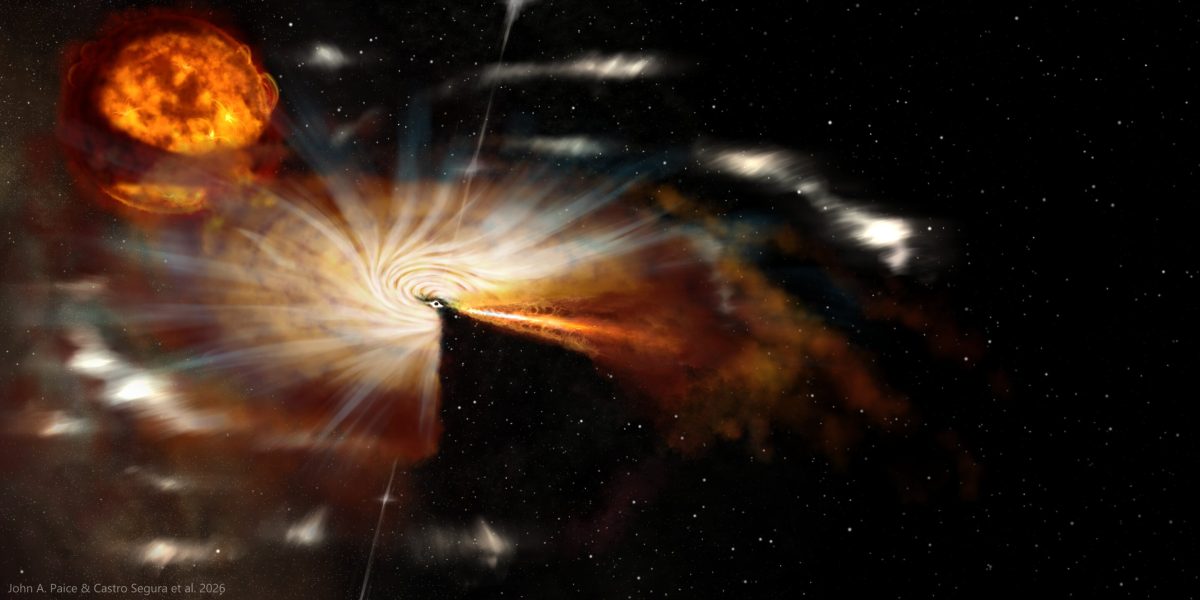
The Swift J1727.8−1613 system was identified in 2023, when it experienced a sudden increase in brightness and promptly became one of the most luminous objects in the sky. It comprises a black hole and an adjacent star, from which matter is accreted into the compact object, developing a hot accretion disk.
The interior gas is heated to millions of degrees, resulting in the emission of most energy within the X-ray spectrum. This is the reason why such objects are designated as X-ray binaries.
The observations were carried out using the Very Large Telescope (VLT) at the European Southern Observatory, under the leadership of Noel Castro Segura from the University of Warwick. The findings were published in the peer-reviewed journal Monthly Notices of the Royal Astronomical Society, as documented by phys.org.
Disc and jets
Astronomers acquired one of the most comprehensive optical datasets of such an event. Instead of relying on a few isolated images, they conducted a series of measurements that encompassed the entire duration of the system’s activity, from the abrupt increase in brightness to its subsequent fading.
At the moment the powerful jet was expelled, the accretion disk surrounding the black hole experienced substantial alterations. This presents a rare opportunity to observe the relationship between material infalling and its ejection into space.
This identical system has already been documented in the record books. Radio interferometric measurements from the same period revealed the longest jet ever observed in X-ray binary systems.
The wind after it subsides
The most unforeseen outcome manifested at the conclusion. Even when the luminosity had diminished to approximately one-hundredth of its maximum value, a substantial outflow of gas persisted from the system. Such outflows originating from the surface of the disk are designated as disk winds.
According to the authors’ estimates, the quantity of ejected material may be comparable to that which ultimately accretes onto the black hole. Such outflows persist well beyond the cessation of the brightest phase.
Inefficient absorption of a substance
The primary author of the study, Noel Castro Segura, elucidated that the process of accretion onto a black hole is considerably less efficient than earlier estimations suggested. A substantial fraction of the inflowing matter may never traverse the event horizon, which consequently alters the calculations pertaining to the evolution of binary star systems within galaxies.
Co-author Kyle Solomons of the University of Cape Town highlighted an additional aspect of this phenomenon. Researchers generally concentrate on the initial stages, despite the fact that there is sufficient energy at the conclusion to induce a substantial gas outflow, even in the presence of weak X-ray emission.
