

Solar flares generate magnetic storms, and magnetic storms cause numerous problems for people. That is why it is so important to provide advance warning of them. The new MAGIC CubeSat mission will be able to issue warnings three hours before an event, rather than only 15 minutes in advance, as has been the case until now.
Mission Objectives
Warnings about space weather could be received hours before it reaches Earth rather than only minutes in advance, thanks to a miniature instrument developed in the United Kingdom that will soon be deployed in deep space. MAGIC, the MAGnetometer from Imperial College, is part of the European Space Agency’s CubeSat mission, the Heliospheric Pioneer for Solar and Interplanetary Threats Defense (HENON), which is scheduled for launch in early 2027.
By measuring the Sun’s magnetic field much farther upstream than current real-time space-weather monitors, the mission aims to extend the warning period for severe solar storms from tens of minutes to several hours.
The research was presented at the Royal Astronomical Society’s National Astronomy Meeting in Birmingham by Jonathan Eastwood, Professor of Space Physics in the Department of Physics, Blackett Laboratory, at Imperial College London.
Coronal Mass Ejections and Current Warning Systems
Space weather is caused by activity on the Sun, including solar flares and coronal mass ejections—enormous eruptions of magnetized plasma that travel through space. When these eruptions reach Earth, they can trigger geomagnetic storms capable of disrupting satellites, communications, navigation systems, and power grids.
Although scientists can already predict when a coronal mass ejection is likely to reach Earth, forecasting how severe its effects will be is much more difficult. This depends on the magnetic field carried by the eruption, which can be measured only directly as it travels through space.
At present, operational space-weather forecasts rely on spacecraft located at the Sun–Earth L1 Lagrange point, approximately 1.5 million kilometers, or 930,000 miles, from Earth. For the fastest coronal mass ejections, this gives forecasters only about 15 minutes of warning.
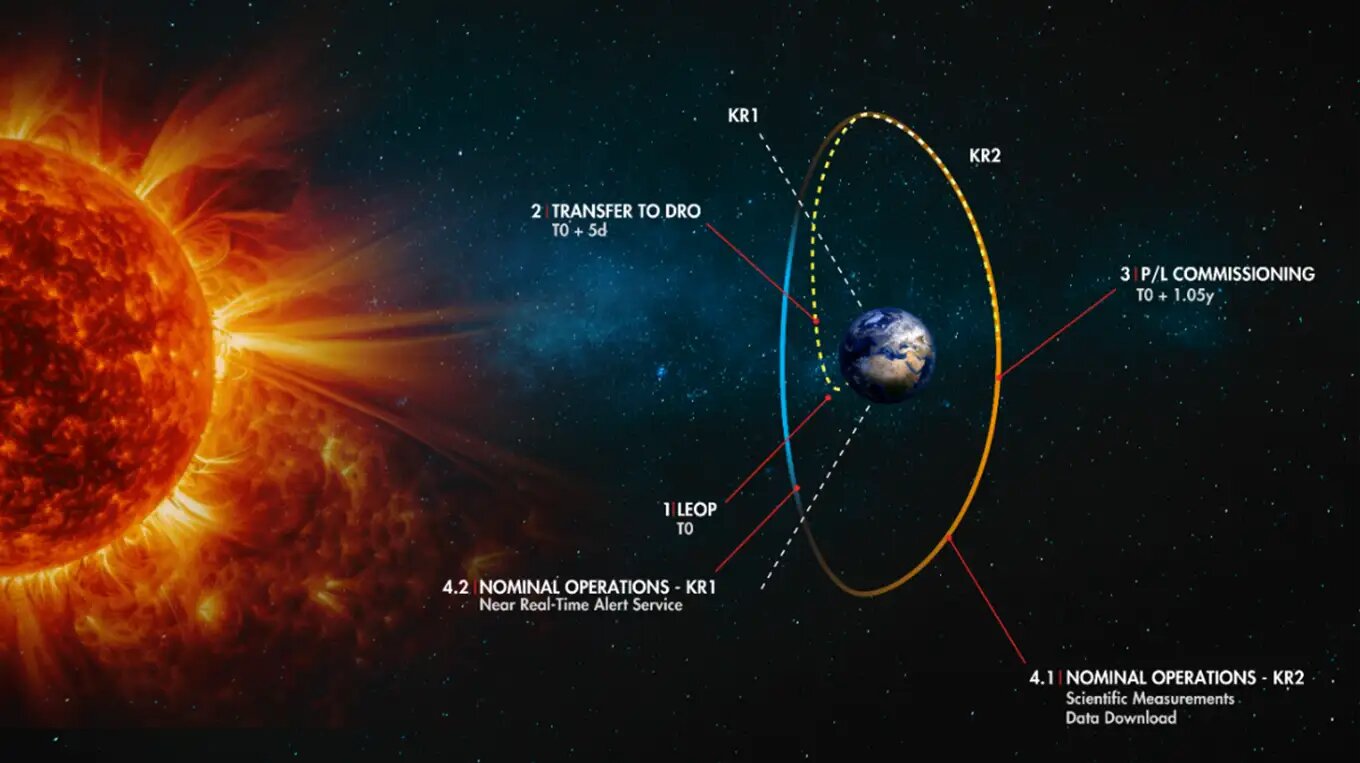
A Special CubeSat Orbit
HENON will take a different approach. The CubeSat will travel into a special orbit that will place it approximately 15 million kilometers, or 9.3 million miles, farther upstream from Earth—ten times farther from Earth than L1—allowing it to sample the solar wind much earlier.
“From a technology perspective, this is an exciting mission because it will be the first time our miniature MAGIC instrument has flown into deep space to measure the interplanetary magnetic field,” Eastwood said.
Prospects for Space-Weather Forecasting with the New Instrument
MAGIC, developed at Imperial College London, will measure the interplanetary magnetic field carried by the solar wind as it travels away from the Sun. Together with two other instruments developed by scientists in the Czech Republic and Finland, MAGIC will provide the measurements needed to test whether earlier and more accurate space-weather forecasting is possible.
If successful, HENON could increase the warning time for the strongest geomagnetic storms tenfold, from approximately 15 minutes to two or three hours. This would give satellite operators, power-grid managers, and other users significantly more time to prepare for the consequences of major space-weather events.
“The success of HENON will represent a step forward in our ability to forecast space weather and will pave the way for the future operational space-weather mission SHIELD, which is being developed by the European Space Agency,” Eastwood said.
The SHIELD mission will provide continuous early warning of potentially dangerous solar storms from a location much farther away than current spacecraft. HENON is a technology-demonstration mission managed by the European Space Agency and is scheduled for launch in early 2027 as a secondary payload on the same rocket as the PLATO mission.