

For decades, astronomers believed that the surface of Mars completely froze about 3 billion years ago and has remained that way ever since. If that were truly the case, any liquid water would long ago either have moved underground or evaporated into space. However, thanks to a new analysis of mineral data collected by Zhurong — China’s first Mars rover — researchers led by Jiacheng Liu of the University of Hong Kong have found evidence that does not support this theory.
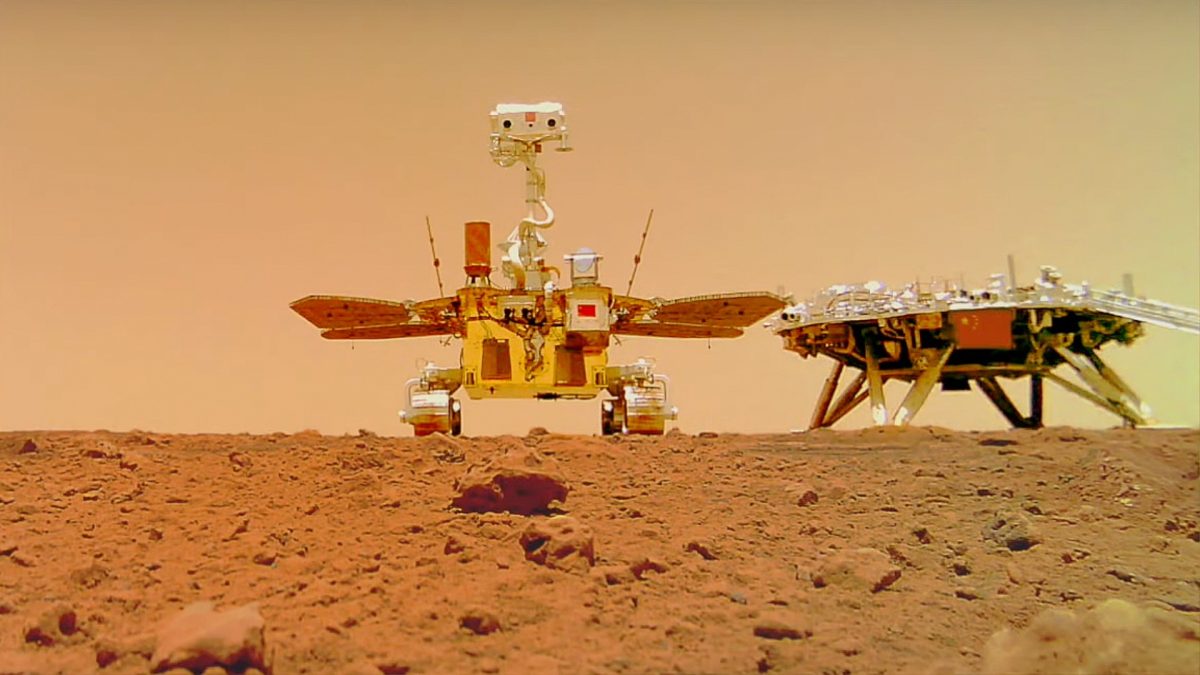
Photos from Zhurong
In May 2021, Zhurong landed in Utopia Planitia, a vast plain in the northern hemisphere of Mars. Over the course of 93 days, it collected a large amount of data about the Martian surface before a dust storm interrupted its mission in 2022.
During that time, Zhurong’s cameras photographed light-colored, flat rocks protruding from the sand, while its instruments transmitted data to Earth indicating that the rocks were rich in water-bearing minerals. However, based on the images alone, researchers found it difficult to determine the exact mineral composition of these rocks.
Minerals Point to the Presence of Surface Water
In their study, Liu’s team analyzed the remaining Zhurong data in greater detail. This time, they focused on the shapes of tiny crystals visible directly beneath the surfaces of the rocks: some curled like cabbage leaves, while others branched like fir trees. Using combined measurements obtained with the rover’s laser and infrared spectroscopy instruments, the scientists determined that these structures were formed by selenite — a large-crystal form of gypsum that can form only by crystallizing directly from concentrated salty water.
Based on the thickness of the mineral layer, the researchers calculated that its formation would have required a body of water between 6.25 and 25 meters deep (20.5 to 82 feet), which would have accumulated on the surface over time.
Judging from the density of the surrounding craters, they estimated the age of the surface itself at approximately 757 million years. The team suggests that the water originated from underground brines, melted and was pushed upward by heat from volcanic activity, and was then trapped and concentrated as freezing proceeded from the top downward.
Inspiration for Future Missions
If the team’s measurements are accurate, they would indicate that surface water on Mars may have persisted for hundreds of millions of years longer than most models suggest. Because selenite crystals can tightly seal tiny cavities in which they formed, they could potentially preserve a chemical snapshot of this ancient environment.
In turn, this region of Utopia Planitia could become a strong candidate for detailed investigation by future Mars rovers equipped with instruments designed to study ancient environments preserved within crystalline structures.
According to phys.org
