

A recent examination of a 17th-century manuscript indicates that the renowned astronomer and engineer Galileo Galilei may have been engaging in experiments with the development of sophisticated four-lens telescopes as early as the early 1630s. If this information is confirmed by additional historical or material evidence, it could make him one of the first to operate such schemes.
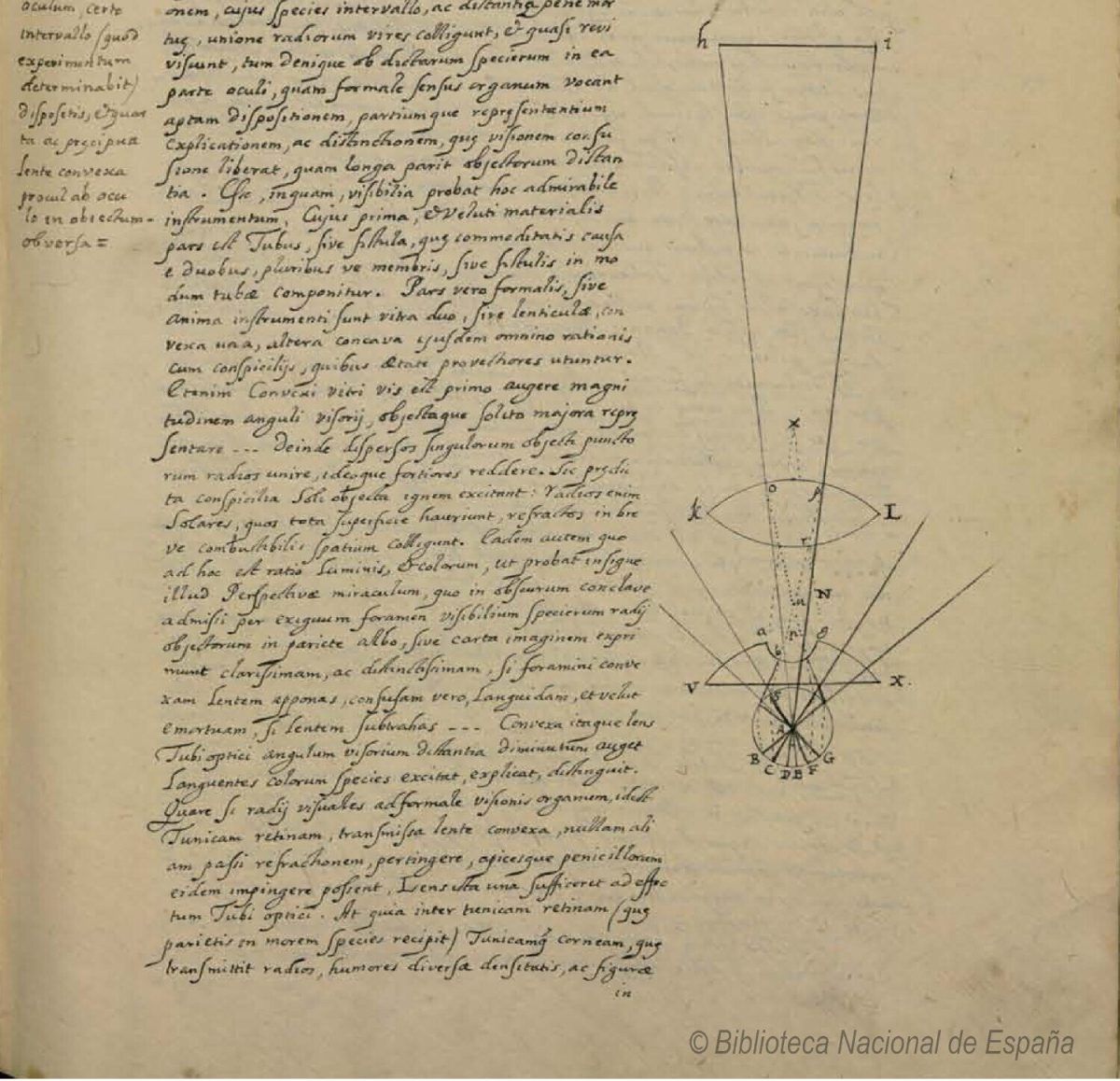
Information regarding telescopes as documented in an ancient manuscript
The renowned scientist Galileo Galilei was capable of constructing not only relatively straightforward telescopes equipped with two lenses but also significantly more intricate instruments comprising as many as four optical components: two biconvex lenses, one convex lens, and one concave lens. This assumption is supported by an article authored by José María Moreno of the University of Limerick, as reported on phys.org.
The article was published in the Annals of Science journal. It examines a study of a manuscript titled De Tellescopiis Stellarum, dated 1666. The author is thought to be the Spanish monk Ignacio Muñoz, and the manuscript concerns telescopes. Specifically, the author provides a detailed description of the design and operating principle of the instrument, which features four lenses.
It is noteworthy that, during that period, telescopes equipped with four lenses were already produced on a large scale, although they remained relatively novel instruments. These telescopes are believed to have been invented between 1643 and 1645, with mass production commencing towards the end of that decade. However, the manuscript indicates that the instrument described by Muñoz was crafted by Galileo Galilei himself. Consequently, it must have been fabricated no later than the early 1630s.
Galileo and telescopes
Galileo Galilei was long credited with inventing the telescope. In fact, the first telescopes appeared in the Netherlands in 1608, before Galileo created his own version. However, it was Galileo who quickly perfected this device and turned it into a powerful tool for astronomical observations. His scheme consisted of only two lenses – a convex objective and a concave eyepiece – and later received the name “Galilean telescope”.
The situation is also complicated with the telescopes traditionally attributed to Galileo himself. Many such devices were made in the first half of the 17th century, but only a few have survived to this day. A new study notes that none of the eight telescopes from this period that have survived can be unequivocally attributed to Galileo. This also applies to the two examples from Florence, which are usually used to illustrate articles about telescopes, but this affiliation is not unanimously accepted. Therefore, it is impossible to determine with absolute certainty which telescopes Galileo made at the end of his life.
No systematic records exist concerning the types of telescopes he constructed. It is only known that he never sold these devices; however, he did distribute them as presents. Notably, he gifted three telescopes to the King and Queen of Spain, though the specific models remain unidentified.
Are the telescopes truly attributable to Galileo?
A recent study has emerged concerning this little-known manuscript, briefly asserting that the telescope it describes was manufactured by Galileo. It is essential to clarify the origins of this instrument. It was presented to him by the Viceroy of New Spain, Antonio Sebastián de Toledo Molina y Salazar, not merely as a gift, but explicitly for the purpose of assessing his technical proficiency.
The fact remains that Monk Muñoz did not arrive in New Spain — i.e., the colonies of the Spanish Crown — by coincidence, but as a punitive measure for his attempt to establish an unauthorized order. He appealed to the Spanish king, requesting that the merchant fleet, which was traveling from the Philippines through these colonies back to the homeland, include him. He asserted that he was a highly skilled optician capable of providing the royal fleet with optical instruments unparalleled in the world.
The viceroy expressed skepticism regarding his statement and, to substantiate the claim, instructed him to describe the device, which he subsequently did. The question of whether it was genuinely created by Galileo and subsequently acquired by the family of a Spanish nobleman remains a subject of debate.
