

Pluto’s path around the Sun is a long elliptical journey that takes 248 Earth years. The dwarf planet is currently moving gradually farther away from our star. According to new data published in The Planetary Science Journal, this increasing distance is already causing a gradual and noticeable change in Pluto’s extremely thin atmosphere.
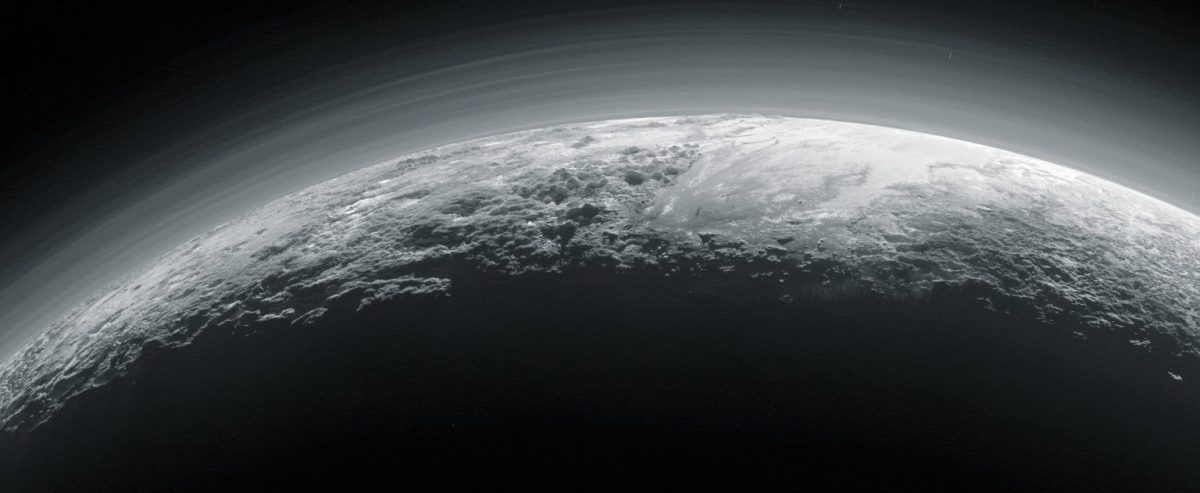
During its historic flyby in 2015, the New Horizons spacecraft studied Pluto’s physical properties in detail, including its atmospheric pressure. In a new study, a team led by Amanda Sickafoose of the Planetary Science Institute compared those measurements with the results of recent observations. The researchers found that Pluto’s gaseous envelope began to shrink significantly in mid-2021, which may indicate the beginning of atmospheric collapse.
How to Observe Pluto’s Atmosphere
Even through the best ground-based telescopes, Pluto appears only as a tiny, blurred spot. Astronomers therefore use the highly effective method of stellar occultations, observing the moment when Pluto passes in front of a distant star and casts a shadow on Earth.

The dimming and subsequent return of the star’s light allow astronomers to study distant objects with a spatial resolution of several kilometers, several orders of magnitude better than other ground-based methods. Scientists have used this technique to track changes in Pluto’s atmospheric pressure since the late 1980s. For the latest study, astronomers analyzed ten occultations recorded between 2017 and 2023.
The Anatomy of the Contraction
Pluto’s atmosphere consists mainly of nitrogen, with small amounts of carbon compounds that form a thin haze around the dwarf planet. Its density is only a few millionths of that of Earth’s atmosphere.
The analysis showed that the size and pressure of Pluto’s atmosphere increased steadily between 1988 and 2015 and remained on a stable plateau until 2021. By 2022, however, measurements revealed a clear 16% decline in atmospheric parameters.

The physical cause of this phenomenon is the cooling of Pluto’s icy surface. As the dwarf planet moves farther from the Sun, falling temperatures cause atmospheric gases to condense and settle on the surface as frost. As a result, the haze layer becomes thinner and descends to lower altitudes.
What Lies Ahead for Pluto
Scientists discussed the possibility of such a scenario as early as 1996, and in 2021 another research team suggested that Pluto’s atmosphere had been “freezing out” since 2018. The new study provides the first direct evidence that this process has begun.
Researchers will have plenty of time for further observations, because Pluto will not begin moving closer to the Sun again until 2114. Over the coming decades, astronomers will be able to determine whether the dwarf planet’s gaseous envelope disappears completely or returns to life during the next stage of its orbit.
We previously explained why Pluto will not regain its status as a planet.
According to psi.edu
