

Pluto’s icy moon Charon had hidden the secret of its rotation for billions of years. But new computer modeling, the results of which were published in the scientific journal Nature Communications, has finally shed light on its early childhood. Scientists found clear tectonic “scars” on the surface of this celestial body, proving that in the past Charon rotated around its axis ten times faster than it does today.
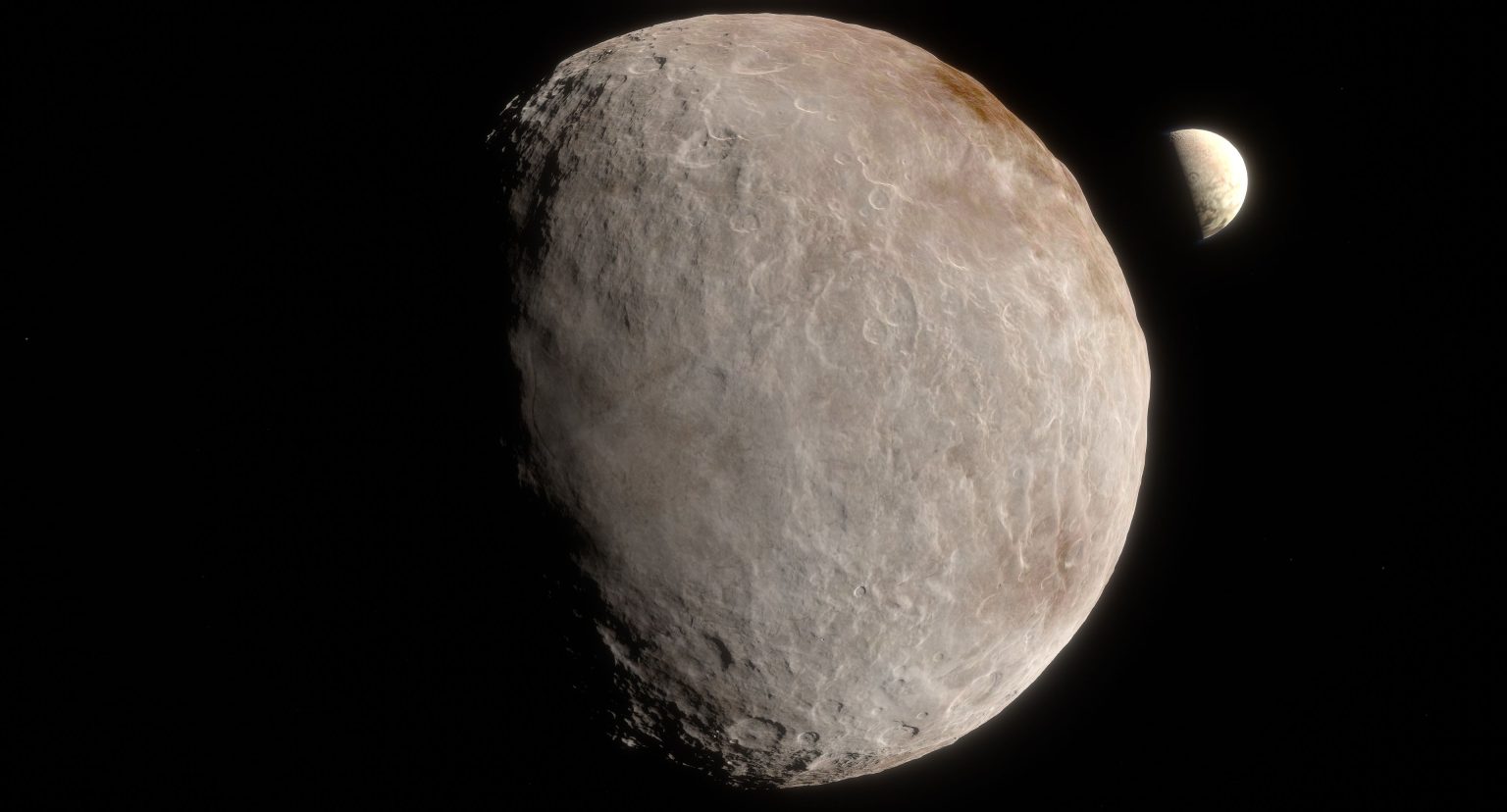
A fundamental mechanism of interaction between celestial bodies operates in the Solar System, known as tidal braking. Under the influence of powerful tidal forces from the host planet, the satellite gradually slows down its own rotation. At the same time, tidal forces deform its interior, which can change the thermal state and geological structure of the body. Eventually, the rotation synchronizes with the orbital motion, and the satellite finds itself in a state of tidal capture, when the same side is always turned to the planet.
In theory, this process had long been described for many worlds, but finding its undeniable geological traces is extremely difficult. Charon became an ideal candidate for such a search: its icy surface froze about 4 billion years ago and has hardly been renewed since, preserving a unique record of the early Solar System.
The mysteries of Oz Terra
A group of researchers led by Hanzhang Chen studied the structure of mountain ridges in Charon’s northern hemisphere, in a region called Oz Terra. The scientists analyzed giant faults stretching for more than 200 km. The asymmetric shape of their slopes indicated that these structures formed as a result of global compression of the crust, not its stretching.
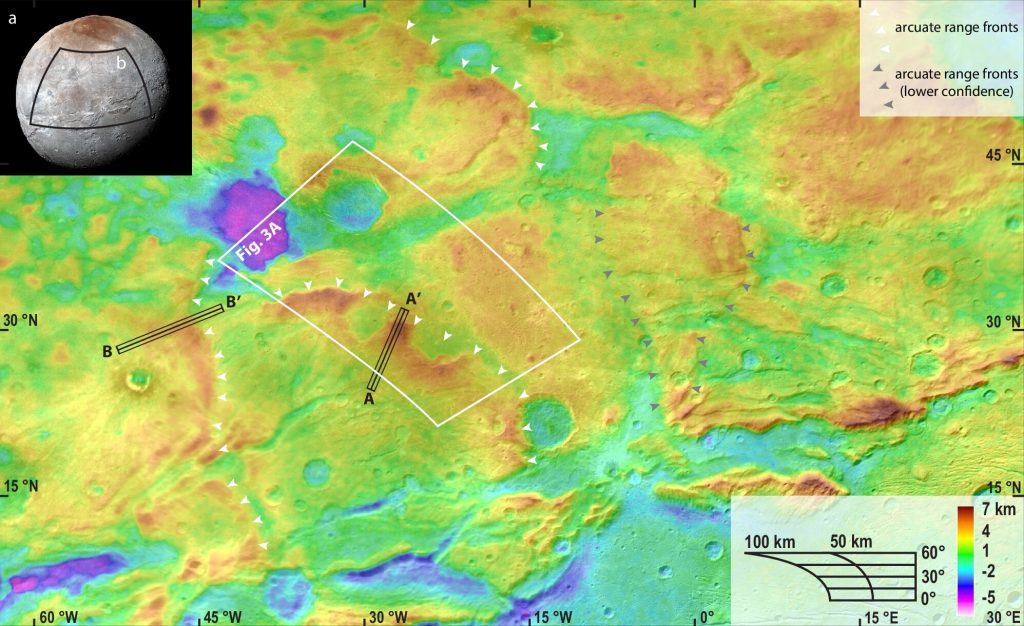
Mathematical modeling showed that, for such folds to appear on the surface, Charon must have had a strong icy shell at least 30–36 km thick at the time of its slowdown. As its rotation slowed, the moon’s shape changed, causing its equatorial zone to compress by about 1%. The icy crust absorbed this enormous stress along pre-existing fault lines, pushing up majestic ridges.
A day lasting 14 hours
Astronomers’ calculations make it possible to reconstruct an astonishing picture of the past. At the beginning of its evolution, Charon completed one full rotation around its axis in just 14.3 hours. Over time, the gravity of neighboring Pluto steadily slowed the moon down until the length of its day increased to the current 153.3 hours, or about 6.4 Earth days.
These data also indicate that the moon began its history in a relatively cold state. This allowed it to quickly build up a thick and rigid icy “armor,” which preserved the traces of its gravitational struggle. Although some unknown variables still remain in the models, this discovery is a unique geological document that will help scientists understand the complex history and evolution of other icy worlds on the outskirts of our system.
Earlier, we reported on how Charon’s “red cap” formed.
According to phys.org
