

So far, nearly all stellar-mass black holes detected by astronomers have been found in binary systems. However, astronomers have long suspected that these binary black holes are the exception and that most black holes in the Milky Way exist on their own.
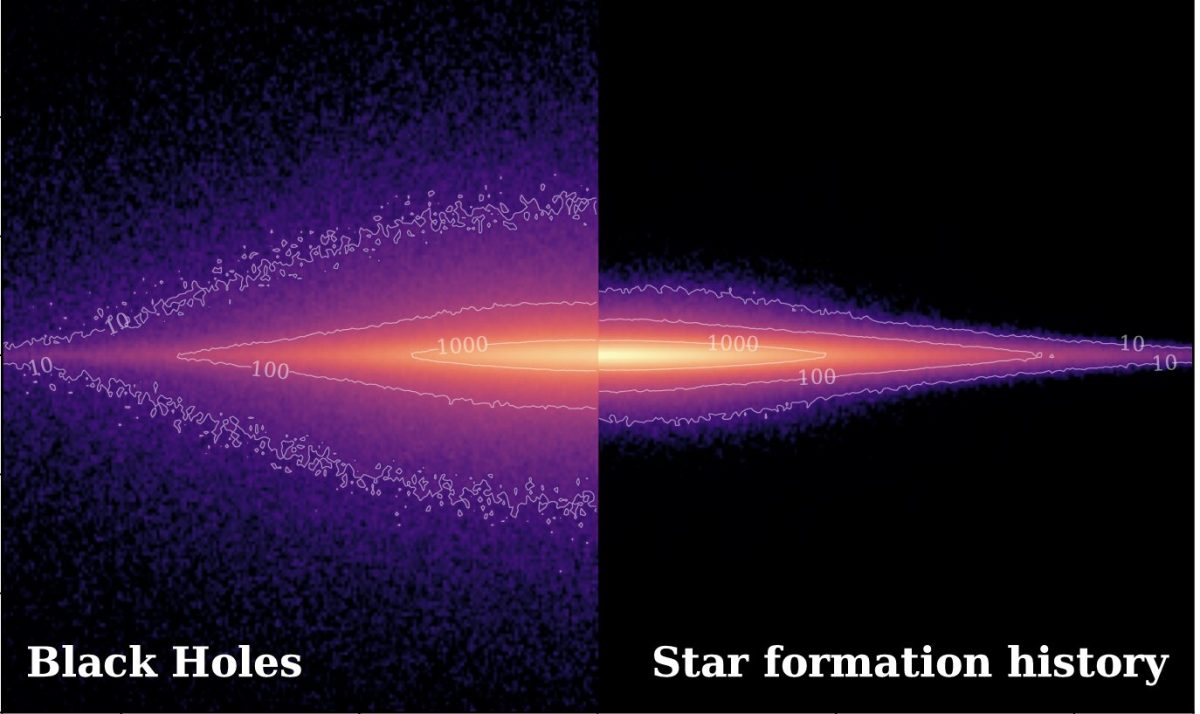
Simulations Reveal Black Holes
As phys.org reports, researchers led by Wagg of the Flatiron Institute in New York used computer simulations and calculated that more than 90% of the stellar-mass black holes in our galaxy may be isolated in this way, suggesting the existence of an enormous reservoir of objects that have yet to be observed.
By definition, black holes cannot emit light at any wavelength. Therefore, the only way to detect them is through their gravitational influence on other objects—for example, when a companion star is stretched or heated. Because isolated black holes have little surrounding material to disturb, they are effectively invisible, making it difficult for astronomers to study how black holes form and change over time.
Until observational methods improve, there is no clear solution to this problem. However, astronomers can still learn a great deal from models. In their study, Wagg’s team created a simulation of the Milky Way’s history, modelling how stars are born, evolve, and die over billions of years.
Their simulation also accounted for the supernova explosions that create black holes and the powerful natal “kicks” that can propel them through the galaxy. By running the model through cosmic time, the researchers were able to estimate how many black holes should exist today, where they are likely to be located, and how quickly they are moving.
A Hidden Population
The results suggest that approximately 91% of the stellar-mass black holes in the Milky Way are now isolated, with no companion star that could reveal their presence. About 3% received enough speed from the initial “kick” at birth to escape the galaxy entirely.
This leaves only a small fraction in the binary systems that astronomers normally rely on for detection. It means that the population studied so far provides a poor representation of what actually exists.
With future data from the Roman Space Telescope, the next Gaia data release, and various spectroscopic surveys, many astronomers hope that black holes will be detected using more subtle methods—for example, by observing how their gravity bends the light of distant stars.
Through their simulations, Wagg’s team has now provided a predicted map showing where to search for these elusive objects and what signs to look for. Using these predictions as a guide, astronomers will be able to test their models of stellar death and black-hole formation against a much larger and more representative portion of the galaxy’s hidden population.
