

The star that gave life to our planet will eventually destroy it. Astronomers have long agreed that the Sun’s gradual expansion into a red giant will make Earth uninhabitable. However, independent researcher Gabriel Harry believes that humanity may have a chance to avoid this fate.
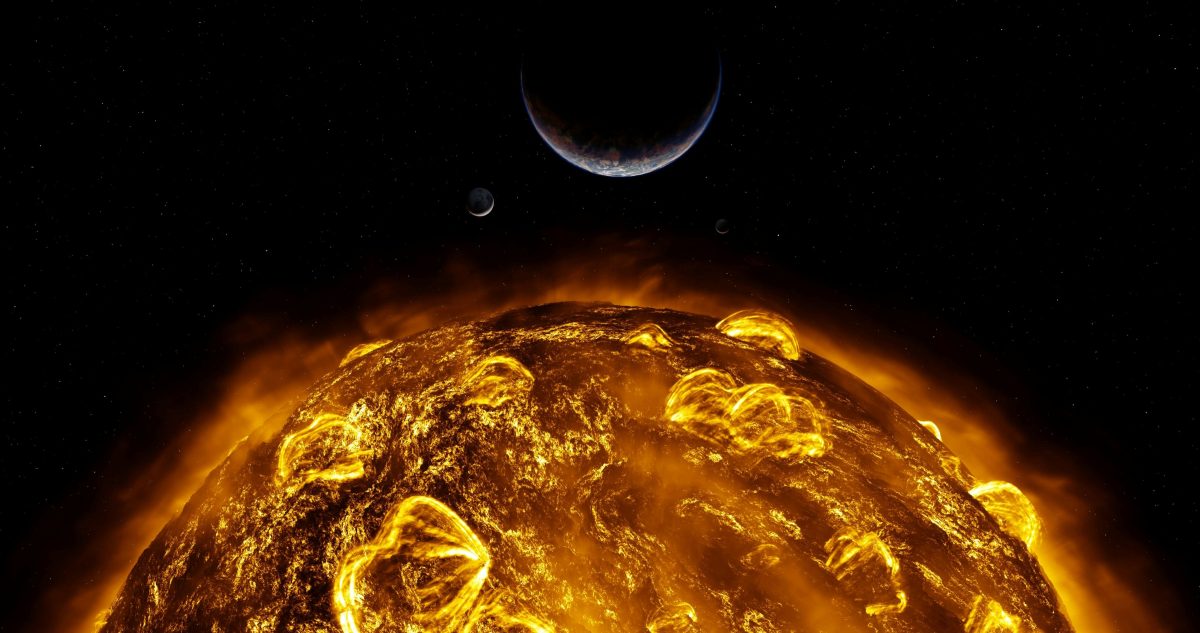
In a study accepted for publication in the Journal of the British Interplanetary Society—with a preprint available on arXiv—Harry presented a comprehensive megascale engineering plan. The author proposes solutions to a range of long-term threats: increasing solar luminosity, the planet’s engulfment by the red giant, the cessation of plate tectonics, water loss, changes in Earth’s axial tilt and rotation, and collisions with space objects. According to the researcher, without intervention, humans will be able to live on Earth for about another 1 billion years, but implementing his protective system could preserve the biosphere for an astonishing 9.1 billion years.
A Giant Parasol
In approximately 1 billion years, the Sun will exhaust a significant portion of its fuel and begin to expand. Temperatures on Earth will rise rapidly, the oceans will boil, and the atmosphere will burn away. In 5 billion years, the star will become a white dwarf, depriving the system of heat, while in 100 trillion years, star formation in the Galaxy will cease altogether.
Harry considers protection from solar radiation to be the first priority. He proposes constructing a giant sunshield 700,000 kilometers wide. It would be positioned slightly beyond the Moon’s orbit and secured with a carbon cable attached to a counterweight at the L1 Lagrange point—the region between Earth and the Sun where gravitational forces are balanced.
The shield would cover 70 degrees of the sky. Made of aluminum only 0.1 millimeters thick, similar to the sunshield used by the James Webb Space Telescope, it would have a mass of approximately 10¹⁵ kilograms. The required aluminum could be extracted from 0.01% of the Moon’s mass, while producing 2 million kilometers of carbon cable would require using 40% of the material contained in the dwarf planet Ceres.
Jupiter as an Artificial Sun
Completely blocking the Sun would create a new problem—a shortage of light and heat. To solve it, Harry proposes using Jupiter as a gigantic source of fuel. Fusion reactors could be placed 6,500 kilometers deep within the gas giant’s atmosphere, where they would consume helium-4 and hydrogen. The energy produced would be directed to Jupiter’s L1 point and then transmitted to Earth using lasers and relay stations, effectively serving as an artificial Sun.
However, this would not be enough. To prevent Earth from being engulfed when the Sun enters its red-giant phase, the planet’s orbit would have to be expanded from 1 to 1.2 astronomical units. To achieve this, the researcher proposes extracting oxygen from Jupiter and using it to form a particle beam aimed at Earth. Over hundreds of years, the force of this beam would gradually push the planet farther away from the star.
Although such megaprojects may appear to be science fiction today, they demonstrate the theoretical possibility that highly advanced civilizations of the future could survive even events that we currently regard as an inevitable death sentence.
We previously reported on how lunar dust could save Earth from global warming.
According to phys.org
